
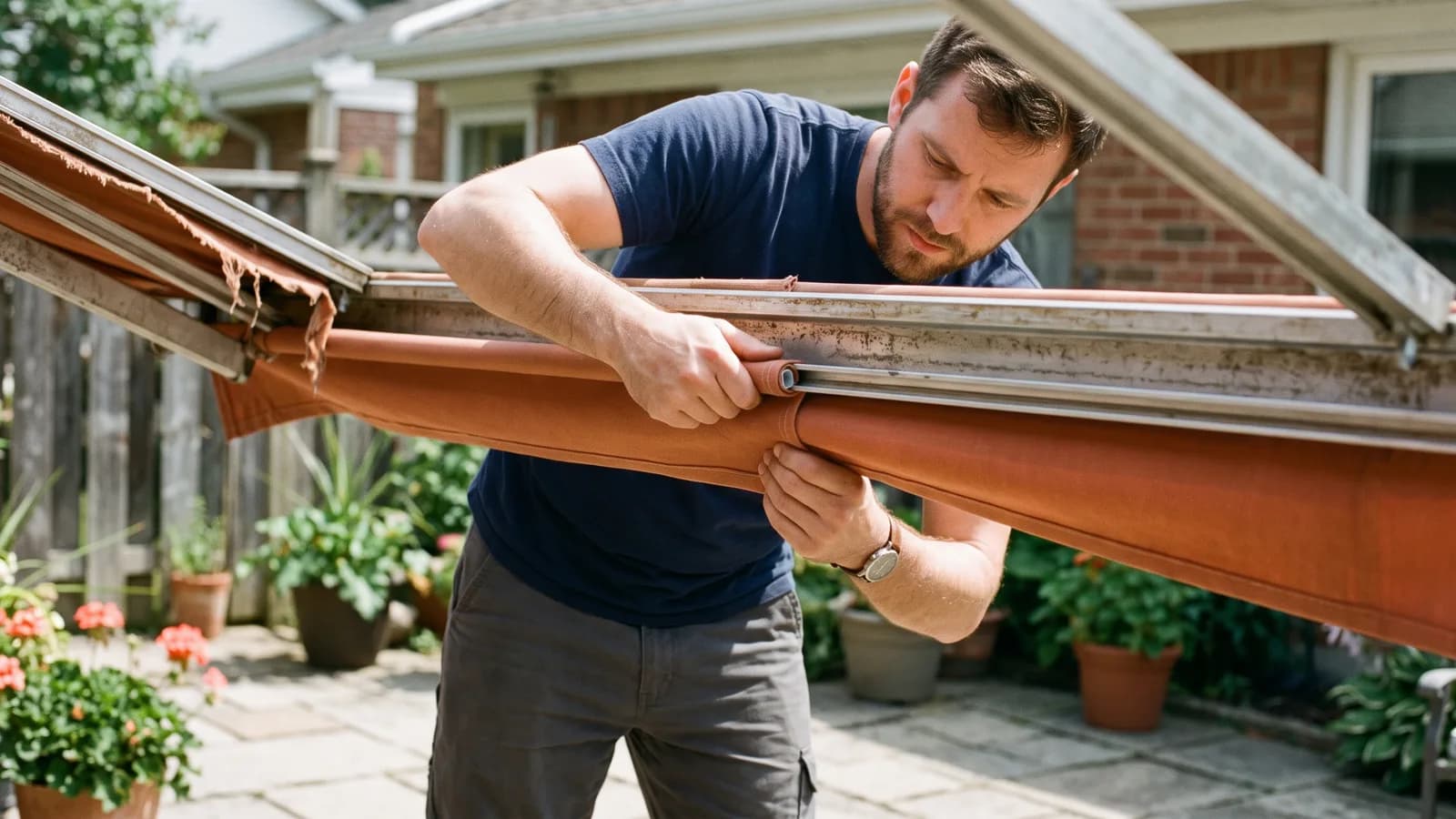
Most awning dealers put nearly every marketing dollar toward new installations and let re-cover jobs and service calls arrive whenever they happen to arrive. That leaves money on the table. A homeowner who bought a retractable awning years ago already trusts the dealer and already owns the frame, and at some point that fabric will need replacing or that motor will need attention. Reaching that person before they start searching for someone new is some of the least expensive revenue a dealer will ever generate.
Why re-cover and service work gets under-marketed
New-install leads get the attention because they show up in ad reports and pipeline dashboards. Service and re-cover work does not arrive that way. It shows up as a phone call from someone who is already a customer, and because that call feels like an inbound favor rather than a marketing outcome, it rarely gets a dedicated budget, a dedicated list, or a dedicated outreach schedule. Sales teams are usually paid on new contracts, so nobody on staff has a direct incentive to chase a re-cover job that pays a fraction of a full installation.
The result is a customer file that sits untouched for years after the install crew leaves. The dealer has the address, the fabric color, the frame model, and the installation date on record, and none of it gets used again until the homeowner happens to call.
The natural re-cover timeline fabric creates
Awning fabric ages visibly in a way most exterior products do not. Sun exposure gradually lightens color, repeated retraction and extension puts wear on seams, and a fabric that looked sharp on installation day will look noticeably tired after enough seasons in direct light. That visible aging creates a predictable, trackable window during which a homeowner becomes receptive to a re-cover conversation, long before the fabric actually fails. As a rough rule of thumb, most acrylic and vinyl awning fabrics start showing this kind of visible fading somewhere in the seven-to-ten-year range, though sun exposure and local climate shift that window earlier or later for any individual installation.
Reaching past customers before they notice the fading themselves
The dealers who benefit most from this timeline reach out before the homeowner notices the fading on their own, not after. A short note with a side-by-side comparison photo, a factory-fresh panel next to a few seasons of sun exposure, does more to prompt a re-cover conversation than any generic seasonal ad. Waiting for the homeowner to notice on their own means waiting for them to also start collecting quotes from competitors, at which point the loyalty advantage the original install earned is worth far less.
Building a service reminder cadence into the customer record
This only works if the customer record captures the details that make timing possible. At minimum, that means the installation date, fabric type and color, frame model, and whether a motor or sensor was installed. From there, a simple reminder cadence, a check-in message a few years after install and another a couple of seasons later, keeps the dealer present in the homeowner's mind without requiring a large campaign:
- Mid-life check-in. A message a few seasons after install asking how the awning is holding up, paired with a reminder that fabric cleaning and motor inspection are available.
- Fading-window outreach. A comparison photo and a re-cover estimate sent once the fabric is likely showing visible wear based on its age and exposure.
- Post-storm follow-up. A check-in after any severe weather event in the area, since wind and hail are the events most likely to surface a frame or motor issue worth catching early.
Warranty terms are part of this conversation too, since a homeowner deciding whether to re-cover now or wait needs to know what is actually still covered. Explaining fabric, frame, and motor warranty terms clearly at the original sale makes this later outreach far easier, because the homeowner already understands what a warranty claim would and would not include.
Where the outreach fits the calendar
Treating a service call as a re-cover and upsell opportunity
Every service call that does come in, a motor that has stopped responding, a frame joint that needs tightening, is also a chance to look at the fabric with a trained eye. A technician who notes fabric condition on every visit and mentions it to the homeowner in plain terms, without pushing, plants the seed for a re-cover months before it becomes urgent. The same visit is a natural moment to mention a wind or sun sensor upgrade for a customer whose original unit does not have one, framed as a genuine improvement rather than an add-on sale. The timing that works for asking a satisfied customer for a review applies here too: a service visit that goes well is a good moment to ask, not just to fix and leave.
A dealer's services pageshould list re-cover and maintenance work with the same visibility given to new installs, so a past customer searching for the dealer's name finds a clear path back in rather than a page built entirely around first-time buyers.
Ready to talk numbers on your own pipeline?
On the strategy call, we'll lay out the plan we'd run for your business and talk through how it fits your market.
Final thought
Re-cover and service revenue does not need a large campaign to grow, it needs a system that tracks what was installed, when, and for whom, and a cadence that reaches out before the homeowner starts looking elsewhere. The acquisition cost on this business is close to nothing, since the trust was already built during the original install. Treating it as a real revenue line with its own outreach schedule, rather than a byproduct of whoever happens to call, turns a quiet stream of repeat work into one of the more dependable parts of the business.
Tagged