
A homeowner rarely gets just one landscape lighting consultation. They get two or three, and then they wait, often for days, while each company builds a custom proposal. The company that sends its proposal first frequently wins the job regardless of price, because the wait itself has already told the homeowner something about how responsive that company will be after the sale is done and the crew has left the property.
Why proposals in this trade tend to take days
Landscape lighting is not sold off a price list. Every proposal involves zone planning specific to one property, fixture counts tied to tree size and facade length, and a transformer calculation that depends on the final zone total. Building that from scratch after every consultation, especially when the designer is also running install crews and other appointments during the day, easily stretches into a multi-day turnaround that feels routine from the inside and glacial from the homeowner's side of it. A designer who saves proposal writing for the end of a long week often does not get to it until the memory of the specific property has already started to blur with the next three consultations.
What the wait actually costs against competing consultations
The math is straightforward once it is written down. A company running twenty consultations a month that takes three extra days on average to turn around a proposal is not just slower on paper; it is handing a meaningful share of those twenty homeowners a three-day window to receive, read, and potentially sign with someone else first. None of that shows up as a lost lead in a report, since the homeowner never actually rejected the slower proposal. They simply signed the one that showed up while they still remembered why they were excited about it.
A homeowner does not sit idle during that wait. They book the next consultation on their list, and by the time a three-day-old proposal finally lands in their inbox, they may have already received a complete one from a competitor who quoted faster. Price and design quality being roughly equal, the faster proposal wins simply because it was the one still in front of the homeowner when the decision got made, and a slower proposal arriving after that decision is already forming has to work much harder to reopen the conversation.
What a slow quote signals
Building a same-visit or next-day quoting process
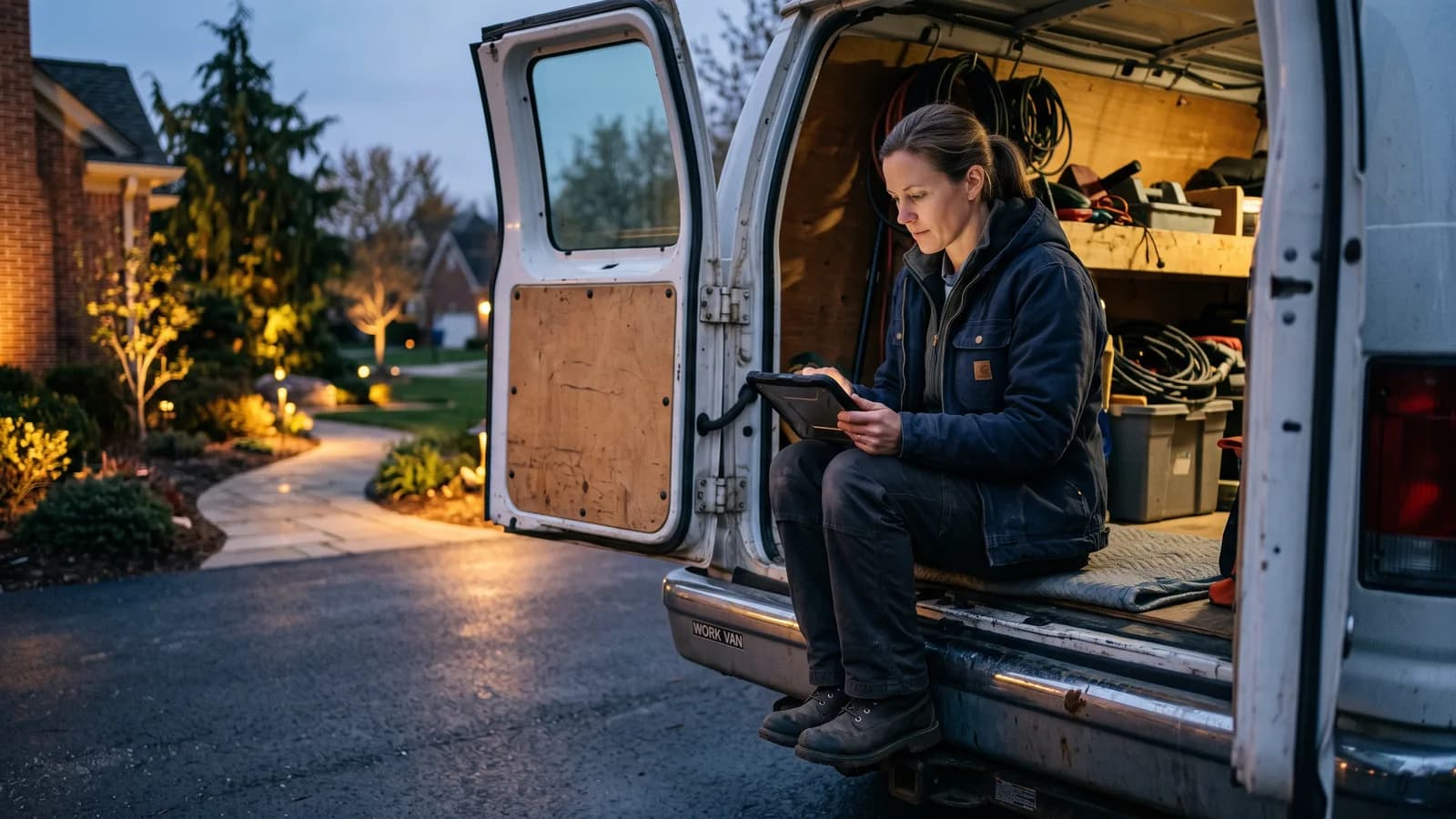
Closing the gap does not require a faster designer. It requires a process that does not depend on the designer sitting down at a desk after hours to build a document from a blank page. Capturing fixture counts, zone notes, and rough measurements directly on a tablet during the consultation, the same way a stalled estimate gets tracked through follow-up, means the numbers already exist by the time the visit ends. From there, producing a complete proposal is closer to assembly than composition, which is a meaningfully different and faster task than writing one from scratch.
Using standardized package tiers as a starting point
A small company worried that pre-built tiers will feel impersonal can keep the customization visible rather than hidden: naming the specific zones added to a base tier in the proposal itself, “starting from the whole-front-yard package, we added the side gate run and the two maples you pointed out,” shows the homeowner exactly where the template ended and their own property began.
A small set of pre-built package tiers, a front-entry package, a whole-front-yard package, a full-property package with facade and tree lighting, gives a designer a structural starting point instead of writing every line item from nothing. The final proposal still gets customized to the specific property and the zones the homeowner actually wants included, but starting from a tier rather than a blank template can cut the build time from hours to minutes, and it also makes it easier to train a second person to build a rough draft before the lead designer signs off on it.
What speed signals about the company after the sale
There is a fair objection here: speed for its own sake is not the goal, and a rushed proposal with a pricing mistake causes far more damage than a slow one. The point of building a faster process is not to skip the review step, it is to remove the hours of blank-page writing that used to sit between the consultation and that review, so the same careful check still happens, just against a draft that already exists instead of one that has to be built from nothing first.
A proposal that arrives the same evening or the next morning tells a homeowner, without a single word about it, that this company follows through quickly. That impression carries directly into how a homeowner expects a service call or a warranty question to be handled a year later. Speed on the front end becomes a stand-in for reliability on the back end, whether or not the two are formally connected in the company's own operations, and homeowners rarely stop to separate the two. Read more about how the process works before a first consultation is booked.
Ready to talk numbers on your own pipeline?
On the strategy call, we'll lay out the plan we'd run for your business and talk through how it fits your market.
Final thought
A homeowner comparing lighting companies is comparing more than fixtures and price. They are comparing how each company behaves under a simple, observable test: how long it takes to follow through on something promised. Building a process that gets a complete, accurate proposal in front of a homeowner within a day of the consultation, rather than a week later, turns proposal speed into one of the most durable advantages a lighting company can build, and one that no competitor can copy overnight.
Tagged