
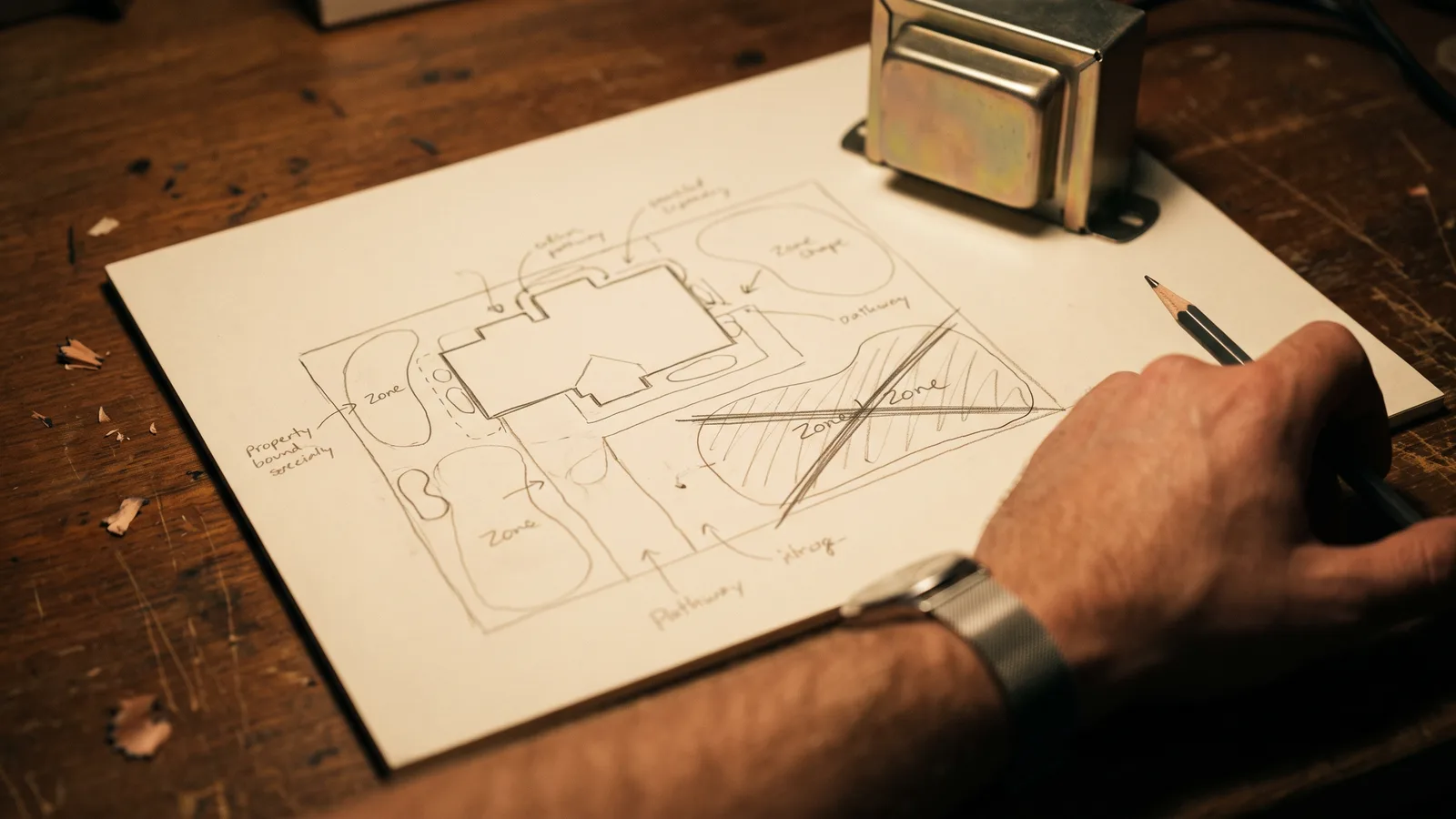
A whole-property lighting design does not arrive in phases the way a kitchen remodel or a landscaping project often does. It arrives as one number, presented all at once, and that single figure can trigger a reflex to shrink the scope before the homeowner has even weighed what each zone actually contributes to the finished result. Financing, raised at the right moment, keeps that reflex from quietly editing the design down to whatever fits a same-day comfort level.
Why the whole-property number feels larger than it is
Most home improvement categories get sold, and budgeted, in pieces. A homeowner replaces the roof this year and the windows next year. Landscape and architectural lighting rarely works that way once a designer has walked the property and proposed a coherent scheme, because a partial version of a lighting design often looks unfinished rather than simply smaller. That pushes the natural proposal toward a single whole-property number, and a single number, even one built from reasonable per-zone value, reads as heavier than the same total spread across a year of smaller invoices. This is even truer when the proposal is built as a whole-property package rather than an itemized list, since the whole point of a package is presenting the design as one coherent number in the first place.
The homeowner is not necessarily objecting to the value of any individual zone. They are reacting to the shape of the payment, one large decision instead of several smaller ones, and that reaction shows up as a request to remove the side yard or the detached garage from the plan, not as a challenge to the design itself.
Cutting a zone rarely saves what a homeowner expects it to save, either. Removing the side yard from a design does not just remove that portion of the cost, it also removes the transition between the front facade and the back patio, so the remaining lighting can end up looking like a partial job rather than a smaller finished one. A designer who understands the design well enough to explain that trade-off plainly, this zone connects those two, cutting it leaves a dark gap right where guests walk between them, gives the homeowner real information instead of letting the cut happen silently on a revised invoice.
When to introduce financing in the sales conversation
The timing matters more than the terms. Financing introduced after a homeowner has already started asking which zones can come out reads as a concession, something offered because the price was too high. Financing introduced earlier, right after the whole-property number is presented and before any specific zone has been named for removal, reads as a normal part of how projects this size get paid for.
A simple sequence works well: present the full design and its total, pause, then immediately show what a monthly payment looks like against that same total before asking for any reaction. The homeowner processes the number twice, once as a lump sum and once as a monthly figure, and the second framing is usually the one that determines whether the conversation moves toward scope-cutting or toward scheduling.
This sequence works best when it is built into the proposal template itself rather than left to whichever designer remembers to bring it up. A standard proposal document that already shows the whole-property total next to a monthly payment figure, before the homeowner has said a word, removes the awkwardness of a designer having to raise financing reactively once the room has already gone quiet. It also keeps the conversation consistent across every designer on the team, instead of some closing more full designs than others purely because of how comfortable they personally are talking about payment plans.
Present the payment before the pushback
What financing preserves versus what a discount preserves
Faced with a homeowner who feels the number is too large, a discount and a financing offer both reduce the sting, but they preserve different things. A discount preserves the sale in the moment while quietly eroding the margin the business needs to cover material, crew hours, and warranty service down the road. Financing preserves both the sale and the margin, since the total the business is paid does not change, only how the homeowner pays it over time.
Scope retention versus margin erosion
The more useful comparison is not discount versus financing on price alone, it is what each does to the design itself. A discount usually still leaves the homeowner deciding what to cut, because the number, while smaller, is still one number attached to the whole project. Financing removes the reason to cut anything, since the monthly payment stays proportional across whatever scope is kept. A designer who reaches for financing first, and reserves a discount for situations where financing genuinely is not an option, keeps more full-property designs intact and protects the margin that funds the service and warranty experience the homeowner will expect after the sale closes.
Cross-border differences worth knowing
Financing terms, disclosure requirements, and typical promotional structures differ between the United States and Canada, and a company operating on both sides of the border needs a genuinely separate conversation for each market rather than a single script translated by currency symbol. In the United States, third-party home improvement financing products are widely available and homeowners are generally used to seeing a monthly-payment option presented alongside a project total. In Canada, financing products for residential exterior work are less standardized market to market, and disclosure rules around interest rates and promotional periods can differ by province. A company should confirm which financing partners and disclosure language are compliant in its specific operating province before building the monthly-payment view into a standard proposal there, and should not assume a script written for one country's market will read the same way on the other side of the border.
This is also a case where a conversation with someone who understands both the design and the numbers helps more than a generic financing partner search. If a whole-property design is the right scope for a property but the number needs a payment structure to land, that is worth talking through directly on a strategy call rather than guessing at what a given market will support.
Ready to talk numbers on your own pipeline?
On the strategy call, we'll lay out the plan we'd run for your business and talk through how it fits your market.
Final thought
A whole-property lighting number is large because the design is whole, not because any single zone is overpriced. Raising financing before the homeowner starts naming zones to cut keeps that framing intact and protects both the design and the margin behind it. Get the timing right, present the monthly view before the objection arrives, understand how the terms differ across the border if the business serves both countries, and financing becomes the tool that keeps a full design sold instead of a fallback offered too late to matter.
Tagged