
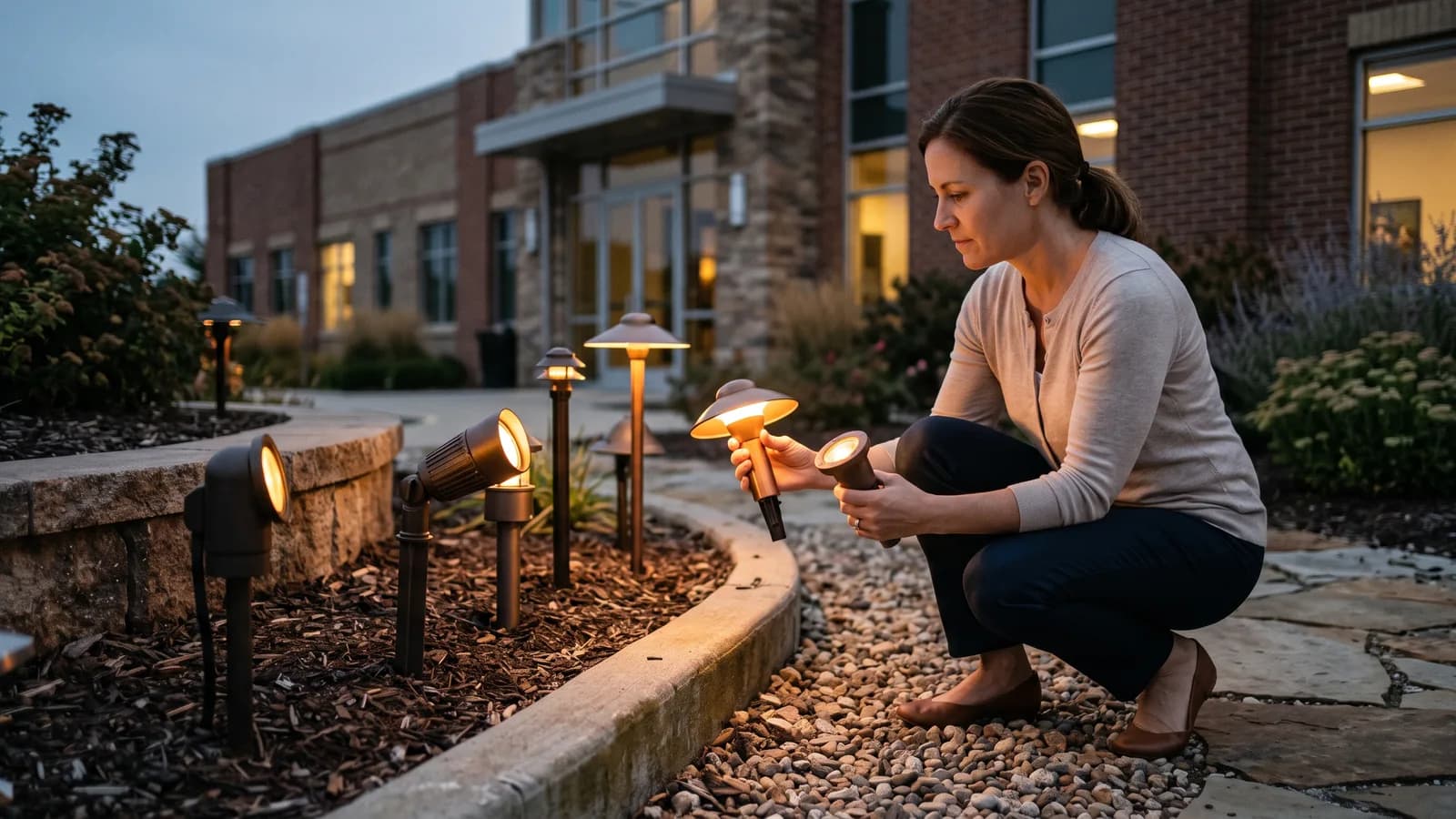
A finished-project photo answers one question well: what does the result look like. It cannot answer the questions a homeowner actually asks once they are seriously considering a design, how big is this fixture next to my hosta bed, what does a warmer color temperature really look like against brick, how wide does this beam spread once it is aimed at a tree twenty feet away. A small live display area answers all three in a few minutes, in a way no gallery ever will.
What a photo gallery cannot answer
A gallery of finished installs is essential for building trust and showing range of work, but it operates at a fixed distance from the homeowner's actual decision. Photos show someone else's property, someone else's plant bed, someone else's house color, lit under someone else's conditions. A homeowner trying to translate that into what their own front yard will look like is doing a lot of mental work the photo cannot do for them, and specific, practical questions, how large is the fixture housing, how does the light read against a particular siding color, come up constantly during design consultations precisely because photos leave them unanswered.
Even a well-shot dusk photo carries a limitation the homeowner cannot fully account for: it was taken at one specific exposure and white balance, chosen by a photographer to make the result look its best. A homeowner comparing that image to what they remember of their own porch light or a neighbor's fixture is comparing two things captured under completely different conditions, and the gap between the photographed version and the true in-person color and brightness only becomes obvious once they are standing in front of an actual lit fixture.
What a small live display area solves
A modest display, a handful of fixture types staked into a small bed of gravel or mulch at an office, a partner nursery, or a garden center, closes that gap directly. A prospective buyer can pick up an actual fixture, compare its size against their hand or against a plant sample nearby, and see two color temperature options lit side by side rather than trying to picture the difference from a written description.
Fixture size, color temperature, and beam spread in person
These three questions come up in nearly every serious design conversation, and a live display resolves all of them at once. Fixture size matters more than it sounds like it should, a homeowner picturing a large, obtrusive housing among delicate plantings is a common and reasonable hesitation that a display removes instantly. Color temperature is genuinely hard to describe in words, a display lets a buyer see a cooler and a warmer option lit next to each other and pick the one that actually matches their taste. Beam spread, how narrow or wide the light falls once a fixture is aimed, is close to impossible to convey any other way, and seeing it in person during early evening, when the display fixtures are actually lit, gives a buyer a real sense of what a similar fixture will do against their own tree or facade.
Time the display to actual dusk, not business hours alone
Where a display earns its cost and where it does not
Building and maintaining a live display area is not free, it needs fixtures, a small transformer, ongoing upkeep, and someone available to walk a visitor through it. Whether that cost is worth carrying depends heavily on local traffic. A company in a dense suburban market with steady walk-in interest or a well-trafficked partner location can turn a modest display into a meaningful sales tool that shortens design conversations and builds trust before the first consultation even happens. A company in a rural or low-traffic market may find the same display sits mostly unused, in which case the fixtures and upkeep cost more than the conversion lift justifies.
Partnering with a nursery or garden center instead of building one
A lower-cost alternative worth considering first is a small display hosted at a partner nursery or garden center that already sees relevant foot traffic, homeowners actively shopping for their yards. This shares the visibility benefit without the full cost of a standalone display, and it can double as a referral relationship, since the nursery benefits from a more finished-looking display bed and the lighting company benefits from being in front of exactly the right audience at exactly the right moment in their planning.
Whichever route a company takes, the display is only as credible as the photography and finished work standing behind it. Pairing it with a strong portfolio built from real dusk photography gives a prospective buyer both the tactile, in-person experience and the visual proof of what a finished property looks like. And because a display depends on having reliable fixture stock on hand, the same supplier reliability that protects a live install schedule also protects a display from sitting half stocked when a visitor stops by.
Ready to talk numbers on your own pipeline?
On the strategy call, we'll lay out the plan we'd run for your business and talk through how it fits your market.
Final thought
A photo gallery and a live display area solve two different problems, and a company that only invests in one is leaving the other question unanswered. Photos build trust in the finished result; a display answers the specific, practical questions a homeowner cannot resolve from a picture alone. Whether that display is worth building in-house or hosting at a partner location is a genuine market-by-market judgment call, but the underlying need, letting a buyer see and touch an actual fixture before committing to a design, holds true almost everywhere this trade operates.
Tagged