
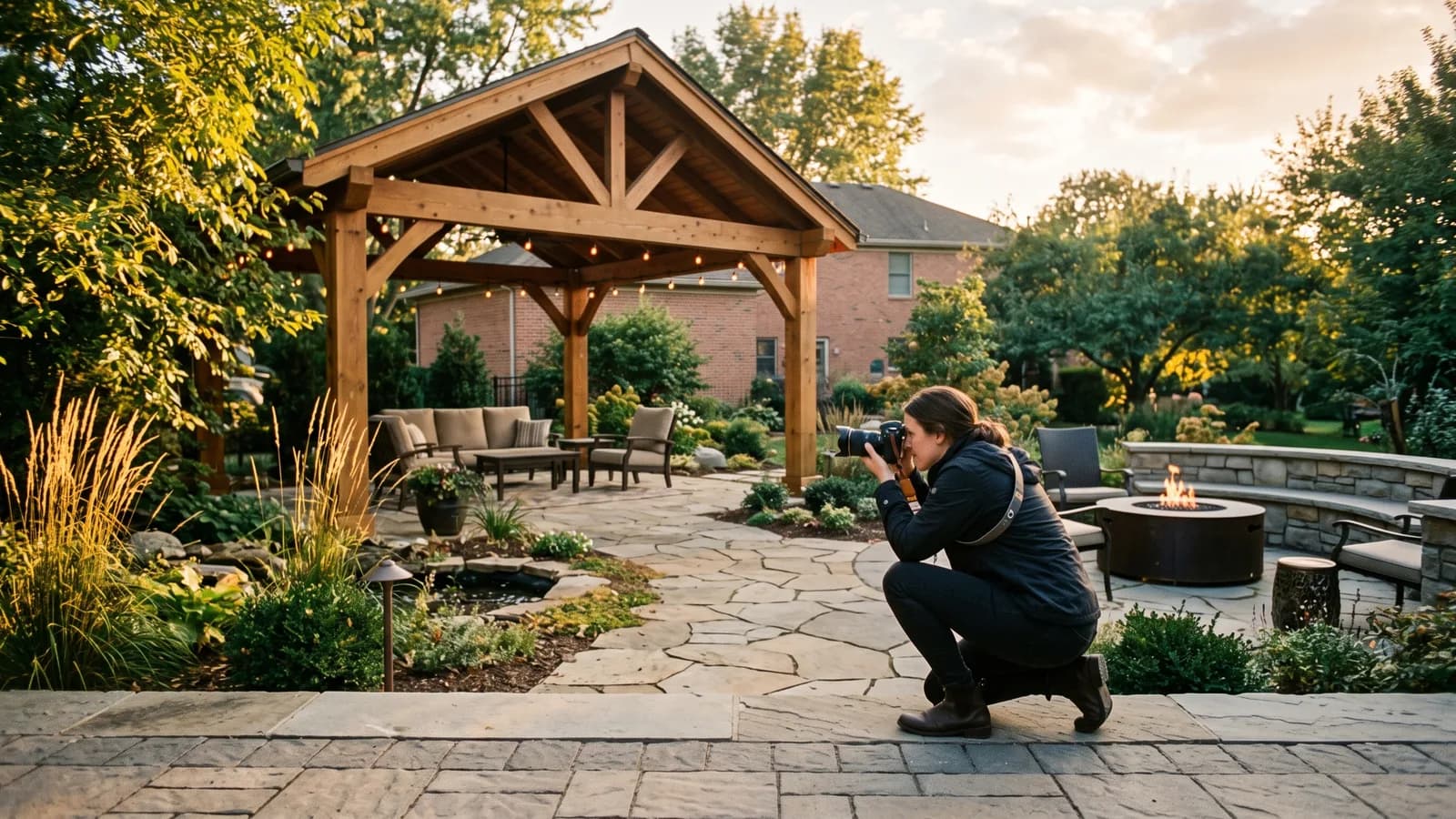
A tight photo of a finished covered patio looks fine on its own, but it does not sell what a design-build firm is actually good at, planning how spaces work together. The sale is the relationship between the patio, the fire feature area, and the path that connects them to the kitchen door, and a portfolio that only shows isolated finishes never proves that spatial thinking happened at all.
Why a whole-space portfolio is harder than single-trade photography
A fence contractor or a single-trade remodeler can photograph the finished product and be done, the whole job fits in one frame from one angle. A full backyard transformation resists that kind of photography because the value is distributed across the entire space. A stunning covered structure photographed in isolation says nothing about whether it was placed well relative to the kitchen, the sightlines from inside the house, or the flow toward a fire feature twenty feet away. Proving that the whole layout was designed, not just built, requires a different approach to the shot list from day one.
Photographing relationships between spaces, not just finishes
Every backyard transformation should produce at least one wide establishing shot that captures two or more functional zones in the same frame, the covered patio and the fire feature area, the outdoor kitchen and the dining space, the pool deck and the shade structure. These shots are harder to compose and depend more on deep focus and a wider lens than a tight material close-up, but they are the images that actually communicate design competence rather than just craftsmanship on a single element.
Building a shot list before the final walkthrough
Waiting until the crew is packing up to think about photography produces rushed, inconsistent results. A shot list built during the design phase, before construction even starts, should map every planned zone of the finished backyard to a specific shot: an establishing wide shot, a detail shot of the primary material or fire feature, and at least one shot capturing how the space is used rather than just how it looks empty. This planning also flags which shots depend on specific site conditions, a covered structure that only photographs well from one particular angle because of how the house sits on the lot, for instance, so that detail is not discovered for the first time on shoot day.
- The establishing shot. A wide frame showing at least two connected zones, proof that the spaces were designed together rather than built as separate line items.
- The material or feature detail shot. A close, well-lit shot of the primary structural material or fire feature, useful on its own for material-focused content.
- The in-use shot. People actually sitting, gathered, or cooking in the space, which sells the lifestyle a static empty photo cannot.
Golden-hour timing and weather dependency
Interior remodeling photography can be scheduled almost any time, since lighting is controlled. Backyard photography is entirely at the mercy of the sky. The window that makes a stone patio or a fire feature glow, roughly the hour before sunset, is narrow, and a cloudy or rainy scheduled shoot day pushes the whole session to a different date entirely. Building slack into the project calendar for a weather-dependent reshoot, rather than treating the first available evening as the only chance, protects the quality of the final images that will represent the project for years. Scheduling the shoot a few days after the final walkthrough, rather than on the exact day the crew leaves, also gives dust and construction debris time to settle and any final planting or cleanup time to be finished before the camera comes out.
Sequencing before, during, and after images for the website
A homeowner considering a project wants to see the starting point as much as the ending point, an overgrown or dated backyard is often closer to what they are looking at right now than any finished showcase photo. A sequence that moves from the original yard, through key construction milestones, to the finished golden-hour shots does more to build trust than the after photo alone, because it proves the transformation is achievable from a starting point a prospective client recognizes as their own. This sequencing also naturally supports trend-focused content, since a documented before-and-after gives a specific design direction real proof behind it rather than leaving it as an abstract description.
The strongest of these sequences belong on a firm's outdoor living services page, not scattered only across individual blog posts, since that is the page a homeowner comparing firms during the research phase looks at first.
Using the portfolio inside the consultation itself
The same photography built for the website and for paid ad creative should be organized for use inside the in-home or showroom consultation, sorted by project type and by the specific combination of zones a homeowner is asking about. A rep who can pull up three examples of a covered structure paired with a fire feature, matched closely to what the homeowner described, closes the gap between what the homeowner is imagining and what the firm can actually deliver far faster than a generic gallery scroll. Organizing the library this way takes an afternoon once a season and pays for itself in every consultation that follows, since a rep flipping through a phone gallery in real time never finds the right image as fast as one working from a pre-sorted set.
Portfolio photography doubles as partner marketing
Ready to talk numbers on your own pipeline?
On the strategy call, we'll lay out the plan we'd run for your business and talk through how it fits your market.
Final thought
A finished covered patio photographed in isolation is a materials photo. A wide shot showing that patio, the fire feature it flows into, and the path connecting both back to the house is a design photo, and design is the actual product a design-build firm is selling. Building the shot list early, protecting the golden-hour window, and sequencing before-and-after images honestly turns a portfolio into the strongest sales tool the firm owns, one that works in the consultation, on the website, and in every referral conversation that follows.
Tagged