
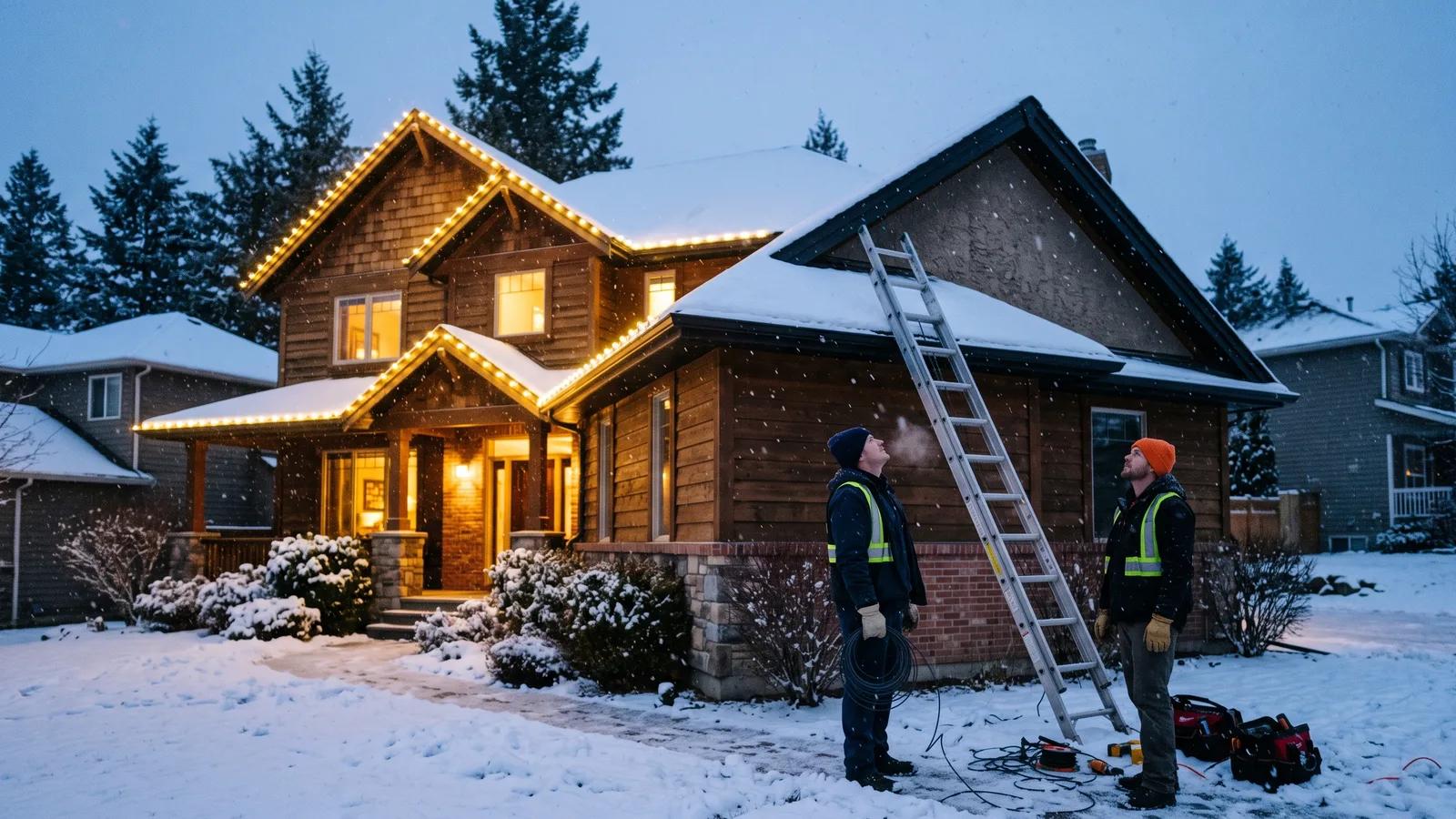
A roofing company can often push a job back a week with no real consequence. A holiday lighting company working against a fixed calendar date has almost no slack to give. Weather is not an occasional disruption to this business, it is an annual certainty that shows up somewhere in the schedule every single season, and the companies that plan for it in advance are the ones a snowstorm never actually catches off guard.
Why weather risk is a scheduling input, not an excuse
Treating weather as an excuse means reacting to a storm after it hits, scrambling to rearrange a week's worth of jobs while customers wait for an explanation. Treating weather as a scheduling input means the calendar was built from the start assuming a certain number of lost or slowed days would happen, somewhere, before the season ends. The difference shows up immediately in how a delay gets communicated: a company with a planned buffer tells a customer “your install is now scheduled for Thursday, as planned for weather like this,” while a company without one is left saying “we're not sure yet, we'll call you.”
Building buffer days into the install calendar from the start
The mechanics of this connect directly to how crew capacity and backlog are managed across the season. A calendar that books every available crew day to full capacity has nowhere to absorb a lost day when a storm hits, which means one bad weather week pushes every job behind it later than promised. Building in buffer days from the very first week of booking, rather than discovering the need for them mid-November, means a storm shifts a few jobs by a day or two instead of triggering a chain reaction through the rest of the season.
- Space buffer days through the whole calendar, not just at the end of the season, since early storms are just as disruptive as late ones and a buffer only helps if it is available when the storm actually hits.
- Size the buffer to the region's weather history, since a market with frequent early snow needs a larger reserve than one where storms are rare before December.
Cold weather effects on adhesives, clips, and cord flexibility
Weather does not just threaten whether a crew can safely climb a roof, it changes how the materials themselves perform. Clip based mounting systems can become harder to seat cleanly once shingles or gutters are coated in frost, and any adhesive backed mounting point loses reliability fast in cold, damp conditions, since most adhesives need a minimum surface temperature to bond properly. Cord and cable also stiffen in cold weather, which slows install pace and increases the chance of a cracked connector if a crew forces a stiff cord into a tight bend. None of this means installs stop in cold weather, it means the schedule should expect slower pace and account for it rather than assuming a thirty-five degree install day moves at the same speed as a sixty degree one.
Communicating a weather delay before the customer has to ask
The single most damaging weather related mistake is silence. A customer who was told their install was happening this week and then hears nothing when a storm rolls through will assume the worst, that the company forgot, or is disorganized, or is not coming at all. A short proactive message the moment a delay is known, explaining the new expected date and why, turns a potential complaint into a non-event. This is a cheap fix with an outsized return: it costs almost nothing to send and prevents most of the frustrated calls that would otherwise land on the office phone during the busiest week of the year.
A weather delay handled well can build trust
Takedown timing and the risk of leaving displays up too long
Weather contingency does not end at install, it applies to takedown too. Ice accumulation on cords and clips left up into a harsh January stretch makes removal slower and riskier than it would have been in a milder week, and cords left exposed to repeated freeze-thaw cycles degrade faster over multiple seasons. A company that builds takedown buffer the same way it builds install buffer, rather than treating takedown as an afterthought once the busy season is officially over, protects both crew safety and the condition of equipment that needs to go back into storage in good shape for next season.
Regional differences across northern and southern markets
A company operating across multiple regions, or across the border between the United States and Canada, cannot use one weather plan for every market. Northern markets in Canada and the northern United States need to plan install schedules around a real chance of snow and sustained sub-freezing temperatures well before December arrives, with ladder and roof safety protocols adjusted accordingly for ice and cold weather footing. Southern markets face a different but still real set of risks, including late season rain systems and, in some regions, an actual freeze event that can catch a crew unused to icy conditions off guard. The right buffer size and the right safety adjustments both need to be set market by market rather than copied from one region's plan to another.
Ready to talk numbers on your own pipeline?
On the strategy call, we'll lay out the plan we'd run for your business and talk through how it fits your market.
Final thought
Weather is not the exception in holiday lighting, it is a planning input as fundamental as crew size or lead volume. A company that builds buffer days from the start of the season, communicates delays before customers have to ask, and adjusts materials handling and safety practice for cold conditions turns weather from a recurring crisis into a routine, managed part of doing business in this trade every single year.
Tagged