
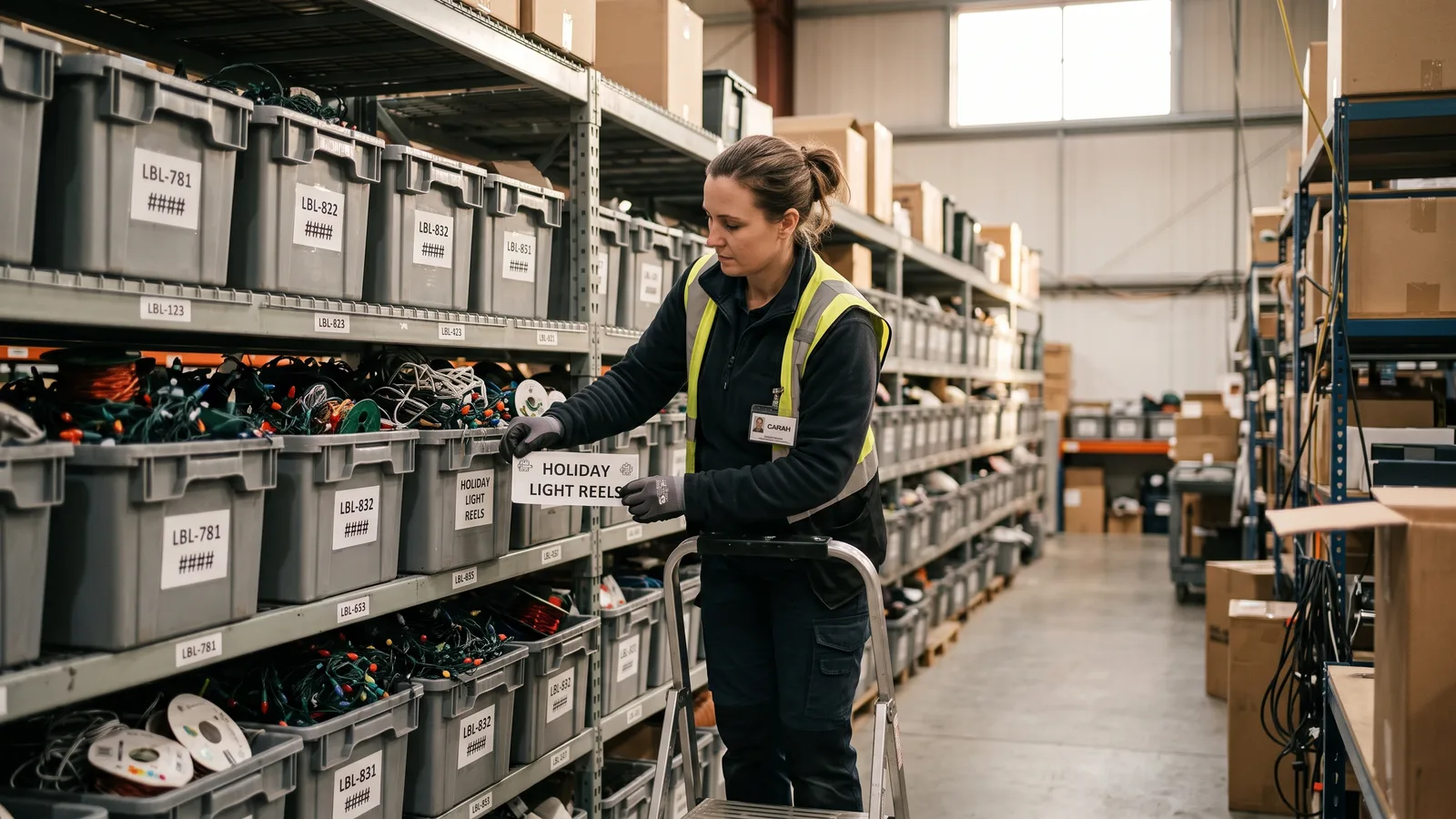
Most home services do not have a natural storage attachment. Holiday lighting does, because nobody wants a garage corner taken up by tangled reels and totes for eleven months of the year. Framed correctly, off season storage is not a favor tacked onto the invoice, it is a recurring revenue line that also locks in next year's renewal, since the lights, the design record, and the relationship all stay with the same company between seasons.
Why storage is a natural attachment for this trade specifically
A customer who buys a holiday lighting package already owns the lights, but they did not sign up to become a warehouse manager for equipment they use six weeks a year. Once the display comes down in January, the physical reels, clips, and controllers need somewhere to live until the following September, and most homeowners would genuinely rather pay a modest annual fee than dedicate garage or attic space to boxes they only need to think about twice a year. That preference is what makes storage a natural, low resistance add-on rather than an upsell the customer has to be talked into.
The seasonality of the trade reinforces this further. A roofing company or a landscaper has ongoing property visits that make an equipment drop-off convenient throughout the year, but a holiday lighting company's entire customer relationship is compressed into a narrow install and takedown window each year. Storage gives the business a reason to stay in physical possession of the product between those two visits, rather than handing everything back to the homeowner and hoping it survives eleven months in a garage untouched.
Pricing storage as its own line item versus bundling it in
There are two workable approaches, and each solves a different problem. Pricing storage as a separate line item makes the value visible: the customer sees exactly what they are paying for and can opt out if they genuinely prefer to keep the equipment themselves. Bundling storage into the overall package price removes a decision point entirely, which can raise attach rates but makes it harder to show the customer what storage alone is worth if they ever ask, or if the company wants to later offer storage as a standalone service to a customer who declined it the first year.
- Separate line item works well for companies building a renewal-heavy business model, since it keeps the storage relationship, and its renewal value, explicit and trackable year over year.
- Bundled pricing works well for a simpler flat package offer aimed at first time customers who want one number and no add-on decisions during the sales conversation.
What storage protects beyond the customer's garage space
Storage under the company's control protects more than floor space. Equipment stored properly, inspected, coiled correctly, and kept dry, lasts longer than equipment shoved into a garage corner by a homeowner in January when nobody wants to be outside. It also protects the company's own install efficiency the following season, since a crew arriving to reinstall equipment they last handled and organized themselves moves faster than a crew untangling whatever condition a homeowner left the totes in. Takedown timing and equipment handling during a cold, rushed January are exactly the conditions where company-managed storage pays off most.
How storage strengthens next season's renewal conversation
A customer whose lights are already sitting in the company's storage facility has a meaningfully lower bar to clear for renewal than a customer starting from scratch. There is no new design consultation needed if the layout is staying the same, no new measurement visit, and often no real sales conversation at all beyond confirming the install date. This directly strengthens the renewal economics that already make repeat customers the highest leverage growth channel in this trade. Storage effectively removes friction from the exact moment where a customer might otherwise drift toward a competitor or decide not to bother this year.
Storage as a renewal anchor, not just a fee
Warehouse and insurance considerations for storing client property
Holding customer property between seasons is a real operational responsibility, not just a convenience feature. A clean, organized, climate reasonable storage space reduces the chance of damage, pest issues, or mixed-up totes between customers, all of which turn a value-add service into a liability if handled carelessly. Insurance coverage should explicitly account for customer property held in storage, not just the company's own equipment and vehicles, since a standard general liability policy may not automatically extend to goods held on behalf of clients. A short conversation with an insurance broker before offering storage at scale is worth having, particularly once the total value of stored customer property across a full client base starts to add up.
Storage also opens a natural bridge into other conversations with the same trusted customer, including whether a homeowner might eventually want permanent programmable trim lighting that stays up year round instead of a seasonal display that needs storing at all. That is a longer, separate conversation, but a storage relationship is one of the easiest points to raise it from, since the company already has full visibility into the property and an established trust relationship with the homeowner.
Ready to talk numbers on your own pipeline?
On the strategy call, we'll lay out the plan we'd run for your business and talk through how it fits your market.
Final thought
Storage is one of the few genuinely natural add-ons in this trade, solving a real problem homeowners have while giving the company a recurring revenue line and a built-in reason for next year's renewal conversation to be easy. Price it deliberately, handle stored property with real operational care, and treat it as a retention tool first. Done well, storage turns a one season transaction into a multi-year relationship without adding a single new sales conversation.
Tagged