
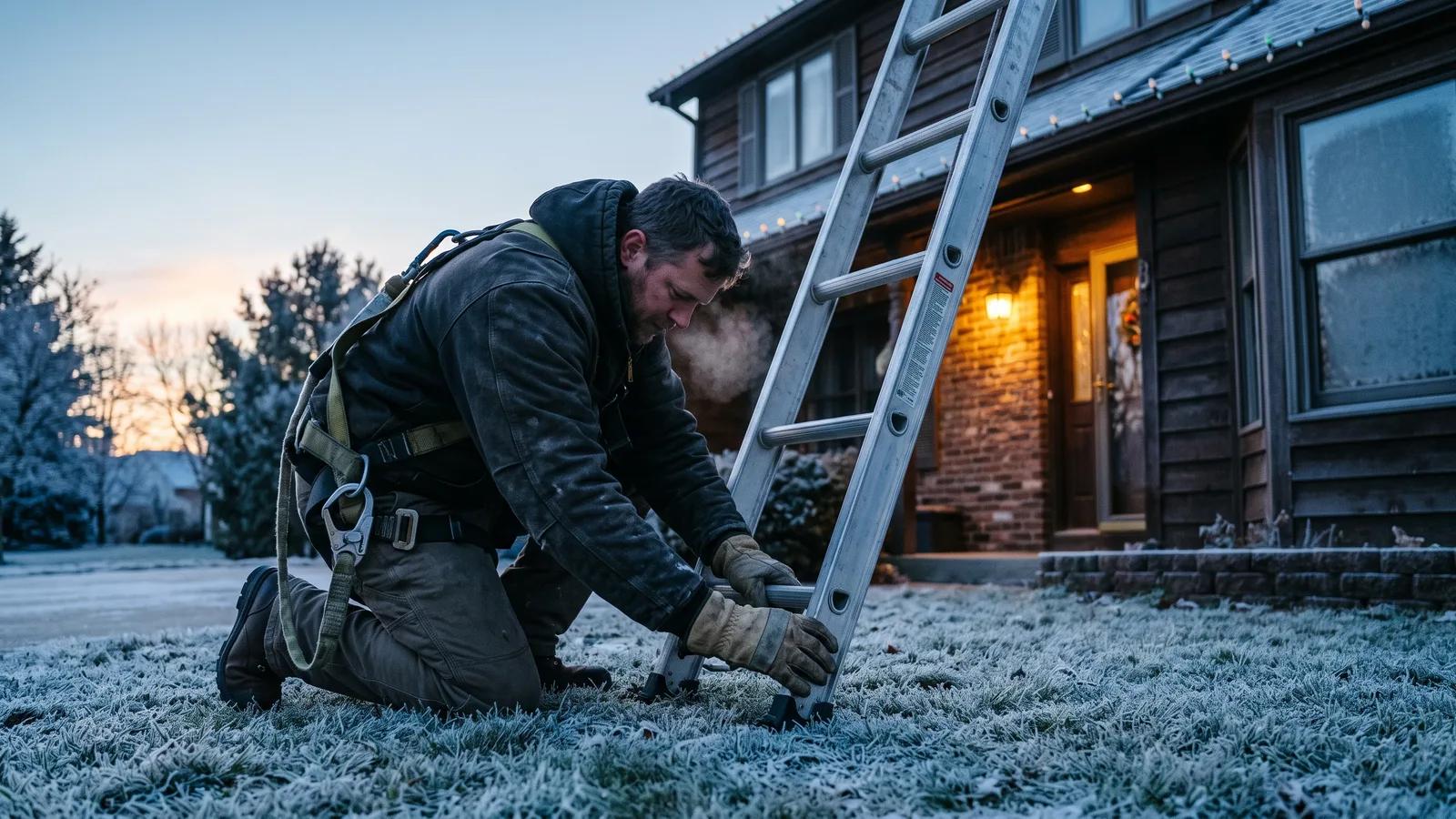
Holiday lighting installers spend six straight weeks on ladders and steep rooflines, often in the coldest, iciest conditions of the fall. A fall injury during that window does not just cost one installer a paycheck, it can pull a crew out of rotation during the exact weeks when there is no slack left in the schedule to absorb it. Safety protocol in this trade is as much a capacity protection measure as it is a compliance one.
Why holiday lighting installs carry more fall risk than typical exterior work
A roofing crew mostly works when weather cooperates and rarely climbs an icy ladder on purpose. A holiday lighting crew works through the exact stretch of the calendar when frost, early snow, and short daylight are most common, because that is when the season happens. Add repeated ladder placement and removal at multiple points around a single property, unfamiliar rooflines the crew has never walked before, and the physical fatigue of installing dozens of jobs back to back, and the exposure adds up in a way that a typical exterior trade does not experience at this intensity.
Ladder placement, roof access points, and cold weather footing
Good ladder discipline starts before anyone climbs. The base needs to sit on stable, level ground, not on a slope, mulch bed, or loose gravel that shifts under weight. The angle needs to be checked, not eyeballed, since a ladder set too steep or too shallow is unstable in a way that is not obvious until someone is already several rungs up. Roof access points should be identified and agreed on before the crew starts, rather than improvised at whichever spot looks convenient in the moment.
- Check the ladder feet every placement, not once at the start of the day, since ground conditions change from property to property and even from one side of a house to the other.
- Use a second person to foot the ladder on any steep pitch or when installing near a roof edge, rather than relying on the ladder's own stability alone.
- Wear footwear built for cold, wet surfaces. Standard work boots lose grip fast on frost covered shingles or metal roofing, and the difference shows up exactly when it matters.
Working around ice, frost, and early snow
Frost on a roofline in the early morning is one of the most underestimated hazards in this trade, because the property can look dry and safe from the ground while the actual surface underfoot is coated in a thin, nearly invisible layer of ice. Crews should default to waiting until direct sun or rising temperature has cleared visible frost before working a steep or metal roof, even if that means starting the property later than planned. A short delay costs far less than an injury, and it is a far easier conversation to have with a homeowner than the one that follows an accident.
Insurance implications of a fall injury during peak season
Beyond the immediate human cost, a fall injury during peak season carries operational consequences that compound. A claim can affect the company's workers' compensation experience rating for years afterward, raising costs well past the season it happened in. More immediately, losing an experienced crew member for even two or three weeks during the busiest stretch of the year removes install capacity the business cannot easily replace on short notice, which pushes directly into the backlog problem that every lighting company is already managing against a fixed holiday deadline. A safety program that prevents even one serious fall pays for itself many times over in avoided disruption alone.
Training new seasonal hires before their first roof
Because most install crews are hired fresh each season, or partly turn over from year to year, safety training cannot assume experience. New hires need hands-on practice setting up and footing a ladder, a walkthrough of the company's roof access and harness expectations, and at least one supervised job before working independently on a steep or unfamiliar roofline. This training has to happen before the compressed sales window reaches full volume, since there is no good time to slow down and train once the calendar is booked solid.
Rushed onboarding is where injuries start
Building a stop work rule for unsafe conditions
Every crew member, regardless of seniority, should have clear authority to pause work on a specific property if conditions feel unsafe, without needing to escalate through a supervisor first. This matters most on the days that are hardest to judge from the office: a light freezing rain that started after the crew left, a roof that turns out steeper or more deteriorated than expected once someone is actually on it, or wind that picks up mid-install. A stop work rule only works if crews genuinely believe using it will not cost them time, pay, or standing with the company, so it needs to be stated plainly and reinforced when someone actually uses it well, not just written into a handbook and forgotten. Weather contingency planning for the season should assume this rule will be used and build buffer days around it, rather than treating every stopped job as an exception to explain away.
Ready to talk numbers on your own pipeline?
On the strategy call, we'll lay out the plan we'd run for your business and talk through how it fits your market.
Final thought
Safety protocol in holiday lighting is not a generic checklist borrowed from another trade, it is a direct response to the specific conditions this trade works in: cold, ice, unfamiliar rooflines, and a calendar with no slack for a crew member sidelined mid-season. Train every new hire before their first roof, check ladder footing every single placement, and give crews real authority to stop when conditions call for it. The companies that treat safety as a capacity protection measure, not just a compliance box, are the ones that still have a full crew standing on December first.
Tagged