
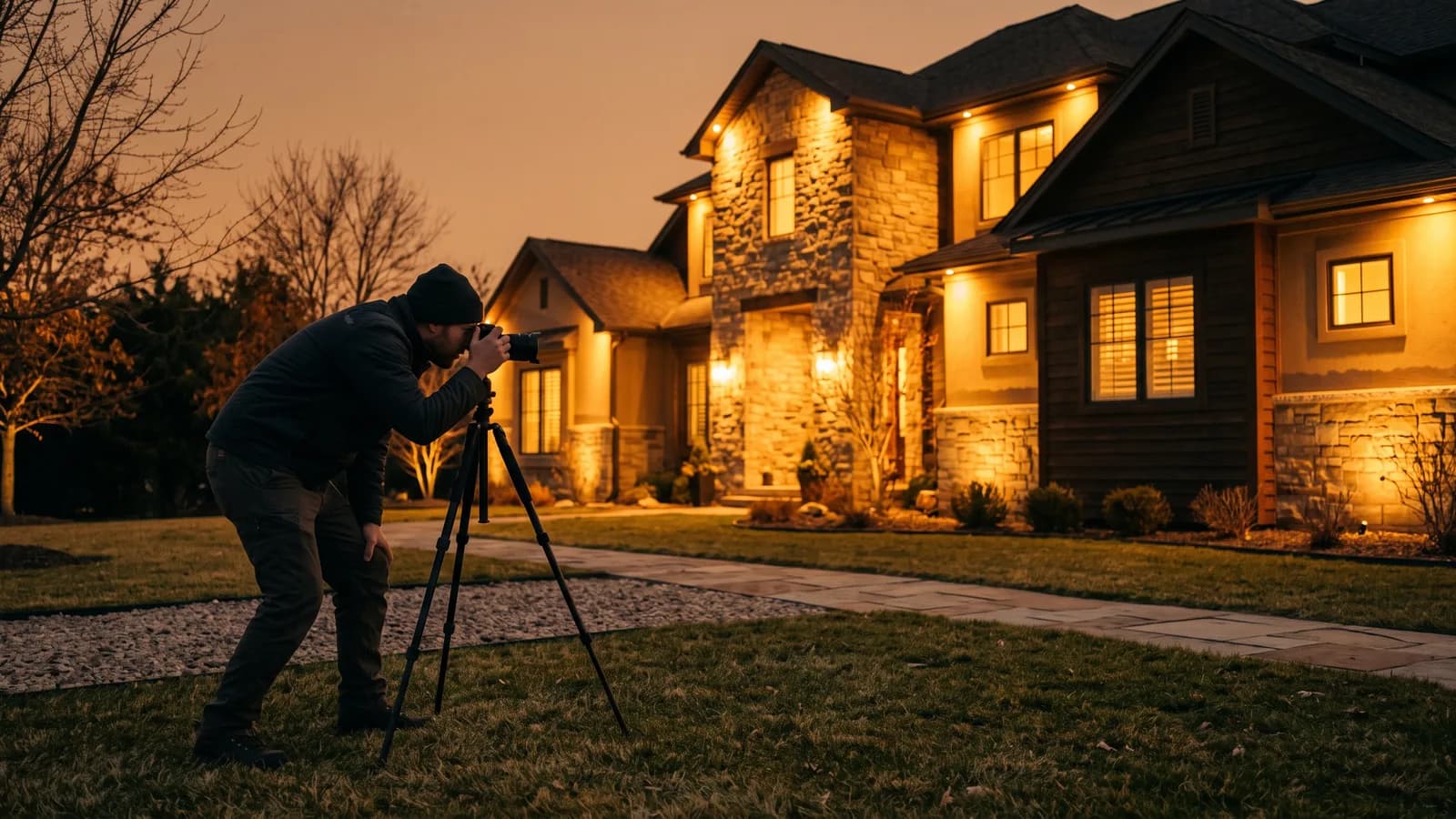
In most home improvement trades the finished product looks roughly the same at any hour, so photo quality is a nice-to-have. In exterior and landscape lighting, the entire sales argument lives in a photo taken during a narrow window after sunset, and a poorly exposed or badly framed shot genuinely fails to communicate the result a homeowner is paying for.
Why after photos carry this trade's entire sales argument
A daytime photo of a finished landscape lighting project shows fixture stakes in a garden bed and nothing else. There is no way for a prospective buyer browsing a website to understand what a project actually does without seeing it lit, which means the after photo is not a supporting image the way it is in most trades, it is the product demonstration. A weak photo does not just look unpolished, it fails to prove the core claim the entire business is built on. Compare that to almost any other exterior trade: a new window or a repainted deck photographs the same at ten in the morning as it does at seven in the evening, so a company can afford to be casual about when the camera comes out. This trade does not have that luxury, which is exactly why treating photography as a marketing afterthought costs more here than it would anywhere else.
The blue hour window and why timing beats equipment
The period right after sunset, once the sky still holds color but the fixtures are bright enough to read clearly against it, is the only window where a photo captures both the lighting design and the architecture of the house at the same time. Too early and the fixtures look washed out against a still-bright sky. Too late and the sky goes fully black, which flattens the photo and loses the sense of place a buyer needs to picture their own home in the result. A crew member with an entry-level camera who shows up at the right minute will consistently outshoot someone with far better equipment who arrives twenty minutes too late. This is why the shooting plan should be built around the closeout schedule for a given job, not around whoever is free that evening, since a crew that finishes wiring at four in the afternoon still has to wait for the sky to cooperate before the photo that will actually sell the next job can be taken.
~20 min
A rough rule of thumb for the usable blue hour window after sunset, illustrative only. It shifts with latitude, season, and cloud cover, which is why the crew's shot list should be built around watching the sky rather than a fixed clock time.
A repeatable shot list by project type
Leaving photo quality to whoever happens to have a phone out produces an inconsistent portfolio, some strong shots mixed in with plenty that undersell good work. A written shot list by project type gives every crew the same starting point, regardless of who is on site that evening.
Facade and roofline shots
Facade work benefits from a wider composition shot straight on from the front walk, capturing the full elevation with the sky still holding some color behind the roofline, followed by a tighter shot isolating one architectural feature, a gable, a column, an entryway, where the lighting design does the most work. Roofline trim lighting reads best from an angle slightly off-center rather than dead-on, since a straight-on shot tends to flatten the line into a single band instead of showing its shape against the house.
Path, step, and garden bed shots
Path and step lighting reads best low to the ground, at roughly the height a person walking the path would actually see it, rather than from standing height looking down. Garden bed uplighting on a tree or shrub benefits from a shot taken from a distance that shows the full canopy catching the light, since a close-up on the fixture itself tells the viewer nothing about the effect it produces. Security and entry lighting near a driveway or garage should include enough context in frame that a viewer understands what part of the property is being lit. A short handful of wide establishing shots for every project, taken before the closer detail shots, also gives whoever manages the website a range of images to choose from rather than a single usable frame from an entire evening of work.
Building the habit into the crew's closeout checklist
A shot list only produces a usable portfolio if it becomes a required step, not an optional one. Adding photo capture to the same closeout checklist a crew already uses to confirm a job is complete, alongside things like the dusk demonstration that closes the original sale, means the photos get taken on the first evening the system is fully operational, rather than scheduled as a separate visit that competes with the next job on the calendar. It also removes the awkward ask of scheduling a homeowner for a return visit just for photos, which most people find a little strange once the work is already done and paid for.
Build it into the invoice, not the memory
A strong photo library also feeds the ongoing relationship with existing customers, since the same shots that fill a website portfolio can anchor the conversation during an annual maintenance visit, reminding a homeowner what the system looked like on day one compared to today. See more finished examples on the exterior lighting program page, and for the questions a photo alone cannot answer, like beam spread or fixture spacing, a written spec sheet still has to do that work.
Ready to talk numbers on your own pipeline?
On the strategy call, we'll lay out the plan we'd run for your business and talk through how it fits your market.
Final thought
A landscape lighting portfolio is only as strong as its weakest habit, and photography is one of the easiest habits to get consistently right once it has a standard attached to it. The equipment matters far less than the timing and the checklist that guarantees someone actually shows up during the narrow window when the work looks the way it is supposed to. Get that discipline in place and every finished project quietly becomes an advertisement for the next one.
Tagged