
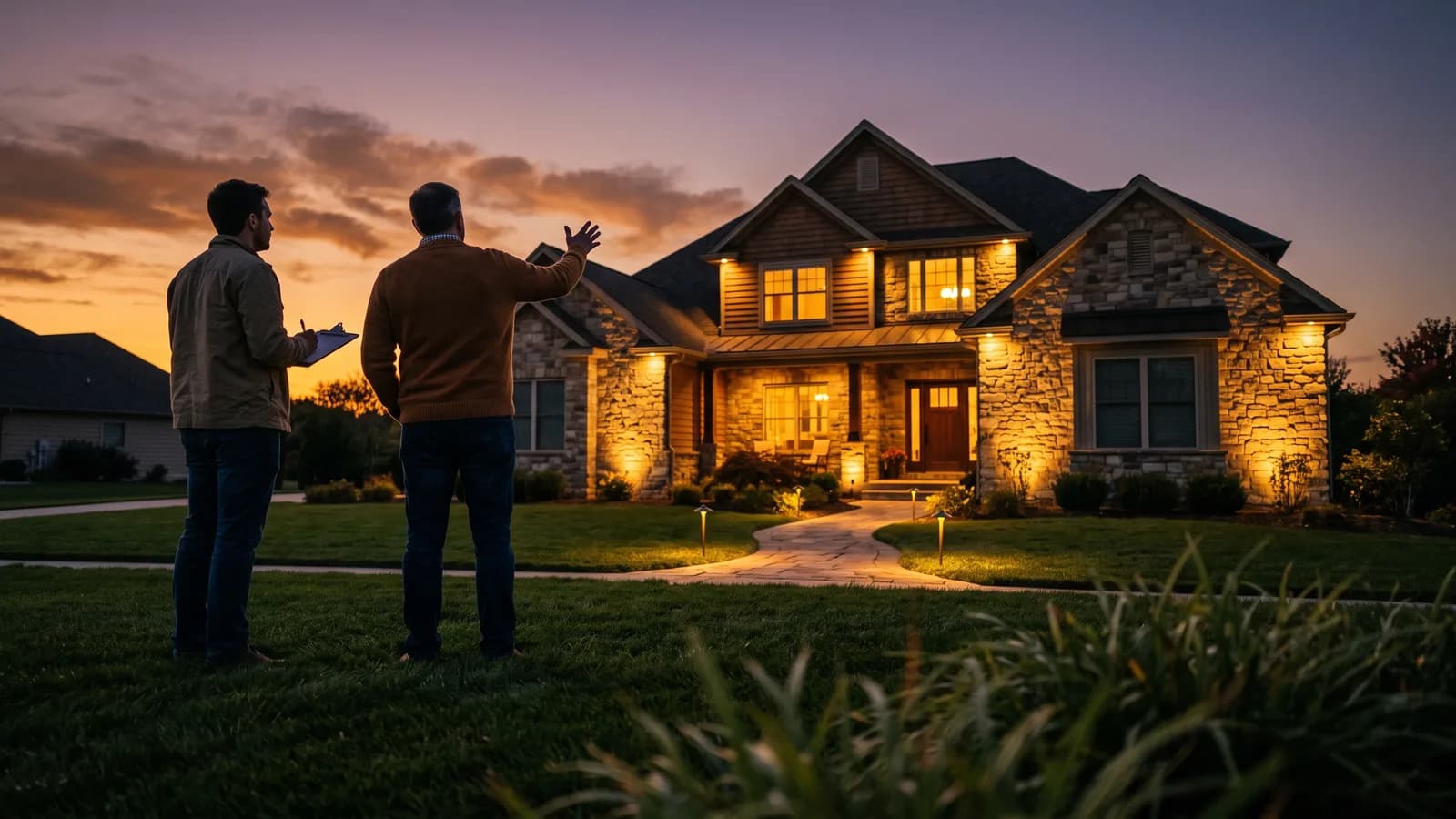
Nearly every other home improvement trade sells a static, daytime product. A new roof, a set of windows, a deck, all of it can be seen and judged in full sun. Landscape and architectural lighting sells an experience that only exists after sunset, which means the highest-leverage move a designer can make is scheduling the consultation to end at dusk instead of treating it like an afternoon estimate visit.
Why daytime estimates undersell this trade
Show a homeowner a daytime yard and describe how the fixtures will wash the facade, uplight the trees, and mark the front steps, and the best-case outcome is that they nod along and try to imagine it. Most people cannot hold that mental picture well enough to justify signing a contract worth several thousand dollars. A daytime visit forces the designer to sell with words and a catalog photo of someone else's house, competing against every other quote the homeowner has collected that also arrived as a stack of paper rather than a lived moment on their own lawn.
Structuring the appointment around last light
The alternative is to treat sunset as the anchor of the appointment rather than an inconvenience to work around. Everything else, the walk of the property, the measurements, the conversation about scope, gets scheduled so it wraps up right as the sky starts to change, and the actual reveal happens in the ten or fifteen minutes when the eye can no longer make out detail without help.
Scheduling backward from sunset instead of forward from availability
Most booking systems default to filling whatever slot a homeowner picks from a calendar of open times. For this trade, the better approach is to build the day's appointments backward from the local sunset time, which shifts by roughly an hour and a half across the year depending on the season and, for companies near a border, on which side of the United States-Canada line the property sits. A consultation booked for the wrong hour either arrives with the light already gone, forcing a rushed and slightly awkward demo, or ends with the homeowner losing patience waiting for the sky to cooperate.
Using temporary demo fixtures to preview zones not yet quoted
A small kit of battery-powered or quick-clip demo fixtures lets a designer preview a zone that has not been formally quoted yet, an uplit tree the homeowner had not mentioned, a step light run along a path they use every night without thinking about it. Setting two or three of these while the homeowner is distracted with paperwork, then switching them on during the walk, turns an add-on into something the homeowner asked to include rather than something that was upsold to them.
The walk-through script that turns the reveal into a close
The value of the dusk demonstration comes from how it is narrated, not just from the fixtures switching on. A designer who stays quiet while the homeowner looks at their own house wastes the moment; a designer who launches into technical detail about beam angles wastes it a different way.
Narrating the transformation instead of narrating the fixtures
The strongest version of this script describes what the homeowner is feeling, not what the equipment is doing. “Watch what happens to the oak in the next few seconds” lands very differently than “this fixture has a wide flood lens.” Pause after each zone comes on rather than moving straight to the next one, and let the homeowner narrate their own reaction before filling the silence. That reaction, not the designer's pitch, is what gets repeated to a spouse who was not present or a neighbor who asks about it later.
Let the silence do the work
What to do when the appointment cannot end at dusk
Some appointments genuinely cannot be scheduled around sunset, a homeowner's only open evening falls on a night with rain in the forecast, or a commercial property needs a midday walk for access reasons. In those cases, a short video of a comparable finished project, ideally shot at the same blue hour window that makes this trade's after photos work in the first place, is the next best substitute. It will not outperform standing on the homeowner's own lawn watching their own house change, but it beats asking them to imagine the result from a daytime description alone. Whenever possible, offer a follow-up dusk walk-through as a second appointment before finalizing scope, particularly for a whole-property package rather than a handful of fixtures, since the larger the proposal, the more that decision benefits from seeing the full effect in person.
Not every inbound call deserves a full dusk appointment, either. Routing small repair or single-fixture requests away from a design consultation keeps evening slots reserved for buyers who are genuinely considering a broader project, which protects the scarcest resource a design team has: the limited hours of usable dusk light each day. Learn more about how the process works before booking a first appointment.
Ready to talk numbers on your own pipeline?
On the strategy call, we'll lay out the plan we'd run for your business and talk through how it fits your market.
Final thought
A dusk demonstration works because it replaces a sales pitch with a memory. The homeowner is not being told what the finished project will look like, they are standing in their own yard watching it happen, which is a fundamentally different kind of persuasion than any brochure or daytime estimate can offer. Building the appointment schedule around sunset, carrying a small demo kit, and narrating the reveal instead of the equipment turns the single hardest part of selling this trade, showing a product that is invisible half the day, into its biggest advantage. The same discipline that makes the demonstration work also shows up later in the after photos that carry the marketing portfolio, since both depend on treating that narrow window of light as the asset it actually is.
Tagged