
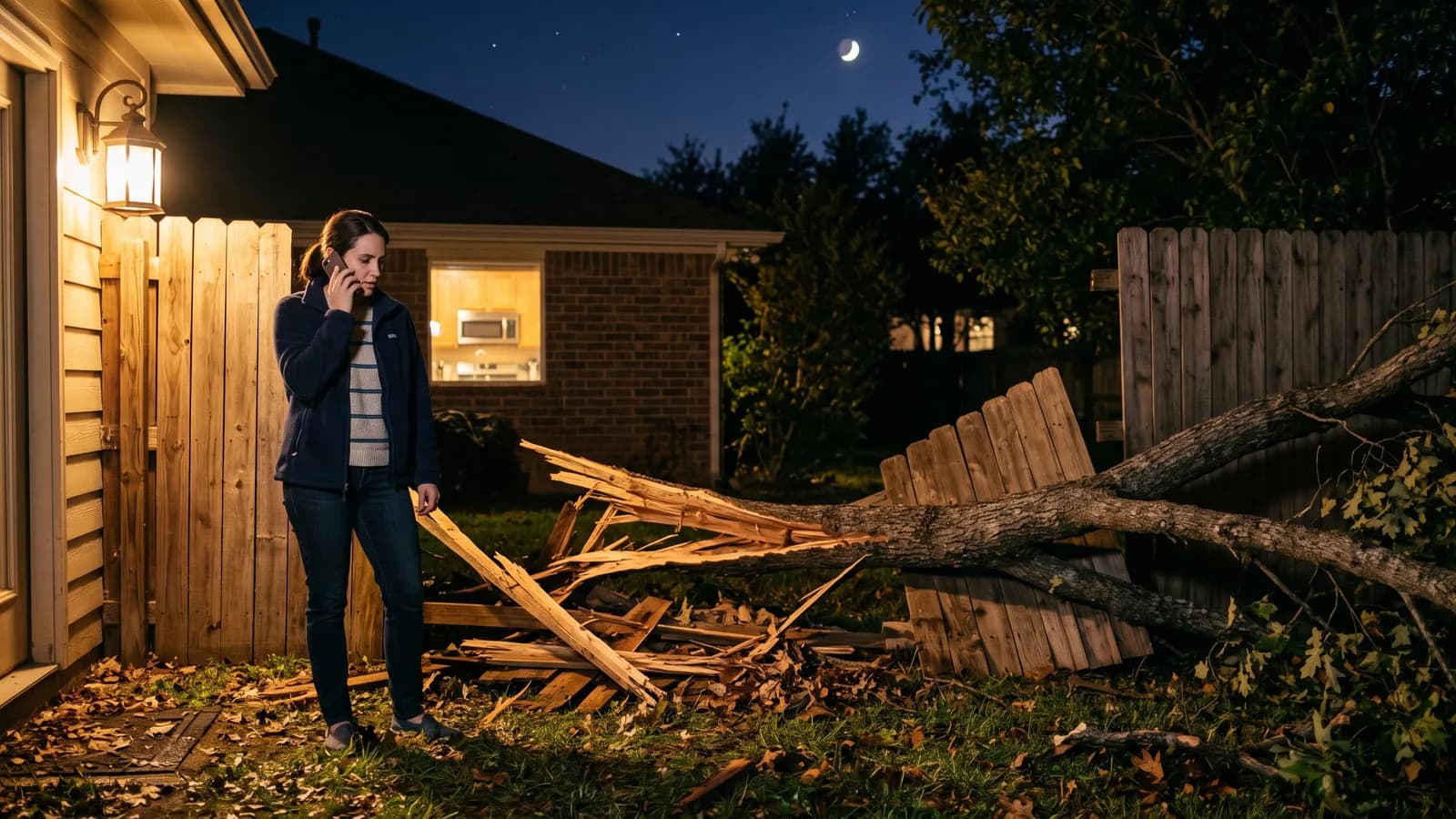
A fence section knocked flat by a storm, a vehicle that backed through a gate, or a break-in attempt does not wait politely for business hours to reopen. It is often urgent for real safety or security reasons, an open yard, a loose dog, a pool no longer enclosed, and the homeowner calling about it will simply call the next name on the search results if the first call goes to voicemail. Always-on voice coverage changes what happens on that call, whatever hour it comes in.
Why fence emergencies do not wait for business hours
A storm that takes down fence sections across a neighborhood rarely arrives on a convenient schedule, and a vehicle strike or an attempted break-in can happen at any hour without warning. Unlike a routine quote request, where a next-day callback is a minor inconvenience, a downed fence often represents an immediate gap in a yard's safety or security, a pet that can get out, a pool that is no longer properly enclosed, or simply an open property line at night. The homeowner on the other end of that call is not comparing prices for fun, they are trying to solve a problem right now. Whether the storm hit a neighborhood in the Midwest United States or coastal Canada, the same basic urgency applies, and neither region's homeowners are inclined to wait until morning for a callback when the yard is open right now.
What a homeowner does when a call goes to voicemail instead
A homeowner dealing with an actual emergency does not leave one voicemail and wait patiently. They call the next company, and the one after that, until someone picks up. A missed after-hours call on a genuine emergency is not a delayed lead, it is very often a lost one, because whoever answers first gets the job. That dynamic makes after-hours coverage a meaningfully different problem for fence contractors than it is for trades where nearly every inquiry can comfortably wait until morning. A search at eleven at night for “fence repair near me” is a search built for whoever answers the phone, not whoever has the best reviews, since the caller has no time to compare anything beyond who picks up first.
Distinguishing genuine emergencies from routine after-hours requests
Not every call that comes in at night is an emergency. Plenty of homeowners simply prefer to research and call in the evening after work, asking routine questions about a replacement project with no urgency attached at all. An Artificial Intelligence (AI) Receptionist that answers every call immediately can ask a few direct questions, is the fence currently down or compromised, is there an immediate safety concern, to sort a genuine emergency from a routine evening inquiry within the first minute of the call. That first minute matters more than it might seem, since it decides whether the call gets escalated toward an on-call crew member or simply logged for a normal follow-up the next business day.
Routing urgency correctly without over-triggering emergency response
Treating every after-hours call as an emergency dispatch is its own mistake, since it burns crew time and on-call goodwill on calls that could easily wait until the next business day. A well-configured system routes a confirmed emergency, a storm- damaged section, a security gap, directly to whoever handles urgent response, while capturing a routine quote request for normal follow-up the next morning. Getting that routing right protects the crew's time as much as it protects the homeowner's. A crew member who gets pulled out of bed for a call that turns out to be a routine quote request quickly loses trust in the after-hours system altogether, which is exactly the outcome careful routing is meant to prevent.
A vague after-hours script creates false urgency
Capturing full details either way so nothing gets lost overnight
Whether the call turns out to be a genuine emergency or a routine evening inquiry, the same information needs to be captured every time, name, address, a description of the damage or the project, and the best way to reach the caller back. That consistency is what prevents a late-night call from quietly falling through the cracks even when it does not require an immediate dispatch. A caller who gives a clear description of the damage overnight also saves the morning crew a step, since they can arrive with a rough sense of materials needed instead of discovering the scope cold. It also feeds directly into how the office keeps track of many active jobs and leads at once without losing any of them, and it reinforces the same principle behind why a fence quote request is never exclusive to one contractor, the business that answers first, day or night, is usually the one that keeps the job. Once urgency is confirmed, the same fast, aerial-measurement-based quoting process that works for daytime leads can often produce a rough number before a crew is even dispatched the next morning. The full range of coverage options is on the services page.
Ready to talk numbers on your own pipeline?
On the strategy call, we'll lay out the plan we'd run for your business and talk through how it fits your market.
Final thought
A downed fence section is one of the few home improvement situations that carries real urgency at any hour, and a business that only answers calls during the day is handing those emergencies straight to a competitor. Always-on voice coverage, configured to tell a genuine emergency apart from a routine evening request and capture full details either way, turns after-hours calls from a gap in coverage into a consistent source of jobs that competitors relying on voicemail simply never see. Over a full storm season, that difference alone can account for a meaningful share of a fence business's total emergency repair revenue.
Tagged