
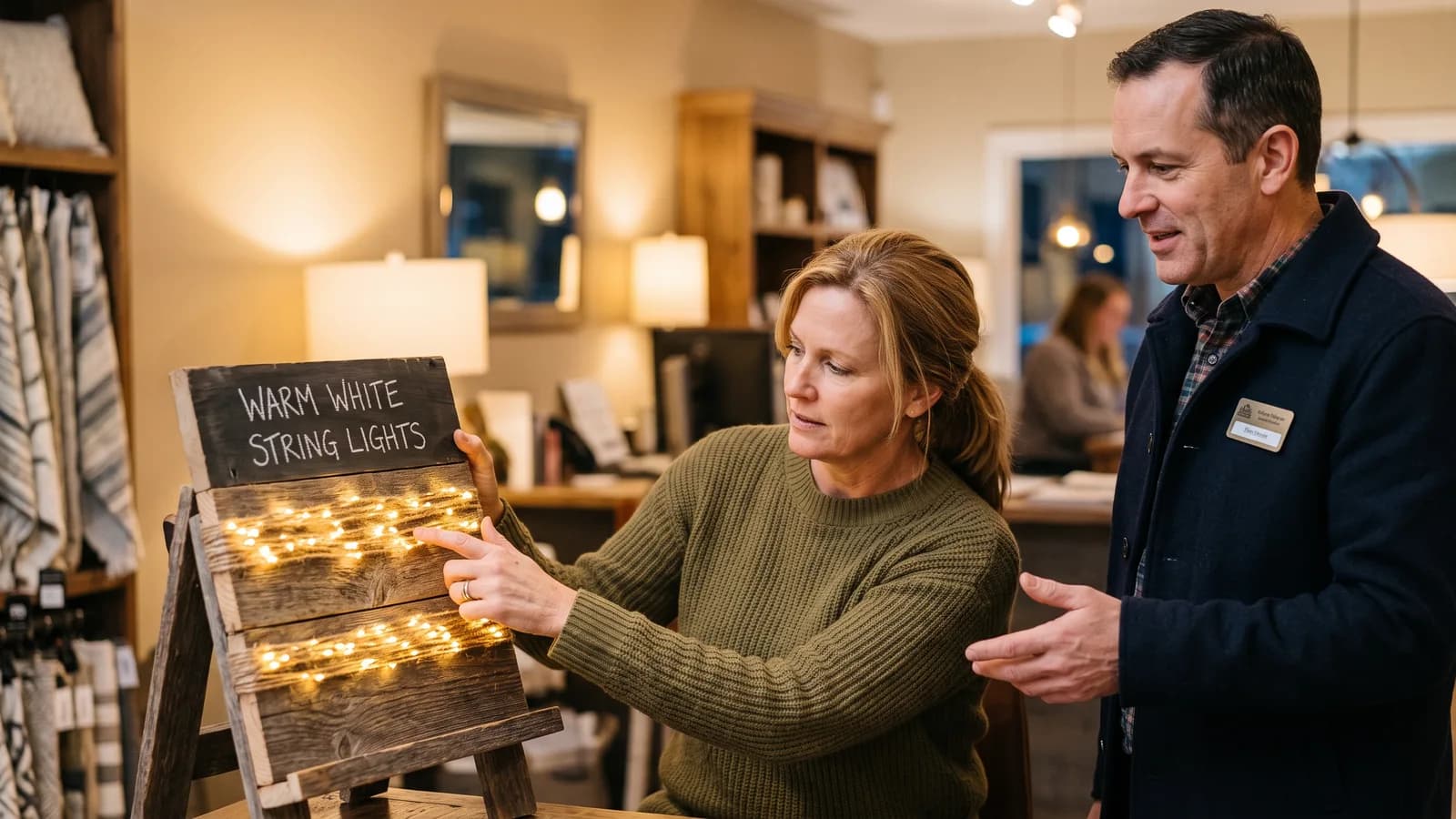
Choosing between warm white icicles, colour changing pathway lighting, and a garland wrapped column is a genuinely hard decision to make from a page of catalog photos. A small physical display, even a single staged section inside an office, a trailer, or a demonstration yard, gives a homeowner something to point at instead of something to imagine. That small investment tends to shorten the consultation and raise the confidence with which a homeowner picks a package.
Why catalog photos alone struggle to sell a design decision
A photo of a finished house is useful for showing scale and style, but it compresses a lot of decisions a homeowner still has to make on their own: how dense the wrap needs to be to avoid looking sparse, how warm white actually compares next to their own porch light, and how a colour changing strand looks static versus in motion. Screens also do the colour temperature of light no favours. A warm white bulb photographed on a phone and viewed on another phone rarely renders the same amber tone twice, which means two homeowners looking at the identical photo can walk away with two different mental pictures of what they are buying. This is not a knock on strong portfolio photography, the same images that get someone to book a consultation in the first place simply cannot finish the decision the way a hands-on sample can.
The result is a consultation that spends a lot of time on description, “it's warmer than that, more like candlelight,” rather than decision. A physical sample collapses that back and forth into a single glance.
What a minimal staged display actually needs to include
A useful display does not require a dedicated showroom. A single mounted board or a small section of fence line with two or three strand types wired to a switch covers most of what a consultation needs:
- A warm white versus colour changing comparison. The single most common decision point, shown side by side under the same ambient light rather than described verbally.
- A spacing sample. Two short sections wired at different bulb spacing so a homeowner can see the difference between a dense, full wrap and a wider spaced, more subtle line.
- One textured element. A small piece of garland or a wrapped column section, since foliage based products photograph very differently from how they read in person.
- A dimmer or control demonstration. If the company offers programmable or colour changing options, a working remote or app control in the display lets a homeowner try it rather than take a claim on faith.
Using a trailer or mobile display for on-site consultations
Companies that run most of their consultations in the home rather than in an office still benefit from a portable version of the same idea, a small case with two or three wired sample loops and a battery pack, brought into the consultation and set up on the kitchen table or front step. It takes under a minute to set up and gives the same side-by-side comparison an office display offers, without requiring the homeowner to visit anywhere. For companies running a trailer as a mobile showroom, the same principle applies at a larger scale, a fixed panel wired to run off the trailer's power that can be parked at community events or left staged in a driveway during a design consultation.
Climate affects where a display holds up best over time. In much of the northern United States and across most of Canada, an outdoor demonstration section left wired through a full winter faces the same wind and moisture exposure as a live install, so an indoor or garage-based version tends to survive repeated seasons better than one left outside year round. Companies in milder southern climates have more flexibility to keep a small outdoor demonstration section running for a larger share of the selling window without the same wear.
Bringing the display into the consultation conversation deliberately
A display only earns its keep if it gets used on purpose rather than sitting in the corner as decoration. The strongest use is early in the design consultation, right after measurements are taken and before pricing comes up, so the homeowner is choosing a look rather than reacting to a number. Walking a prospect over to the sample and asking “which of these two feels more like what you pictured for the front of the house” turns an abstract style conversation into a concrete choice, and that choice becomes the anchor the rest of the consultation, including how the quote gets built, can reference back to.
Show the comparison before the price
Keeping a small display fresh across multiple seasons
Bulbs age and colour temperature drifts over a few seasons of storage and use, so a display that looked accurate in year one can quietly mislead a homeowner by year three if nobody checks it. A simple annual habit fixes this: before the first consultation of a new season, swap any strand that looks dimmer or noticeably warmer or cooler than a fresh one, and confirm any control demonstration still pairs correctly. It is a fifteen minute check, but it protects the display's whole purpose, showing homeowners exactly what they will get, not what the sample looked like three seasons ago.
Ready to talk numbers on your own pipeline?
On the strategy call, we'll lay out the plan we'd run for your business and talk through how it fits your market.
Final thought
A staged display does not need to be elaborate to change how a consultation feels. A warm white and colour changing pair, a spacing comparison, and one textured sample give a homeowner something honest to react to, and that honesty tends to speed up the decision rather than slow it down. For a business built around a visual product sold in a narrow window, letting people see it before they buy it is one of the cheapest upgrades available to the sales process.
Tagged