
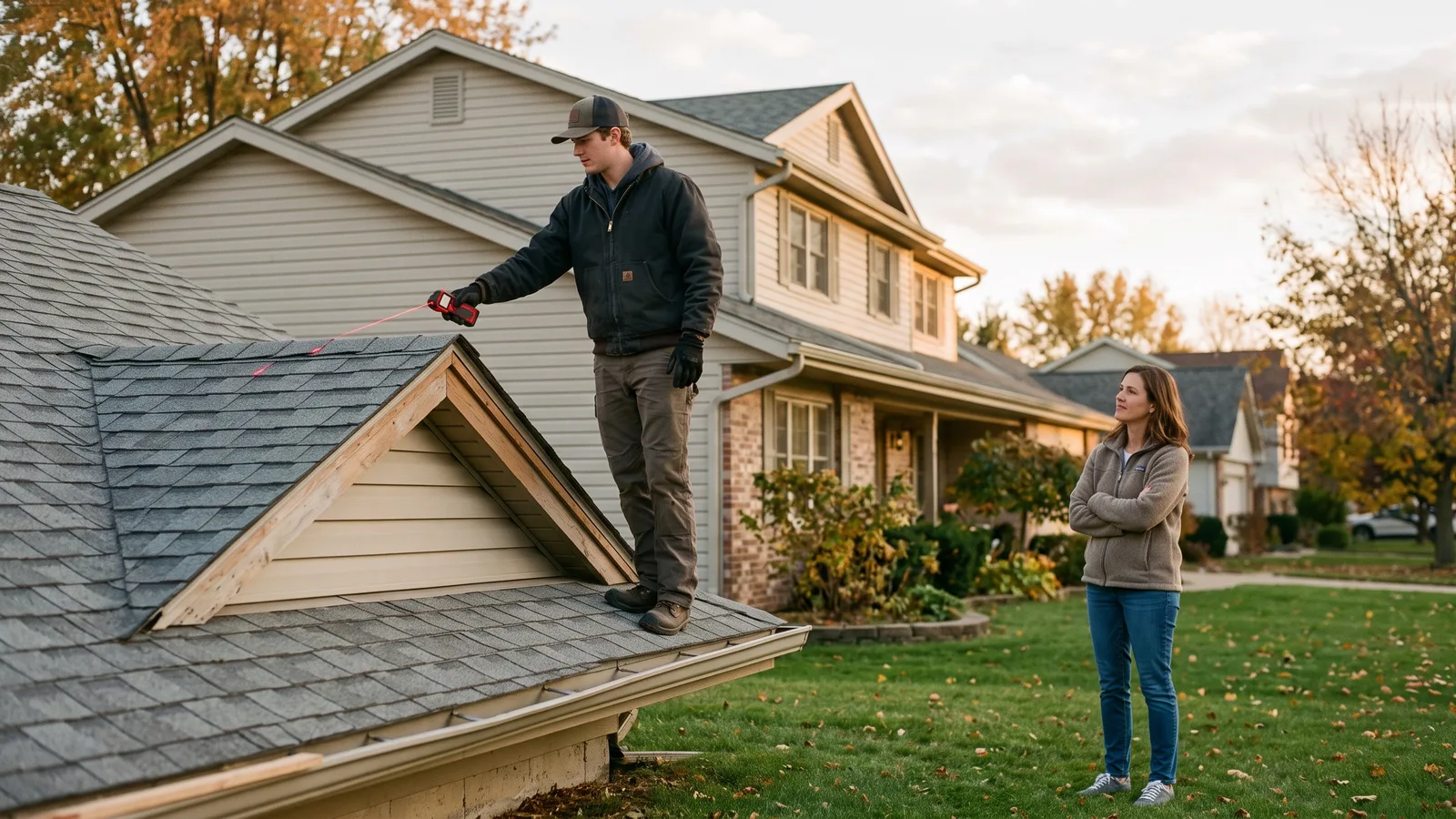
Unlike many home services, a holiday lighting quote depends heavily on physical details a phone call simply cannot capture. Roof pitch and material, tree branch structure, outlet placement, and whether last year's hardware is still usable all change labor time and material count. Miss any of them during the consultation and a clean quote turns into a change order the crew has to sort out on install day, which is the worst possible time to discover a problem.
Why holiday lighting quotes fail more often on missing details than on price
Most lost jobs in this trade are not lost because the price was too high, they are lost because the quote turned out to be wrong once the crew showed up to install it. A rough footage estimate given over the phone, or eyeballed from the street, tends to miss the details that actually drive labor time: a steep or metal roof that slows ladder work, a mature tree with a branch structure that needs more lights than it looks like from the ground, or an outlet that turns out to be further from the install area than assumed. A consistent, thorough on-site consultation is what protects the quote from these surprises before a homeowner ever sees a number.
Roofline pitch, material, and access points
Roofline details drive both labor time and safety planning, so they need to be assessed in person rather than assumed. Pitch affects how long clip installation takes and what ladder positioning and footing the crew will need. Material matters just as much: metal roofing, tile, and asphalt shingle each hold clips differently, and some materials require a different mounting approach entirely. Access points around the property, where a ladder can safely be placed against each section of roofline, should be noted during the visit rather than figured out for the first time on install day.
- Note pitch by section, since many homes have a mix of gentle and steep rooflines that each need different handling.
- Identify material by section too, a home with both shingle and metal roofing over an addition is common and each surface needs its own approach.
- Mark usable ladder access points around the property, including any obstacles like landscaping, slopes, or fencing that will slow crew movement.
Tree structure and the difference between wrap style and drop style lighting
Trees are one of the most commonly underestimated parts of a quote. A mature tree with dense branching takes considerably longer to wrap than a young, sparse one of similar height, and the style the homeowner wants changes the material count entirely: wrap style lighting follows the trunk and major branches closely and uses more linear footage per tree, while drop style lighting hangs strands from the upper canopy and uses less material but requires careful placement to avoid an uneven, patchy look from the ground. Noting tree count, approximate height, and branch density during the consultation, along with which style the homeowner actually wants, keeps the per-tree or linear footage pricing accurate instead of guessed at.
Power access, outlet count, and extension needs
A design that looks great on paper falls apart if the property does not have enough accessible, weather rated outlets to power it, or if the outlets are too far from the display for a reasonable extension run. The consultation should count available exterior outlets, confirm they are rated for outdoor use, such as a ground fault circuit interrupter outlet designed to trip safely if moisture gets into the circuit, and note the distance from each outlet to the areas being lit. Where outlet count or placement falls short of what the design needs, that gap should be flagged and discussed with the homeowner before the quote is finalized, not discovered by the crew standing in the yard with an extension cord that will not reach.
Documenting existing hardware from a previous installer
Many consultations happen at homes with existing hardware already in place, whether from last year's install with the same company or from a previous provider. That hardware, clips, hooks, and sometimes usable outlet extensions, can meaningfully reduce install time if it is still in good condition, but it needs to be evaluated honestly rather than assumed usable. Note the condition, whether it matches the current design plan, and whether it needs replacing outright. This is also the moment to confirm whether the property sits inside a community with design guidelines that might restrict the plan, since that is far easier to catch during the consultation than after a deposit has already been collected.
Photograph everything during the visit
Turning the consultation into a same-visit quote
The real payoff of a thorough consultation checklist is speed. An estimator who has captured pitch, material, tree structure, power access, and existing hardware condition in a consistent format can generate an accurate quote before leaving the property, rather than promising to follow up later once the details are sorted out. This connects directly to why quoting speed matters so much during the compressed weeks when this trade sells most of its volume: a same-visit quote captures a decision while the homeowner is still engaged, rather than losing momentum to a callback days later. Companies that want to walk a prospect through exactly what to expect from that first visit can point them to a plain explanation of the process before the estimator even arrives.
Ready to talk numbers on your own pipeline?
On the strategy call, we'll lay out the plan we'd run for your business and talk through how it fits your market.
Final thought
A holiday lighting quote is only as good as the consultation that produced it. Roofline pitch and material, tree structure and lighting style, power access, and existing hardware condition are not optional details, they are the inputs that determine whether install day goes smoothly or turns into an unplanned negotiation on a customer's lawn. A consistent checklist, followed every visit, is what lets an estimator walk away with a quote the crew can actually deliver on.
Tagged