
How a holiday lighting company prices a job shapes more than the number on the quote. It shapes how easily a homeowner can compare that quote against a competitor's, how naturally an add-on like a wreath or pathway lighting fits into the conversation, and how predictable revenue per job becomes as the season fills up. Three pricing structures dominate the trade: linear footage, per tree or per shrub, and flat tiered packages. Each solves a different part of the quoting problem, and most established companies end up using some blend of the three rather than picking just one.
Linear footage pricing and why it rewards accurate measuring
Charging by the linear foot of roofline, eave, or railing is the most literal way to price the labor and material involved, a longer roofline takes more strand, more clips, and more crew time, so the price scales directly with the measurement. The strength of this model is fairness and consistency, two houses with similar rooflines end up priced similarly regardless of who happens to be doing the estimate that week.
Its weakness is that it lives or dies on measuring discipline. An estimator who eyeballs a roofline instead of measuring it, or who forgets to account for peaks, dormers, and multiple elevations, either underquotes the job and eats the difference in labor time, or overquotes it and hands a competitor an easy opening on price. Companies that rely on linear footage as their primary model tend to invest early in either a reliable measuring tool or a standardized walk-around method the whole estimating team uses the same way, precisely because the model's fairness depends on the number behind it being accurate.
Per tree and per shrub pricing for landscape heavy properties
Some properties are driven far more by landscaping than roofline, a large mature tree wrap, several ornamental shrubs, and a row of foundation plantings can represent more labor time than the house itself. Per tree and per shrub pricing handles this better than a footage model, since it prices the actual unit of work, climbing and wrapping a specific tree, rather than trying to force a landscape heavy job into a roofline-based number.
The trade-off is that per tree pricing needs its own tiers, since a ten foot ornamental shrub and a thirty foot mature oak are not the same job even though both are technically one tree. Companies that use this model well typically break trees into two or three size classes at the estimate stage, small, medium, and large, rather than quoting every tree at a single flat rate regardless of size.
Mixing footage and per-item pricing on a single quote
In practice, most quotes end up blending the two models rather than picking one exclusively, roofline and railing priced by the foot, trees and shrubs priced per item, with a simple addition at the bottom. This hybrid approach tends to match how homeowners actually think about their own property, as a house plus a yard, rather than as a single undifferentiated perimeter. It also makes it easier to price an add-on later in the season, adding one more tree to an existing footage-based quote is a clean, easy-to-explain line item rather than a recalculation of the whole job.
Flat tiered packages and why some homeowners prefer them
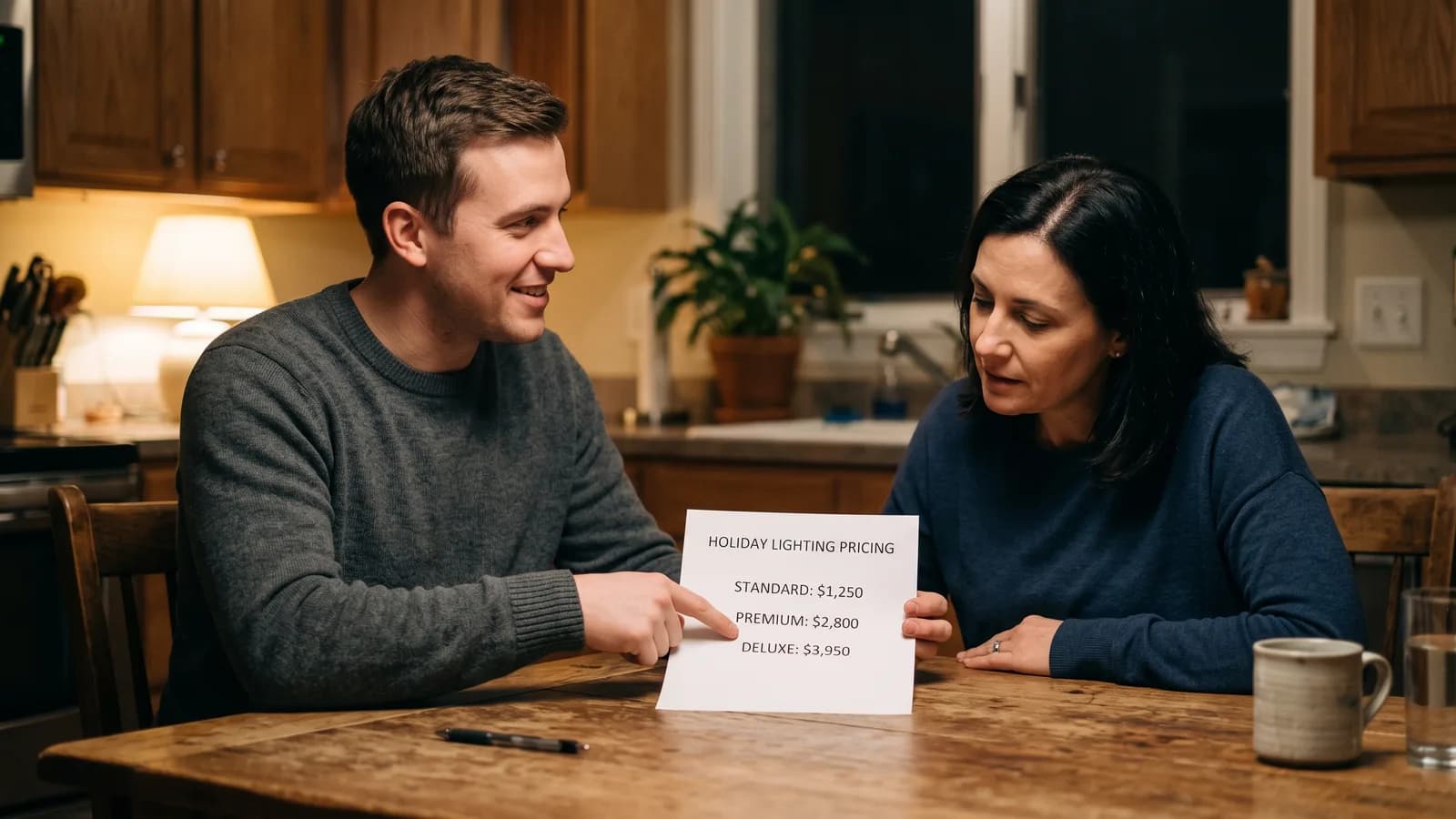
A meaningful share of homeowners do not want to think about footage or tree counts at all, they want to know what a small, medium, or large home typically costs and pick the tier that sounds right for their situation. Flat tiered packages, built around a few common home sizes with a defined scope at each level, serve exactly that preference. They also make marketing simpler, since a published starting price for a typical package gives prospects a concrete number to anchor against before they ever request a quote.
The risk with flat packages is scope creep at the edges. A homeowner whose property sits right between two tiers, or whose landscaping is unusually dense for their home's square footage, can end up quoted a package that undershoots the actual labor involved. Companies that lean on flat packages as a primary model usually keep a documented escalation path for properties that genuinely fall outside the standard scope, rather than quietly absorbing the difference every time.
How each model affects add-on and upsell conversations
The pricing model a company leads with also shapes how natural an upsell conversation feels during the design consultation. Linear footage and per-item pricing make add-ons feel like simple, incremental choices, adding a wreath or a section of pathway lighting is just one more line at its own price, clearly separate from the base quote. Flat packages can make the same conversation feel more like an upgrade decision, since moving a homeowner from one tier to the next changes the whole number rather than adding a small line. Neither approach is wrong, but a sales team should know which framing their pricing model naturally supports so the upsell conversation does not feel forced against the structure of the quote itself.
- Footage and per-item models sell add-ons as small, low friction additions.
- Flat package models sell add-ons as a step up to the next tier, which works best when the tiers are clearly differentiated.
- Larger add-ons, like extending coverage to a detached garage or a second structure, sometimes justify a payment plan conversation regardless of which base model is in use.
Match the model to how the estimator quotes on site
Choosing a primary model without losing pricing flexibility
There is no single correct model, only a correct fit for a given company's typical property type and sales style. A business working mostly larger, roofline-heavy homes leans toward footage pricing. A business in a landscape heavy market leans toward per tree pricing. A business selling mostly to first time buyers who want a simple decision leans toward flat tiers. What matters most is picking a primary model the estimating team can apply consistently, while keeping enough flexibility in the quoting tool to handle the property that does not fit the standard case, the oversized lot, the multi-structure property, the unusually dense landscaping, without forcing a workaround that undermines the pricing model's own logic.
Ready to talk numbers on your own pipeline?
On the strategy call, we'll lay out the plan we'd run for your business and talk through how it fits your market.
Final thought
Linear footage, per tree, and flat packages each solve a real problem, fairness, landscape accuracy, and simplicity, and most mature holiday lighting businesses end up running some combination rather than a single pure model. The choice that matters most is not which model looks best on paper, but which one an estimator can price accurately and quickly on site, since a quote that takes days to finalize loses jobs no matter how well the underlying pricing logic was built.
Tagged