
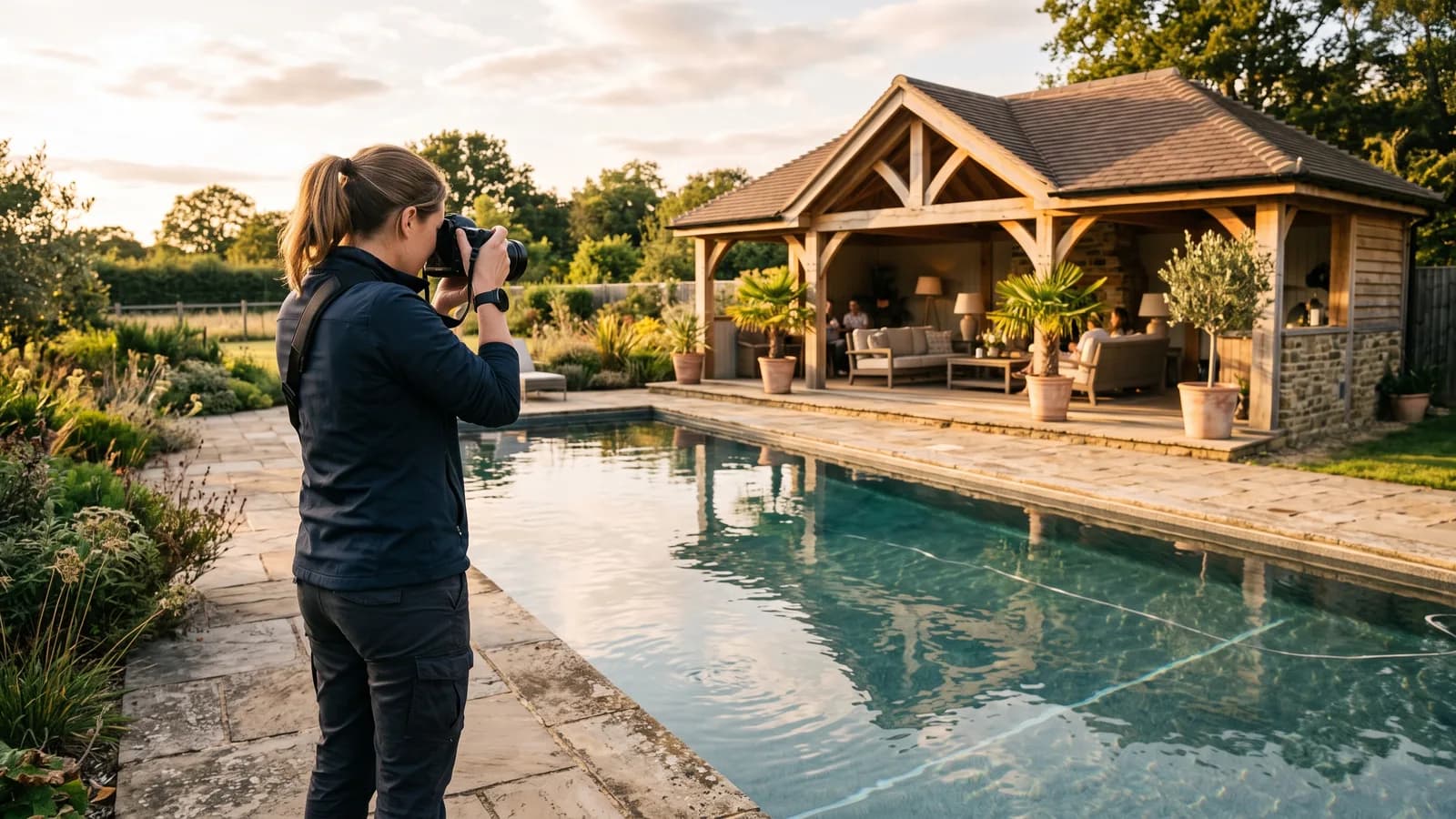
A finished cabana rarely stands alone in real life. It sits beside a pool, a patio and landscaping that took just as much planning as the structure itself. A photograph that isolates the cabana from that context, cropped tight against a plain background, understates exactly what the next prospective client is trying to picture for their own yard.
Why a Cabana Cannot Be Photographed Like a Standalone Structure
For a trade like siding or roofing, the structure itself is the entire story, and a tight, well-lit shot of the finished exterior says everything a prospective client needs to see. A cabana is different. It is almost always part of a larger outdoor living project, and a shot that leaves out the pool, the surrounding patio and the landscaping tells only part of what was actually built. A homeowner evaluating a builder is not just asking “can they build a structure,” they are asking “can they build the backyard I am picturing,” and only a full-scene photograph answers that second question.
Building a Repeatable Shot List
A portfolio built from whatever photo happened to turn out well on a given day looks inconsistent and, worse, makes it hard for a prospective client to compare projects side by side. A repeatable shot list, used on every completed job, produces a portfolio that reads as a coherent body of work rather than a scattered collection. It also makes life easier for whoever is holding the camera, since a crew member or a hired photographer working from a fixed checklist does not have to improvise a shot list on-site every time, and the finished set of photos ends up looking like it came from the same builder project after project.
Wide Establishing Shots With the Pool Included
Every finished project should include at least one wide shot that captures the cabana, the pool and the connecting patio in a single frame. This is the shot that does the heaviest selling work, since it shows scale, proportion and how the structure actually relates to the rest of the yard, which is the exact picture a prospective client is trying to form in their own head during a consultation.
Detail Shots That Show Materials and Craftsmanship
- Roofline and exterior finish close-ups. These reassure a prospective client evaluating build quality, not just design, that the materials hold up under close inspection.
- Interior detail of changing rooms or bar counters. A shot that shows storage, counter finish or a changing room layout answers practical questions a wide exterior shot cannot.
- Evening or lit shots when the structure includes lighting. A cabana with integrated lighting photographed only in daylight leaves out one of its most appealing features.
- A framing or in-progress shot from partway through the build. One photo showing the foundation or open framing, placed next to the finished result, gives a prospective client a sense of the actual construction behind the polished final image.
Timing the Shoot Around Golden Hour and Landscaping Maturity
Light quality matters as much as composition. Photographing a finished cabana and pool during the late-afternoon golden hour, when warm, low-angle light reflects off the water and softens every material in frame, produces a noticeably stronger result than a flat midday shoot. Just as important is timing the shoot around landscaping maturity rather than rushing to photograph the moment the crew leaves the site. Newly planted landscaping often needs a full season to fill in, and a shoot scheduled too early can show bare mulch beds around a structure that will look completely different a few months later.
Schedule the shoot as its own project milestone
Turning a Portfolio Into Case Studies, Not Just a Gallery
A gallery of finished photos is useful, but a case study built around those same photos does more work. Pairing the full-scene shots with a short description of the project, the yard constraints that shaped the design, any homeowners association or setback consideration that was resolved along the way, and what the homeowner asked for at the start, gives a prospective client a story they can see themselves inside of, not just an image to scroll past. A short paragraph explaining how the multi-trade build came together, foundation, framing, roofing and electrical work all coordinated on one job, also signals professionalism to a prospective client comparing several builders at once. These case studies also make strong material for the landing pages built to convert cabana shoppers, where a real project with real context outperforms a generic stock photo every time.
For builders who also maintain a physical showroom or display model, the same photography standard applies there too, a display model photographed in isolation misses the chance to show how the structure looks integrated into a finished outdoor space.
The finished portfolio is also one of the best tools for asking past clients to talk about the project publicly. Timing a review request around the same window as the final photography lets a builder pair a strong written review with the images that prove it, which is a stronger combination than either one on its own.
Ready to talk numbers on your own pipeline?
On the strategy call, we'll lay out the plan we'd run for your business and talk through how it fits your market.
Final thought
A cabana photographed alone tells half the story. A portfolio built around full-scene shots, a repeatable list of angles and details, and shoot timing that respects both light and landscaping maturity, sells the finished lifestyle as much as the structure itself. That standard, applied consistently across every completed project, becomes one of the most persuasive assets in the entire sales process for the next homeowner deciding whether to trust the builder with their own yard.
Tagged