
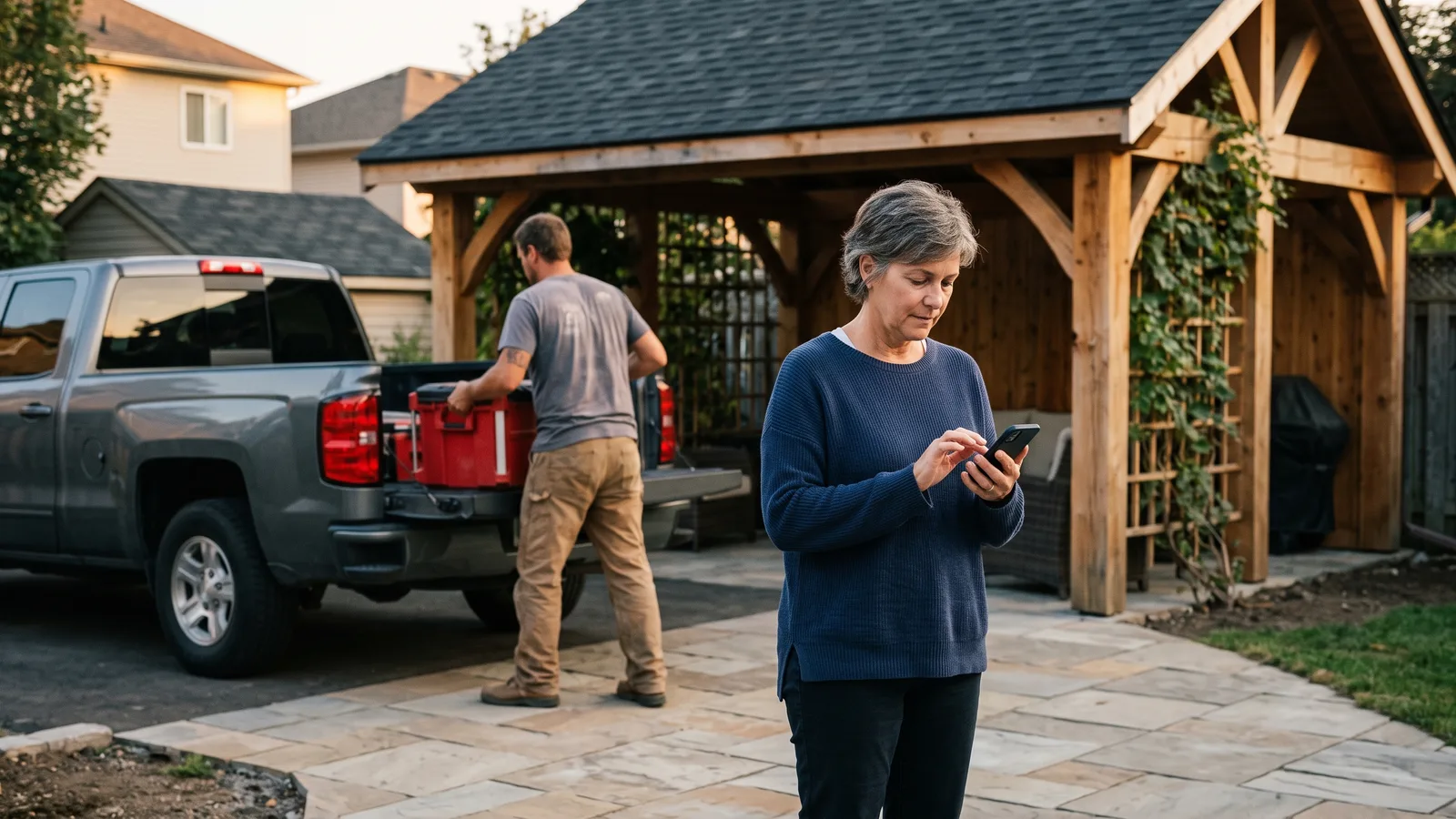
A window or roof replacement is often finished in a single day, which makes the timing of a review request simple, ask right after the crew leaves. A cabana build stretches across weeks and several trades, moving through excitement, fatigue and finally satisfaction, and a review requested at the wrong point in that arc reads nothing like the one requested at the right one.
Why Build Length Changes the Review-Timing Problem
A homeowner's mood on any given day of a multi-week cabana build does not reflect the finished result, it reflects wherever the project happens to be that week. Foundation pours bring optimism. A permit delay or a stretch of bad weather brings frustration that has nothing to do with the quality of the work. Framing, which can look rough and unfinished for days at a time, sometimes triggers doubt even on a project that is completely on schedule. A generic reminder to “ask for reviews” ignores all of this and treats a six-week build the same as a same-day repair, which is exactly why so many review requests from long-timeline trades land flat.
A multi-trade build also means the homeowner is forming impressions of several different crews over the course of the project, the foundation team, the framing crew, the roofers, the electrician. A review asked for too early might reflect an opinion of only one of those crews, formed before the rest of the project has had a chance to come together into the finished result the homeowner actually signed up for.
The Wrong Moments to Ask
Some points in the build cycle are reliably bad moments to raise the subject of a review, even when nothing has gone wrong. A homeowner asked in the middle of one of these stretches is not being dishonest by writing a lukewarm review, they are accurately describing how they feel that week, which is exactly the problem.
Mid-Framing and Permit Delays
- During the framing stage. The structure looks unfinished, exposed and sometimes messy, which colors a homeowner's impression regardless of how the finished product will look.
- Immediately after a permit or inspection delay. Frustration at a scheduling holdup outside the builder's direct control still bleeds into how a review would be written if asked for in that window.
- Right after a weather-driven schedule shift. A pushed completion date, even one explained clearly in advance, is not the moment a homeowner feels most positive about the project.
The Right Moment to Ask
The strongest reviews come from homeowners who have had a short window to actually live with the finished cabana, not just admire it at the walkthrough.
One to Two Weeks After the Final Walkthrough
Asking one to two weeks after the final walkthrough, rather than the same day, gives the homeowner time to host a first gathering, use the space at night with any integrated lighting, and settle into the reality of the finished project instead of the adrenaline of just seeing it completed. A review written from that settled point tends to describe the experience of owning the space, not just the excitement of the reveal, which reads as more credible to a future prospective client evaluating the builder.
Let the excitement settle before asking
What to Ask For Beyond a Star Rating
A star rating alone tells a prospective client very little about a project this specific. A short, guided request that asks the homeowner to mention what the space gets used for, how the multi-trade coordination went across foundation, framing, roofing and electrical work, and whether the finished result matched the original rendering produces a review that actually helps the next homeowner picture their own project. This kind of detail also pairs well with the finished project photography, shot around the same post-walkthrough window, since a strong written review next to a strong photo does more than either one alone.
It also helps to ask a homeowner a specific question rather than an open-ended one. Instead of a generic “how did we do,” asking directly whether the finished cabana looks like the rendering they were shown at the start, or whether the homeowners association or setback questions were handled smoothly, produces a more concrete answer than a vague compliment. Specific answers also tend to be the ones a future homeowner actually reads all the way through, rather than skimming past another short, generic five-star comment.
Using the Review in Referral and Portfolio Contexts
A well-timed review is not just for the public review platform it was written on. It becomes material for a case study, a talking point in a future consultation with a similar yard layout, and something worth sharing directly with a referral partner like the pool builder who sent the homeowner in the first place, giving that partner proof their referral led somewhere good. A strong review is also one of the better ways to open a conversation about future maintenance or add-on work with the same homeowner, since a satisfied client who just wrote a thoughtful review is already in a positive frame of mind about the relationship.
Ready to talk numbers on your own pipeline?
On the strategy call, we'll lay out the plan we'd run for your business and talk through how it fits your market.
Final thought
A cabana build does not move through a single emotional beat the way a same-day repair does, it moves through several, and only one of them produces the review worth having. Waiting until the homeowner has actually lived with the finished space for a week or two, then asking for specific detail rather than a bare star rating, turns review collection from a generic reminder into a deliberate part of how the project closes out.
Tagged