
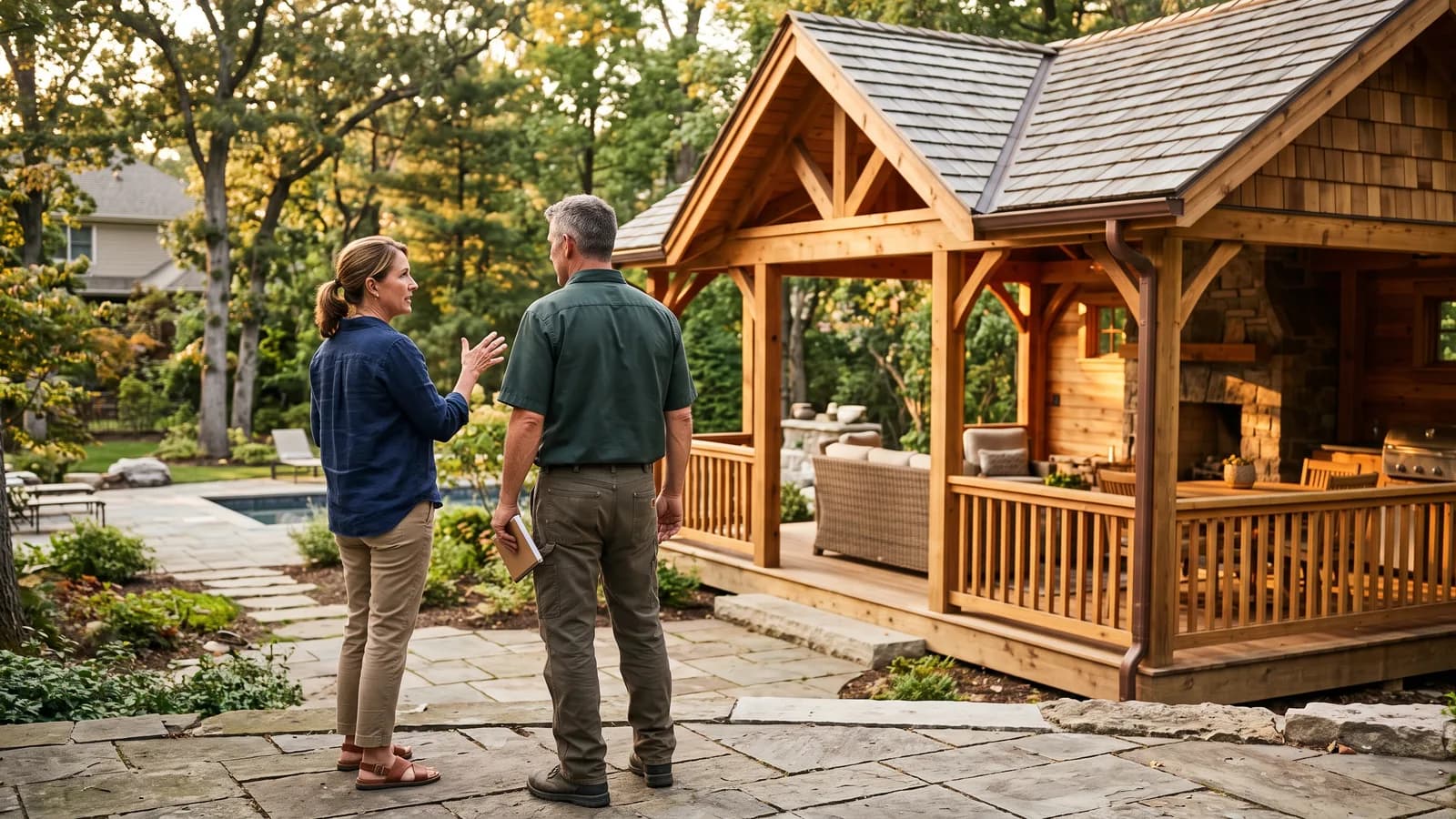
The most common hesitation in a cabana sale rarely comes down to the price itself, it comes down to whether the structure genuinely adds value to the house or simply becomes an expensive way to spend a summer. Homeowners ask this question, directly or indirectly, in almost every consultation. Answering it with honest, locally grounded framing, rather than an inflated promise a real estate agent will later contradict, builds far more trust than dodging the topic ever does.
Why Resale Value Comes Up More in a Discretionary Build
A window or roof replacement rarely triggers a resale value conversation because the value case is obvious, the home needed the work regardless of who owns it next. A cabana is discretionary. No one strictly needs a pool house or a bar cabana, which means the homeowner is implicitly asking whether this spending counts as an investment in the property or simply a lifestyle purchase. That question deserves a direct answer, because dodging it or answering with vague enthusiasm signals that the builder either does not know or is not being straight about it.
What Actually Influences Resale Value for a Cabana
Resale value for a cabana is real but conditional, shaped by a handful of factors that are worth naming specifically rather than promising a blanket return.
Local Market Norms for Outdoor Living Spaces
In markets where a pool and a matching outdoor living structure are already common among comparable homes, a well-built cabana tends to keep the property competitive with its neighbors rather than standing out as an unusual upgrade. In markets where pools and cabanas are still uncommon, the same structure may appeal strongly to a narrower slice of future buyers rather than lifting value broadly. Neither situation makes the project a bad idea, but the honest framing differs, and a builder who has watched local listings for a few seasons usually has a genuine read on which situation applies.
Appraisal practice also differs somewhat between the United States and Canada, and a builder working near the border or with clients relocating between the two should be careful not to apply one country's general appraisal habits to the other. The safest version of the conversation stays local rather than national, since a specific municipality or neighborhood pattern is always more accurate than a country-wide generalization either way.
Quality and Permitting as Resale Factors
An unpermitted structure, or one built with materials that will not hold up to the local climate, is a resale liability rather than an asset, because it becomes a disclosure problem or an inspection flag when the home eventually sells. A properly permitted cabana built to match the quality level of the house protects the value that is already there, even in a market where the structure itself is not the primary driver of a higher sale price. This is one of the clearest, most defensible parts of the resale conversation, because it does not depend on market speculation at all.
Permitting is the part of this answer that never varies
Answering the Question Honestly Without Undercutting the Sale
The strongest version of this answer separates what is knowable from what is not. A builder can speak with real authority about permitting, construction quality and local buyer appetite for outdoor living spaces, all of which are observable. A builder cannot honestly promise a specific dollar increase in appraised value, because that number depends on an appraiser and a future buyer neither party has met yet. Saying exactly that, plainly, tends to build more confidence than a confident-sounding percentage pulled from a general home improvement claim. Pairing that honesty with a clear conversation about how the project is priced in the first place keeps the whole financial picture consistent rather than treating resale value as a separate sales pitch layered on top.
- Lead with what is verifiable. Permitting status and construction quality protect value regardless of market conditions, so start there.
- Name the local pattern honestly. Whether comparable homes in the area commonly carry a similar structure shapes the real answer more than any national statistic would.
- Decline to promise a specific number. A builder who will not guess at appraised value gains credibility precisely because the refusal is unusual in this sales conversation.
When the Honest Answer Is to Build It for Enjoyment, Not Resale
Sometimes the most honest answer is that a cabana should be justified by how the family will use it, not by a projected return at sale. That framing is not a lost sale, it is often the version of the conversation that actually closes, because it removes the pressure of treating a lifestyle purchase as an investment decision it was never going to fully satisfy. The same shift tends to surface naturally during the financing conversation, where a monthly payment already moves the discussion toward what the family gets to use this summer rather than a future sale price. A homeowner who decides to build specifically for years of enjoyment, with resale as a secondary benefit rather than the primary justification, tends to be a more satisfied client through the entire build and less anxious about warranty coverage after the fact, since the expectation was never tied to a future sale price in the first place.
Ready to talk numbers on your own pipeline?
On the strategy call, we'll lay out the plan we'd run for your business and talk through how it fits your market.
Final thought
The resale value question is not an obstacle to talk a homeowner past, it is a legitimate question that deserves a specific, honest answer built from permitting reality, construction quality and local market pattern rather than a generic promise. Builders who answer it this way, and who are equally comfortable saying “build this for how you will use it” when that is the truer story, close more cabana projects with homeowners who trust the entire relationship, not just the number on the quote.
Tagged