
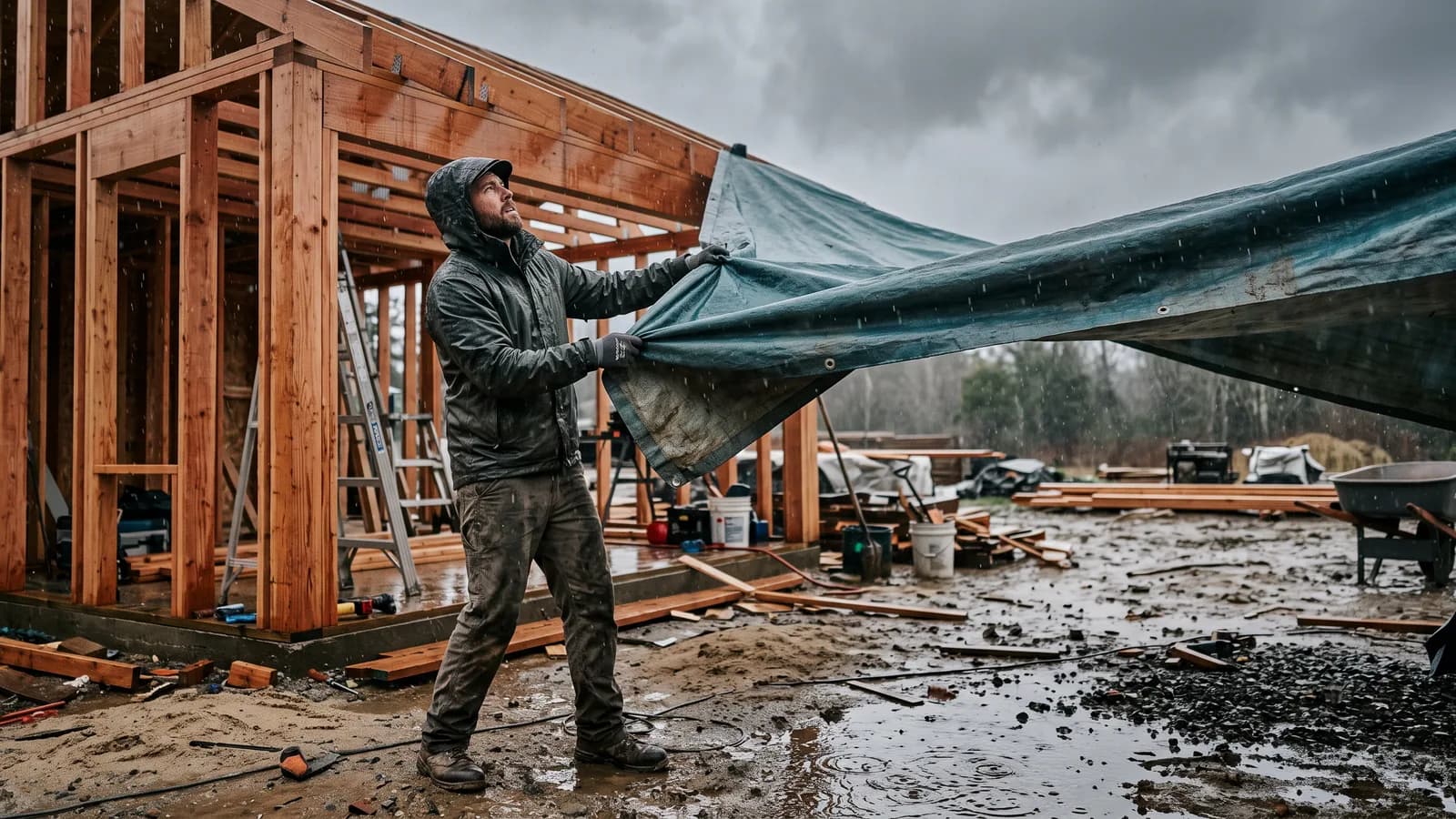
A single-day repair crew can usually reschedule around one bad forecast without the homeowner thinking much of it. A multi-week cabana build carries enough exposure to the calendar that some weather interruption, a rain stretch in spring, extreme heat in the south, or an early frost cutting a northern season short, is close to certain at some point during the project. Communicating the delay before the homeowner notices an empty driveway protects trust far more than explaining it after the fact.
Why Weather Exposure Is Higher on a Multi-Week Build
A structure that takes one day to install has one day of weather risk. A cabana that spans foundation curing, framing, roofing and finish work over three to six weeks has that many separate windows where a forecast can force a change of plans. Foundation pours need a dry window and a minimum temperature to cure properly. Roofing cannot proceed safely in high wind or rain. Painting and staining need specific humidity and temperature ranges to finish correctly. Each of those constraints multiplies the number of days where the schedule is genuinely at the mercy of the forecast, which is simply not a factor most single-day trades ever have to manage mid-project.
Setting Expectations About Weather Before the Contract Is Signed
The best weather communication happens before it is needed. A contract or welcome packet that plainly states typical weather-loss days for the local season, and explains how the crew handles a forecasted delay, prevents the first rain-out from feeling like a surprise. Homeowners who hear “we build in a five to seven day weather buffer for a project this size” during the initial consultation are far more forgiving when that buffer actually gets used than homeowners hearing about weather risk for the first time mid-build.
The Proactive Delay Notification
Once a forecast makes a delay likely, the notification should go out as soon as the crew lead knows, not the morning the crew was scheduled to arrive. A same-day cancellation reads as disorganized even when the underlying cause is entirely outside anyone's control. A notification sent a day or two ahead, once the forecast is reasonably reliable, reads as a builder who is actively managing the project rather than reacting to it.
What to Say Before the Crew Fails to Show
A useful delay message covers three things in order, what the weather is forecasted to do, what that means for the current stage of work, and what the revised plan is. “Rain is forecasted Thursday and Friday, which means we are holding off on the roof deck until conditions dry out, we are planning to resume Monday and will confirm Sunday evening.” That structure answers the homeowner's real question, when will this actually be finished, without requiring them to ask.
Silence is the actual trust killer
A weather delay message also lands differently when it is paired with visible action rather than words alone. Tarping exposed framing ahead of a rain stretch, securing roofing materials staged on site, and covering any electrical rough-in left open all demonstrate that the crew is actively protecting the homeowner's investment during the pause, not simply waiting it out. That protection matters beyond the delay itself, since what each trade is responsible for once the structure is finished starts with how carefully exposed work was handled while the project sat idle. A quick photo of that protective work sent along with the delay notification often does more to reassure a homeowner than the written explanation on its own.
A weather delay rarely affects just one crew, either. A rain-out that pushes framing back a few days also pushes the electrician and roofer scheduled to follow, and each of those trades needs its own updated window, not a vague assumption that they will simply adjust on their own. Confirming the revised date with every affected subcontractor the same day the delay is called, rather than after the fact, keeps the whole sequence from drifting further than the original weather event actually required.
Rebuilding the Schedule After a Delay
A single delay rarely threatens the project on its own, but stacked delays can push a build past the promised completion window, especially late in a short northern season. Rebuilding the schedule after a delay means recalculating the realistic completion date immediately, not waiting until the homeowner asks, and checking whether the delay has any downstream effect on the next project already booked into the backlog. A builder who proactively manages that ripple effect across multiple clients avoids compounding one weather delay into several.
Regional Differences That Affect Weather Risk
Weather risk is not uniform across markets, and the communication plan should reflect that. In much of Canada and the northern United States, the real risk is a short season bounded by frost on both ends, where a lost week in October cannot simply be made up the following month. In the southern United States, summer heat advisories and hurricane season create a different kind of interruption, sometimes safety-driven rather than purely schedule-driven, and crews may need to shift working hours to early morning during peak heat rather than losing the day entirely. A builder working across a wide service radius that spans different microclimates should build separate weather assumptions for each area rather than applying one buffer everywhere.
Ready to talk numbers on your own pipeline?
On the strategy call, we'll lay out the plan we'd run for your business and talk through how it fits your market.
Final thought
Weather delay on a multi-week cabana build is not a failure of planning, it is a predictable feature of a project long enough to have real seasonal exposure built into it. The builders who protect trust through that exposure are the ones who set expectations early, notify proactively before the crew fails to show, and communicate a clear revised plan rather than silence. Handled this way, a weather delay becomes one more example of a well-managed project rather than the moment a homeowner starts to worry.
Tagged