
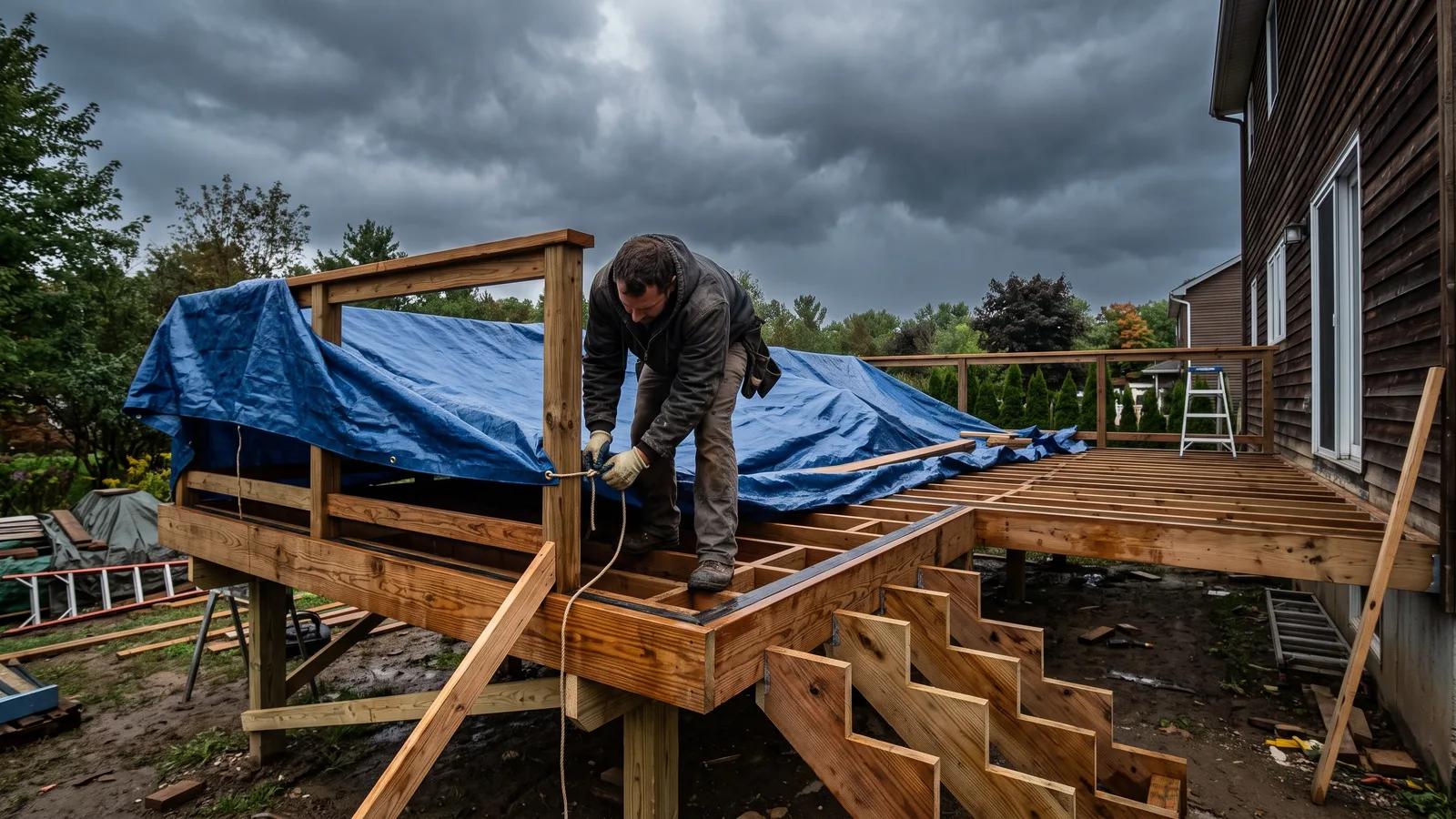
A rained-out deck build is not a surprise to the contractor who has been watching the forecast all week. It is often a surprise to the homeowner who took the afternoon off work to be home for it. The gap between what the crew already knew and what the client finds out, and when, is where a weather delay turns from a normal part of outdoor construction into a frustrated phone call or a review that mentions being left in the dark.
Why decks are more weather-exposed than most renovation work
A kitchen remodel can keep going through a storm. A deck build mostly cannot. Concrete footings need dry conditions to cure properly, lumber that gets soaked before it is sealed can warp or cup, and working at height on wet framing is a real safety problem, not just an inconvenience. Wind matters too, once railings or temporary guards are up, gusty days can push a crew to stand down for reasons a homeowner watching from the kitchen window may not immediately understand. Almost every stage of a deck build, digging footings, pouring concrete, framing, decking, and staining, has its own weather threshold, which means a single storm system can touch the schedule two or three separate times as the project moves through those stages.
What homeowners actually get frustrated about during a delay
Homeowners rarely resent the delay itself once it is explained. Concrete needing to cure without rain is intuitive to most people once they hear it. What generates frustration is finding out about the delay late, or worse, finding out by noticing the crew never showed up. A homeowner who cleared their schedule, moved the dog, or asked a neighbor to watch for the delivery truck feels the silence as disrespect for their time, even when the underlying decision to postpone was completely reasonable.
- Finding out late. A same-morning text after someone has already rearranged their day reads as an afterthought rather than a heads-up.
- Vague timing. “We'll be out when the weather clears” leaves a homeowner checking the forecast themselves instead of trusting the contractor to manage it.
- No revised completion estimate. One delayed day is easy to absorb mentally; three delayed days with no updated finish date starts to feel like the project has stalled entirely.
The delay is not the problem
Building proactive weather communication into the project timeline
The fix is treating weather communication as a scheduled part of the project rather than a reactive scramble. A short message the evening before a forecasted rain day, confirming the crew will not be on site and naming the next likely start window, does more for client patience than almost any other single habit a deck contractor can build. The message does not need to be long. Something as simple as “Tomorrow's rain will push us back a day on the footings, we're watching Thursday as the next dry window and will confirm by Wednesday evening” gives a homeowner something concrete to plan around instead of an open question.
This works best when it is built into the project timeline from the initial consultation, alongside the same sequencing of framing, footings, and finish work that determines crew scheduling in the first place. Setting the expectation early, that outdoor construction includes weather contingency and the office will proactively flag it, means the first delay of the project does not feel like a broken promise. It feels like exactly what was described at signing.
Regional weather patterns worth planning around
Weather risk is not uniform across a deck builder's footprint, and the communication plan should reflect that. A contractor working through a Gulf Coast or southeastern United States summer is planning around sudden afternoon thunderstorms that can interrupt a single day more than once, while a contractor in the upper Midwest or across much of Canada is watching for a hard frost that can delay footing pours well into spring even after the snow itself is gone. Coastal markets on either side of the border add wind as a separate, less predictable variable that can ground a crew even on an otherwise dry day. None of this needs to be complicated to communicate, but it does mean the office should know its own region's seasonal delay patterns well enough to set expectations at signing rather than discovering them mid-project.
Recovering a schedule after multiple delayed days
A single rain day rarely damages client trust. A stretch of three or four delayed days in a row is where patience actually runs out, and where a contractor needs a recovery conversation rather than another one-line update. That conversation should include a revised completion date, an honest read on whether the crew can compress remaining stages once the weather clears, and, where relevant, an acknowledgment that this stretch is affecting the broader crew schedule across other booked projects, not just this one. Homeowners generally accept that a contractor cannot control the weather. What they will not accept quietly is a contractor who seems to have lost track of their project inside a bad-weather stretch. A five-minute call that says plainly “here is where we stand and here is the new target date” resets the relationship far more effectively than silence followed eventually by good news.
Weather delays also interact with the spring rush that most deck builders are marketing into, since a wet spring compresses the same crew capacity that peak seasonal demand is already straining. Building a buffer into quoted start dates during that window, rather than promising a specific day and hoping the weather cooperates, avoids setting an expectation the calendar cannot reliably keep.
Ready to talk numbers on your own pipeline?
On the strategy call, we'll lay out the plan we'd run for your business and talk through how it fits your market.
Final thought
Weather is the one part of a deck build no contractor can control, which is exactly why the communication around it is worth controlling closely. A homeowner who hears about a delay before they discover it themselves, who gets a specific next window instead of a vague promise, and who receives a clear recovery plan after a bad stretch, tends to stay patient through conditions that would otherwise sour the whole project experience. The rain is not the reputational risk. The silence is.
Tagged