
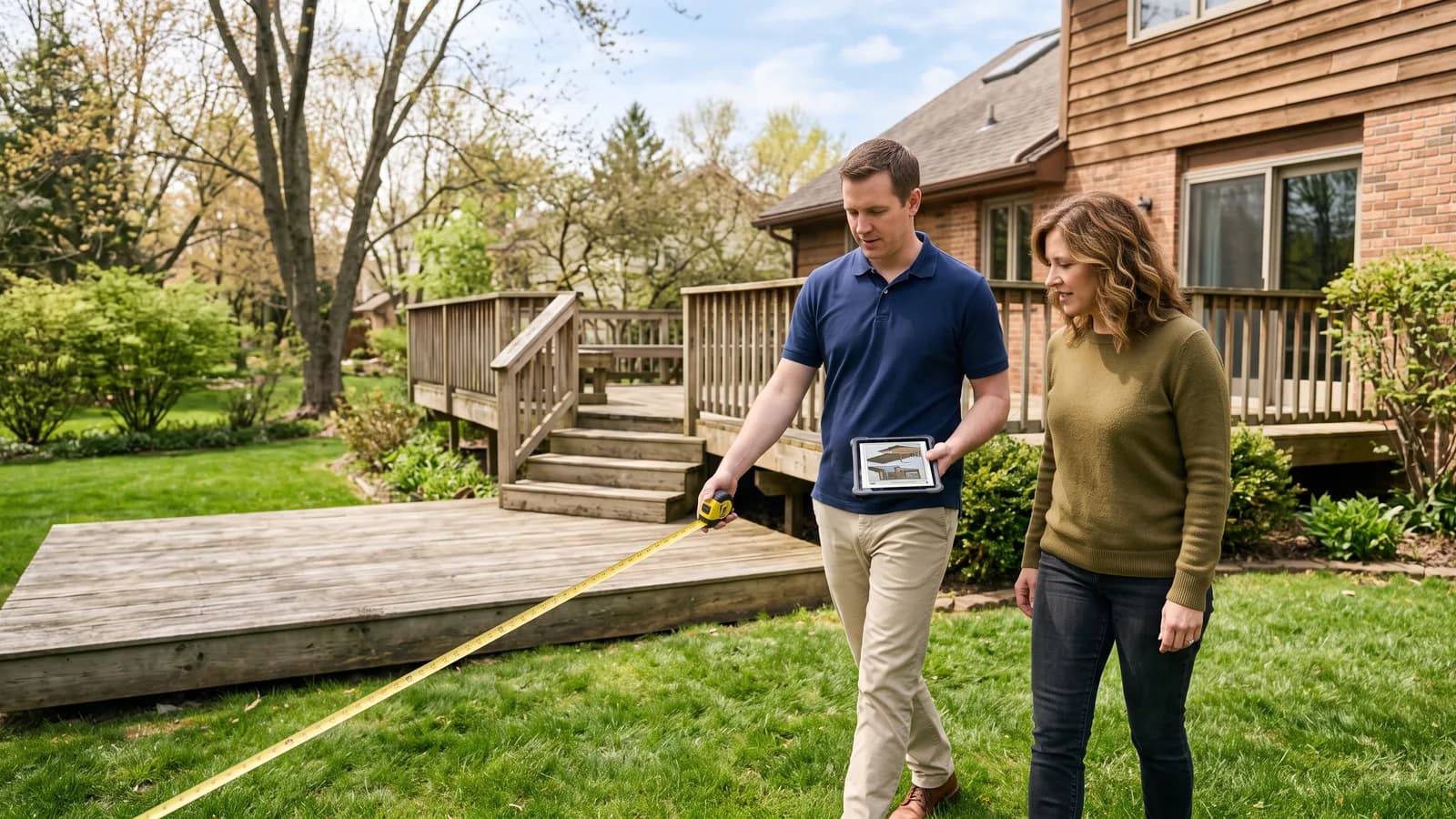
An on-site deck consultation that wanders between measuring, material samples, and pricing in whatever order the homeowner's questions happen to come leaves that homeowner unsure what happens next. The consultation might cover everything it needed to, but without a deliberate sequence, it rarely ends with a clear path to a signed contract.
Why an outdoor consultation has more moving parts than an in-home sale
A deck consultation happens standing on the actual site being built, which adds pieces most in-home sales calls never have to juggle: measuring the space itself, assessing ledger board attachment against the house structure, discussing footing locations relative to property lines and utilities, and walking material samples across the same physical ground the deck will eventually occupy. All of that is happening outdoors, often with the homeowner asking questions the moment something catches their eye, which makes it easy for the visit to lose structure without a rep actively controlling the order. Weather adds one more variable an in-home sale never faces: a consultation that starts under a clear sky can end under a light rain, and a rep working from a fixed sequence can adapt the pace without losing track of what still needs to be covered before the homeowner heads back inside.
A repeatable sequence for the on-site visit
A fixed sequence does not mean a rigid script that ignores what the homeowner wants to talk about. It means a default order the rep returns to after answering a question, so the visit always moves toward a clear conclusion instead of circling the same topics repeatedly.
Measuring and site assessment first
Starting with measurement and site assessment gives the rep something concrete to do with their hands while building rapport, and it produces the real numbers, square footage, height above grade, ledger board condition, that everything discussed afterward depends on. It also signals to the homeowner that the visit is thorough and methodical before a single price is mentioned. This is also the natural point to note anything that will affect the footing plan, a slope across the yard, an existing structure to remove, a buried utility line, so the homeowner hears about it while it is still a planning detail rather than a surprise added to the price later.
Material and design conversation second
Once the space is measured, the material and design conversation has real numbers to anchor against instead of being purely aspirational. Showing composite, pressure-treated, and hardwood samples against the actual measured footprint, and discussing railing and stair options in the context of the real site rather than a showroom, keeps the conversation grounded in what this specific yard can support.
Pricing and next steps last
Pricing comes only after the homeowner has engaged with the design, not before. Presenting a number too early, while the homeowner is still forming an opinion about materials, turns the rest of the visit into a negotiation instead of a design conversation. Ending with a clear next step, whether that is a written estimate by a specific date or a signature on site, prevents the visit from trailing off into a vague “we'll be in touch.”
Order protects the close
Handling interruptions to the sequence without losing control
Homeowners will ask about pricing during the measurement phase or bring up materials before the tape measure comes out, and that is normal. The skill is answering briefly and returning to the sequence rather than abandoning it: “Great question, I'll walk you through pricing once we've confirmed the exact footprint, let's finish measuring first.” That single redirect keeps the visit on track without making the homeowner feel brushed off. Permit and inspection questions often surface early too, and briefly addressing the process before returning to measurement keeps that concern from derailing the rest of the visit.
Training reps to run the same structure consistently
A sequence only protects close rates if every rep runs it the same way, which means training has to go beyond handing someone a script and expecting consistency. Role-playing the redirect moments, practicing how to acknowledge a cash-flow hesitation without abandoning the sequence, and reviewing recorded or shadowed visits against the structure all reinforce the habit. Consistency across a team also makes it far easier to diagnose where a specific rep's close rate is falling short, since every visit is being measured against the same repeatable structure rather than a different improvised order each time. New reps benefit from shadowing an experienced rep through the full sequence at least a few times before running one solo, since reading about the order in a training document lands very differently than watching a redirect happen smoothly in real time, mid-conversation, with an actual homeowner standing there.
Ready to talk numbers on your own pipeline?
On the strategy call, we'll lay out the plan we'd run for your business and talk through how it fits your market.
Final thought
A deck consultation has more physical and structural pieces to cover than most in-home sales calls, which is exactly why it needs a deliberate order rather than an improvised one. Measure first, talk material and design second, present pricing and a clear next step last, and train every rep to return to that sequence after any interruption. A well-qualified appointment run through a consistent structure, described in more detail on how the program actually works, is what turns a good visit into a signed contract instead of a homeowner who says they need to think it over. The structure does not make the rep less human, it just makes sure every homeowner gets the same thorough, organized visit regardless of which rep happens to show up at their gate.
Tagged