
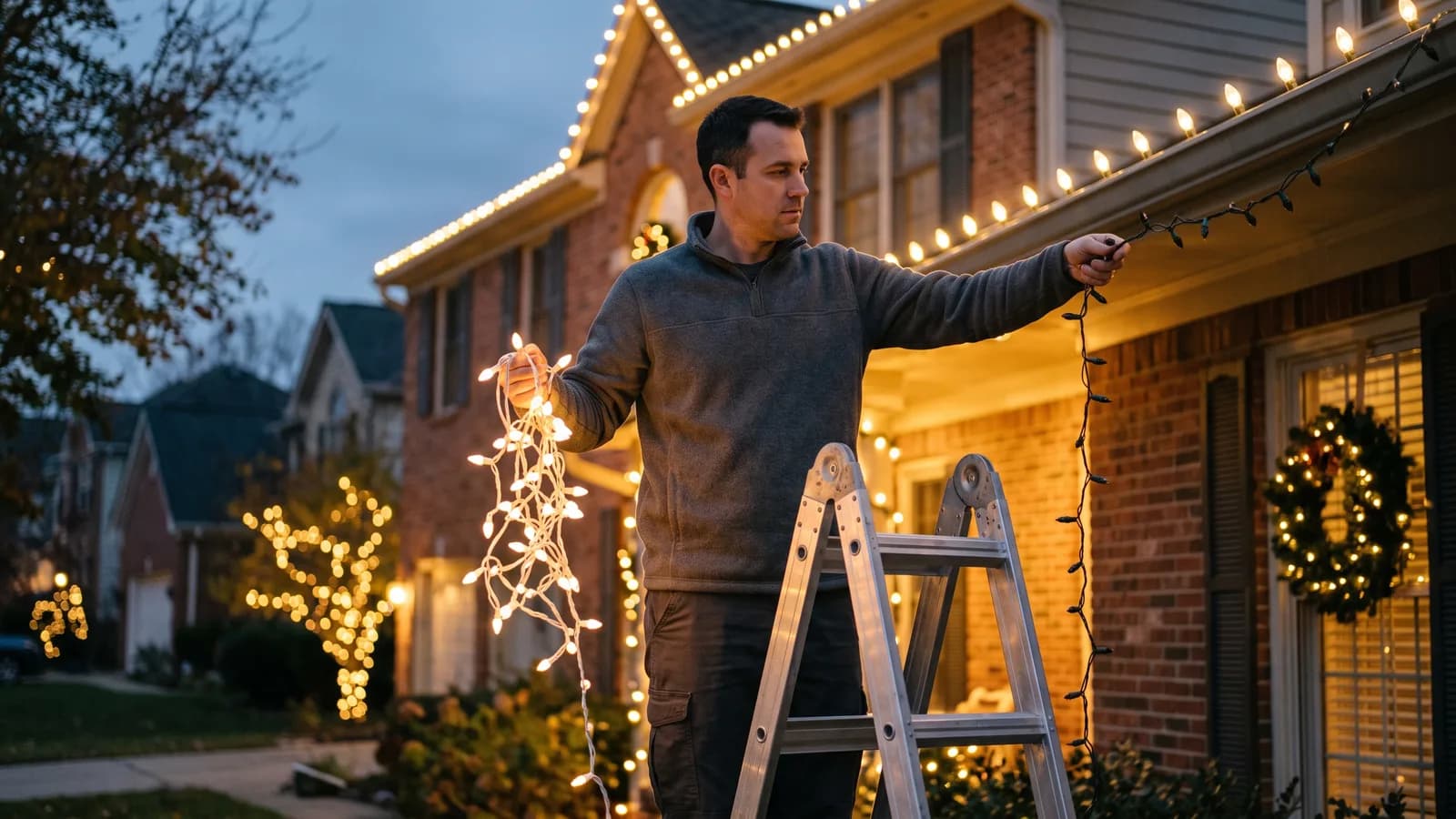
A holiday lighting install is not a one-and-done exterior project. It has to keep looking good for weeks after the crew leaves, through wind, storms, and ordinary bulb failure. A clear warranty policy and a fast mid season service response protect the display's appearance and the company's reputation at the same time, since every day a section sits dark is a day the customer's neighbours see it that way too.
What a fair holiday lighting warranty should and should not cover
A workable warranty draws a clear line between defects in the install itself and the ordinary wear a display experiences over a season outdoors. Covered under a standard warranty: workmanship issues like a clip that was not properly secured, a connection that was not sealed against moisture, or a controller that was not configured correctly at install. Typically excluded: damage from a third party, such as a landscaping crew or a delivery driver clipping a strand, damage from severe weather beyond ordinary wind, and normal bulb burnout that happens on any string light product left running for weeks at a time.
Writing this distinction into the install agreement in plain language, rather than leaving it implied, avoids the awkward conversation that happens when a homeowner assumes every outage is automatically covered. A short, specific list at signing sets the expectation before anything actually goes dark, the same document is also a natural place to confirm any permit or homeowner association rules that a mid season repair visit will still need to respect.
Why response time on a service call matters more here than in other trades
In most exterior trades, a minor defect can wait a week or two without much consequence. Holiday lighting does not have that luxury. A dark section sits in front of the same neighbours who were admiring the display days earlier, and the longer it stays that way, the more the lapse becomes the thing people notice about the job instead of the display itself. A homeowner who waits a week for a callback while a visible section stays out is far more likely to mention that delay to a neighbour than to mention how good the display looked before the outage.
Because the season itself is short, a response window that would be reasonable in another trade, a few business days, effectively eats a meaningful share of the display's total run time. Most companies that handle this well commit to a specific response window, commonly forty eight hours or less during the active season, and treat that window as a hard operational standard rather than a best effort goal.
Diagnosing bulb, timer, and connection failures quickly
Fast response only helps if the technician arriving can diagnose the problem quickly once on site. Most mid season failures fall into three categories, and training a service technician to check them in order shortens the average call considerably: a single bulb or short segment failure, usually isolated to one strand and fixed by a direct swap; a timer or controller issue, often the actual cause behind what looks like a full section outage, since a reset or misconfigured schedule can appear identical to a wiring failure from the ground; and a loose or weather-affected connection point, typically at a splice or a plug exposed to moisture. Working through diagnosis in that order, simplest and most common first, keeps most service calls short instead of turning into an unplanned re-hang of an entire section.
Storm damage versus normal wear in a warranty conversation
Storm damage deserves its own conversation because it sits in a gray area many homeowners do not distinguish from a normal warranty issue. A strand knocked loose by sustained high winds or an ice storm is a weather event, not a workmanship defect, and treating every post-storm call as automatically covered sets a precedent that becomes expensive across a full customer base. At the same time, refusing to help at all after a storm damages goodwill in a way that outlasts the season. The practical middle ground most companies land on is covering labor to re-secure existing material at a reduced or flat service rate after a storm, while treating replacement of material that was actually destroyed as a separate, billable repair. Setting expectations for this ahead of time, alongside broader weather contingency planning for the install season itself, keeps the storm conversation calm rather than adversarial when it actually happens.
Document storm damage before repairing it
Pricing service calls that fall outside the warranty
Not every service call is covered, and pricing the ones that are not needs to be simple enough to quote on the spot rather than negotiated case by case. A flat service call rate covering a technician visit and minor repair, with a clearly stated threshold for when a job escalates to a full material replacement charge, keeps this predictable for both sides. Homeowners tend to accept an out-of-warranty charge far more easily when the rate was disclosed at signing rather than introduced for the first time on the day the technician shows up.
- State the flat rate at signing. Include it in the install agreement alongside the warranty terms, not as a surprise line item later.
- Bundle a same-day dispatch option. Some homeowners will pay a premium for faster response, which can offset the cost of keeping technicians available during peak weeks.
- Route after-hours calls to a reliable intake. A round the clock receptionist option keeps a homeowner calling about a dark section from reaching voicemail during the exact weeks when service call volume peaks.
Ready to talk numbers on your own pipeline?
On the strategy call, we'll lay out the plan we'd run for your business and talk through how it fits your market.
Final thought
A holiday lighting warranty only does its job if it is specific enough to set expectations before anything breaks and paired with a response standard fast enough to matter during a short season. Draw a clear line between workmanship and ordinary wear, commit to a real response window, train technicians to diagnose the common failures quickly, and price the out-of-warranty calls plainly. Handled this way, a service call becomes a chance to reinforce trust rather than a moment that undoes weeks of good will.
Tagged