
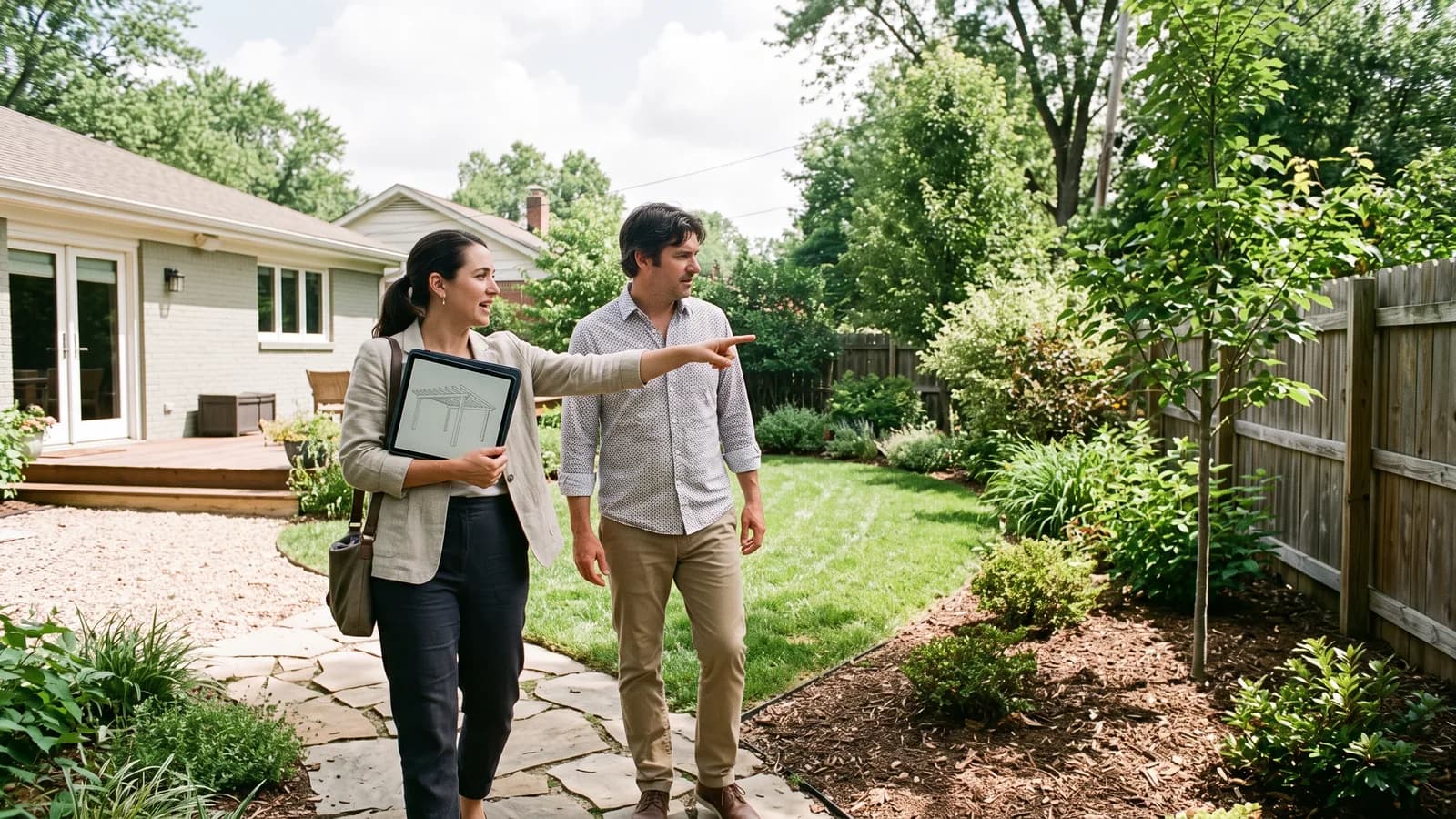
A rep who walks a homeowner through every material option, every roof style, and every accessory in no particular order leaves the buyer with more choices than clarity. The on-site visit works better as a sequence of decisions that narrow one into the next, placement, structure, roof, and accessories, until a real design and a real number exist by the time the rep packs up.
Why the on-site visit is where pergola sales are decided
Pergolas sit in a wide decision space. Attached or freestanding, cedar or aluminum or hardwood, a standard fixed roof or a louvered motorized one, and then a whole second layer of screens, lighting, and heaters on top of that. Presented as an open menu, that width feels overwhelming rather than like genuine choice, and a buyer facing too many open questions at once tends to default to “let me think about it” simply because nothing has been resolved yet. A structured walkthrough turns the same width into a manageable sequence instead of a wall of options.
This matters more for pergolas than for a trade with a narrower product line. A window replacement visit mostly confirms measurements and a style already chosen online. A pergola visit is often where the actual design gets built from scratch, which means the structure of the conversation carries more of the weight for whether the visit ends in a decision at all.
What to confirm before the rep ever measures anything
The strongest walkthroughs start by confirming, out loud, what was already established during intake, rather than re-asking questions the homeowner already answered on a form or a phone call. A rep who opens with “so this would attach along the back of the house, and you mentioned wanting it usable into the evening, does that still sound right” signals that the visit builds on real preparation. This is exactly the groundwork covered in qualifying a lead before the visit happens, and skipping it forces the walkthrough to start from zero instead of from a confirmed starting point.
Structuring the walkthrough around decisions, not features
The four decisions worth sequencing are placement and orientation, structure type, roof style, and accessories, in that order. Placement comes first because it constrains everything downstream, an attached structure along a specific wall rules out certain roof configurations that a freestanding one in open yard would not. Structure type comes next because it sets the budget range the rest of the conversation operates inside. Roof style follows, since a standard fixed roof and a motorized louvered one carry genuinely different price points and timelines. Accessories come last, once the buyer has a concrete structure in mind to attach them to rather than an abstract one.
Each decision should feel resolved before the next one opens. Jumping ahead to discuss lighting placement before the roof style is settled forces the buyer to hold too many open variables in their head at once, and that is usually where the visit starts to drift.
- Placement and orientation. Where the structure sits, and which way it faces relative to the sun and the house, decided by walking the actual yard rather than guessing from a photo.
- Structure type. Attached or freestanding, and cedar, aluminum, or hardwood, chosen once the placement makes the tradeoffs concrete instead of abstract.
- Roof style. A standard fixed roof or a louvered, motorized one, priced and explained now that the buyer knows what structure it sits on top of.
- Accessories. Screens, lighting, and heaters, discussed last against a design the buyer can already picture clearly.
Imagine two reps running the same forty-five minute visit. One bounces between roof samples and accessory brochures while the buyer is still deciding where the structure should even sit. The other resolves placement first, then structure, then roof, then accessories, each step visibly building on the last. Both reps cover the same information by the time they leave, but only one of them leaves with a buyer who can restate exactly what was decided and why.
Closing the visit with a clear next step
A walkthrough that ends with four resolved decisions naturally ends with a real number and a real next step, not a vague promise to follow up. The rep already knows the structure, the roof, and whatever accessories were chosen, which means the quote or the quoting timeline can be stated with confidence rather than hedged. That confidence matters directly when a buyer later mentions they are comparing three quotes, since a specific, well-reasoned proposal is harder to shop against than a generic one built from an unfocused visit.
A resolved visit produces a real quote
Handling a second decision-maker who was not present
Sometimes only one spouse or partner is home for the visit, and the four-decision structure actually helps here too. Instead of leaving the absent decision-maker with a scattered set of impressions to relay secondhand, the present buyer can walk them through four specific, resolved choices, which is a far easier conversation to have at the kitchen table that evening than trying to reconstruct an open-ended tour from memory. Following up with a clear recap of those same four decisions, rather than a general summary, keeps the absent decision-maker just as informed as if they had been standing in the yard. That same discipline carries into how the follow-up cadence should be built for any buyer still working through a decision after the visit ends.
Ready to talk numbers on your own pipeline?
On the strategy call, we'll lay out the plan we'd run for your business and talk through how it fits your market.
Final thought
A pergola walkthrough does not need fewer options to feel less overwhelming, it needs a clearer order. Sequencing placement, structure, roof, and accessories as four decisions that each build on the last keeps the visit moving toward a number instead of a vague promise to think it over, and it gives a buyer something concrete to relay to anyone who was not there to see it firsthand.
Tagged