
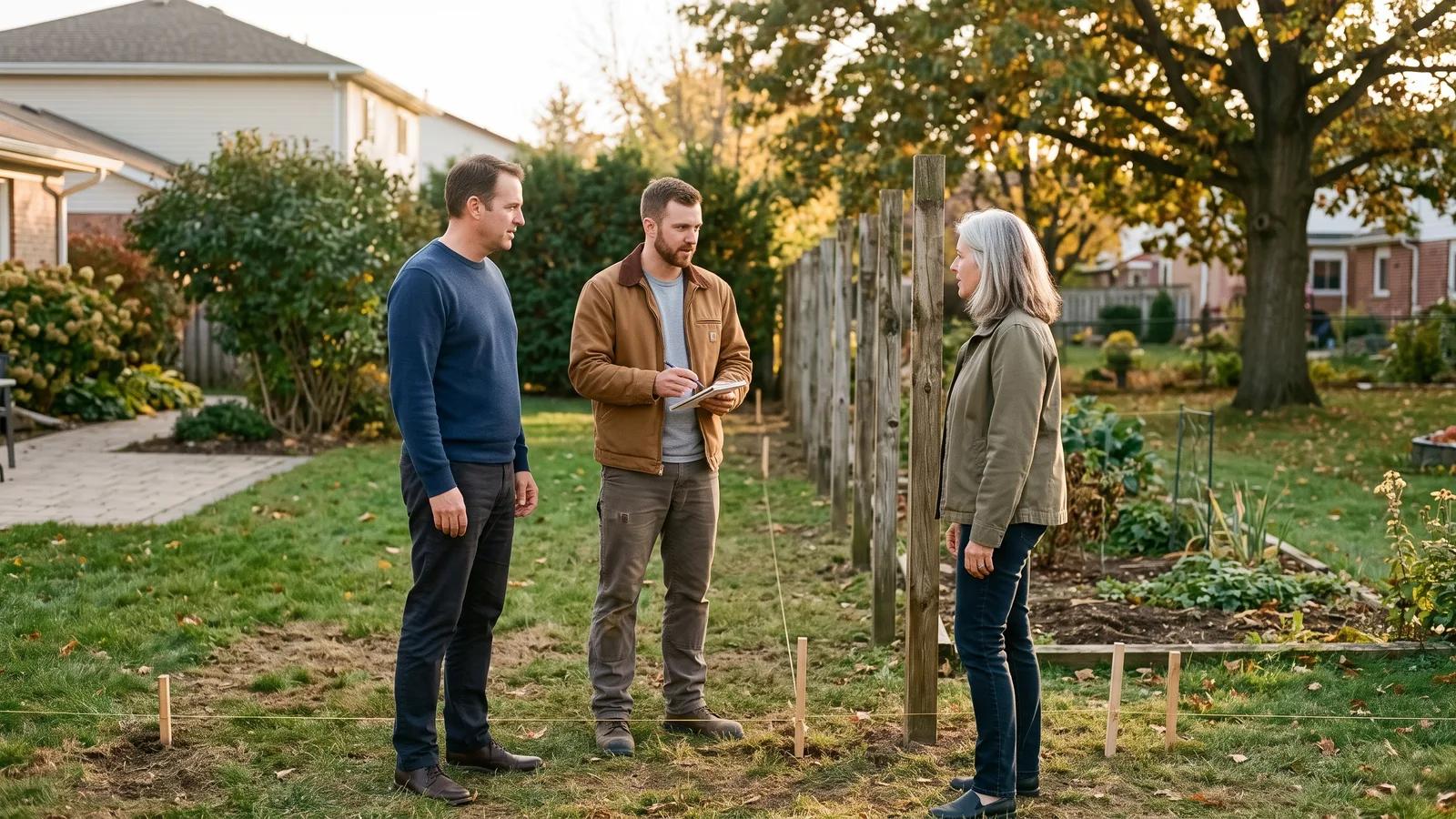
When a fence sits directly on a shared property line, the homeowner who calls in the lead is rarely the only person with an opinion about the style, the height, or who is paying for it. That structural fact shapes the entire sales process for a shared-line job in a way most trades never have to plan around. The contractor is not a mediator between two households, but a sales process that ignores the neighbor entirely tends to run into a stall right before the contract is signed instead of right at the start, where it is far easier to handle.
Why a shared property line makes this a two household decision
A fence built exactly on the boundary line is, by most local conventions, jointly owned and jointly the responsibility of both households, whether or not either homeowner has thought about it that way. That means style, height, and material are not purely the paying customer's call the way they would be for a fence set entirely inside one property. A neighbor who objects to a design after installation has already started is a genuinely difficult problem, far harder to resolve than raising the same question during the first phone call. Local convention on shared-line responsibility also varies enough, by city, by province, by state, that a sales team should not assume the same default applies everywhere the business operates, which is one more reason to ask rather than guess.
Raising the shared-line question during the first conversation
The simplest fix is asking directly, early: is this fence on a shared line, and has the neighbor been part of the conversation yet. A homeowner who has already talked to the neighbor and has informal agreement can move straight to design and pricing. A homeowner who has not yet raised it benefits from a nudge to do so before, rather than after, a design gets finalized, since a neighbor who feels informed from the start is far less likely to object later.
Staying neutral without becoming the mediator
The contractor's role here is narrow and worth keeping narrow. Providing a written estimate either household can share, being available to answer material or design questions from either side, and staying out of any disagreement about who should pay what share, keeps the business relationship clean. The moment a contractor starts advocating for one household's preference over the other's, the business risks being pulled into a dispute that has nothing to do with the fence itself.
A simple written cost sharing agreement both households can sign
When two households do agree to split the cost, a short written agreement, even a half-page document, protects everyone involved. It should note the total cost, the agreed split, the material and design both parties approved, and a signature line for each household. This is not a legal contract between the neighbors that the contractor drafts on their behalf, it is a simple record that prevents the far more common problem of one household remembering the agreed split differently than the other does once the invoice arrives. It is worth invoicing each household separately for its agreed share rather than collecting one payment from the paying homeowner and leaving the neighbor reimbursement to be sorted out between the two of them, since that habit is where cost sharing agreements most often quietly fall apart after the fence is already built.
Keep the paperwork simple
What to do when the neighbor will not engage
Sometimes the neighbor simply will not respond to calls, texts, or a note left at the door. Rather than letting the project sit indefinitely, setting a clear deadline with the paying homeowner, a date by which the project proceeds regardless of whether the neighbor has weighed in, keeps things moving. Where the fence is being built entirely on the paying household's side of a confirmed property line rather than directly on the boundary, the neighbor's agreement is a courtesy rather than a requirement, and the sales team should know which situation applies before promising a specific date.
A brief, friendly note left with the neighbor, or a short call from the paying homeowner explaining the plan and the deadline, usually resolves the silence faster than repeated contact from the contractor would. Neighbors are often simply slow to respond rather than opposed to the project, and a low-pressure heads-up is frequently all it takes to get a reply within a few days.
Keeping the primary customer's project moving regardless
A non-responsive neighbor should never become the reason a paying customer's project stalls indefinitely. The material selection process can proceed on schedule, and if cost sharing does not materialize, the quote simply reverts to the original household covering the full price, a scenario worth mentioning upfront so it is not a surprise later. This also connects to how material cost changes get communicated, since a delayed decision while waiting on a neighbor can push a project into a different pricing window than the one quoted.
Ready to talk numbers on your own pipeline?
On the strategy call, we'll lay out the plan we'd run for your business and talk through how it fits your market.
Final thought
A shared property line does not have to slow down a fence sale, but it will if the neighbor conversation gets ignored until it becomes a problem. Raising the question early, staying neutral rather than becoming a mediator, putting any agreed split in writing, and setting a deadline for a neighbor who will not engage keeps the paying customer's project on schedule while still handling the two-household reality of a shared fence line honestly.
Tagged