
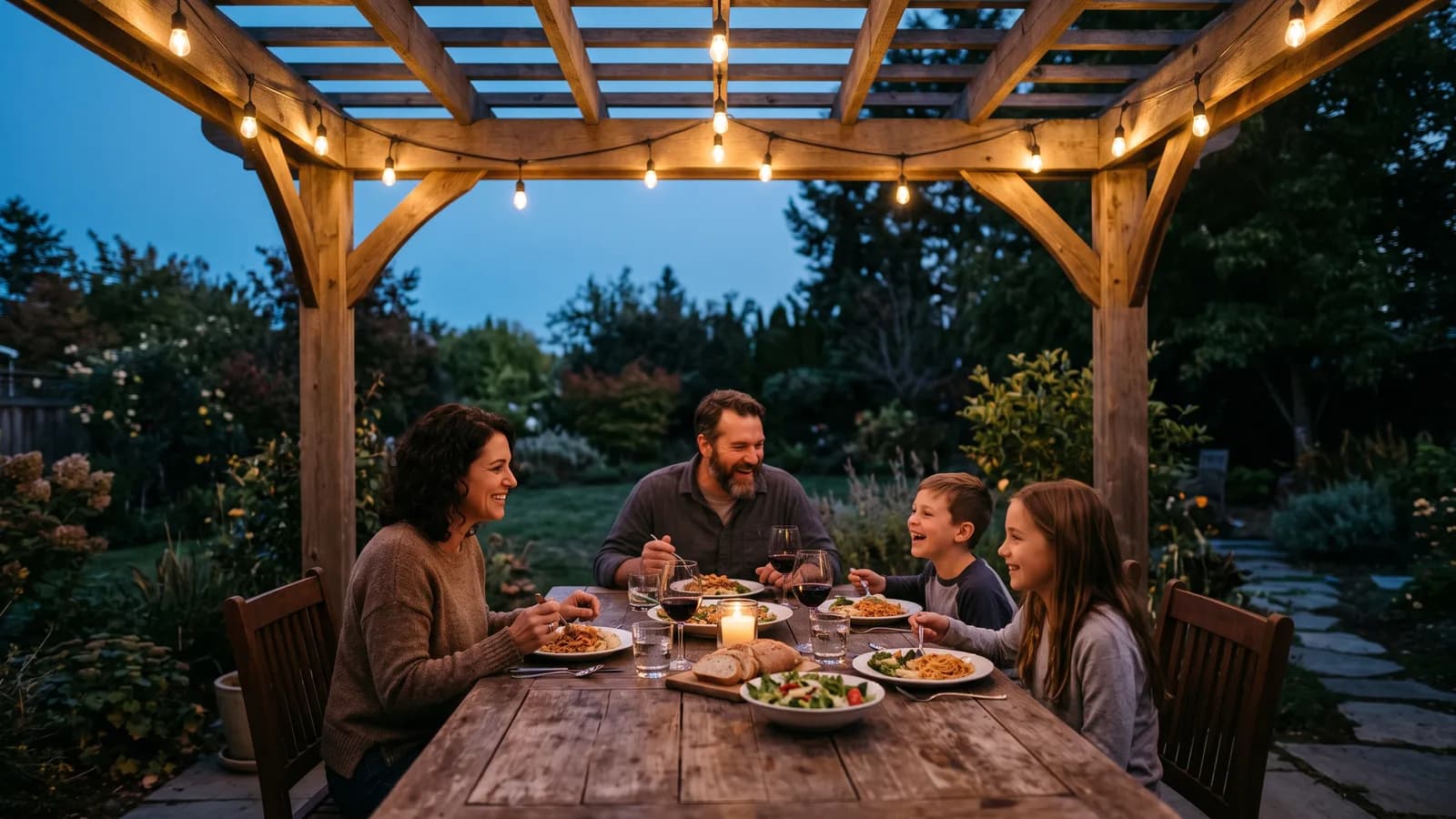
Someone scrolling Meta is not searching for a structure. They are picturing an evening, dinner outside with friends, a quiet coffee before the day starts, a backyard that finally gets used instead of walked past. Creative that opens with a lifestyle moment earns a stop far more often than creative that opens with a spec sheet, and for a pergola specifically there is real material, lighting, shade, a motorized roof closing over a table, that makes this an easy story to tell well.
The mistake most dealers make is starting the creative brief with the product instead of the moment. A brief that opens with specifications, roof style, material options, dimensions, produces an ad that reads like a spec sheet even when it is dressed up with nice photography. A brief that opens with the evening being sold, who is sitting at that table, what time of day it is, what they are doing, tends to produce creative that actually earns attention from someone who was not thinking about pergolas at all thirty seconds earlier.
Why lifestyle sells before the product does on Meta
A cold audience has not asked for information about pergolas, they have not searched anything and are not comparing options. The only job of the first two seconds of an ad is to make someone stop scrolling, and a shaded dinner table at dusk does that more reliably than a daytime photo of an empty structure against a fence line. Once someone stops, the pergola can do its job as the setting for that moment rather than the subject of the ad, which mirrors how the actual buying decision tends to start, with a feeling about the backyard, not a spec.
Creative angles that work for pergolas specifically
- Evening dinner under lighting. A table set for a family meal with integrated string lights or post lighting glowing against a dusk sky reads as an aspirational, attainable moment rather than a product demonstration.
- A motorized roof closing in real time. Footage of louvers rotating shut as weather turns communicates a genuine product benefit inside a lifestyle scene, rather than as a standalone feature callout.
- Morning coffee in dappled shade. A quieter, slower moment that appeals to a different part of the audience than the entertaining angle, worth testing as a separate variant rather than assuming one lifestyle angle covers everyone.
- A kids' space that stays cool. Shade as a practical parenting benefit, not just an aesthetic one, resonates with a segment of the audience the entertaining-focused creative does not reach.
- A weather-adaptive close. A short clip showing a sudden rain shower with the louvered roof already sealed and the family still seated comfortably underneath tells a genuinely useful story about year-round use that a fixed-roof structure cannot claim.
Sequencing lifestyle creative into product-specific retargeting
Once someone has engaged with a lifestyle ad, clicked through, or spent time on a landing page, the retargeting sequence can shift toward material and configuration detail, cedar against aluminum, attached against freestanding, the louvered roof upgrade closed for rain versus open for sun. That detail would have been wasted on a cold audience that had not yet decided they wanted a pergola at all, but it is exactly what a warmer audience is trying to evaluate. Where that visitor lands after the ad matters as much as the ad itself, the same visibility work that captures earlier search intent should feed the same landing page logic, matching content to how decided the visitor already is rather than sending everyone to one generic page. That same logic runs the other direction too, matching the call to action to how far along a search visitor is is the same discipline the ad sequence is applying to a scrolling audience instead of a searching one.
Seasonal creative refreshes that match the buying calendar
Lifestyle creative shot once in early summer will feel stale by the time fall messaging needs to run. A spring refresh should lean into the entertaining season ahead, while fall creative can lean into decisiveness, a family gathering that needs to move outdoors before it gets too cold, and the shorter timeline that a fall buyer typically has to work with. Reshooting or at minimum recutting creative each season keeps the ads feeling current rather than like stock footage recycled from a prior year.
Match creative to the offer, not just the season
Where product-detail creative still earns its place
Detail-focused creative is not useless, it simply belongs later in the sequence. A close shot comparing cedar grain to a powder-coated aluminum finish, or a short clip of a louvered roof operating, answers real questions for someone already deciding between options. Running that same detail shot as a cold-audience opener usually underperforms because it assumes a level of interest the viewer has not reached yet, which is also why how fast a lead gets a response once they convert matters just as much as the creative that got them there in the first place, since a strong ad sequence that ends in a slow callback still loses the booking.
A useful rule for sequencing is to ask what question the viewer is actually holding at that point in the funnel. A cold viewer is asking whether this is even something they want, which lifestyle creative answers. A retargeted viewer who already clicked through once is asking which specific option fits their yard and budget, which detail creative answers. Running the wrong creative for the question a viewer is actually asking wastes spend regardless of how well either piece was produced on its own.
Ready to talk numbers on your own pipeline?
On the strategy call, we'll lay out the plan we'd run for your business and talk through how it fits your market.
Final thought
A cold audience responds to a feeling before it responds to a feature, and a pergola gives a dealer genuine material, light, shade, a roof that closes, to build that feeling honestly rather than manufacturing it. Save the material comparisons and configuration detail for the audience that has already shown interest, and let the first impression do what it does best, make someone picture their own backyard instead of reading a spec sheet for someone else's.
Tagged