
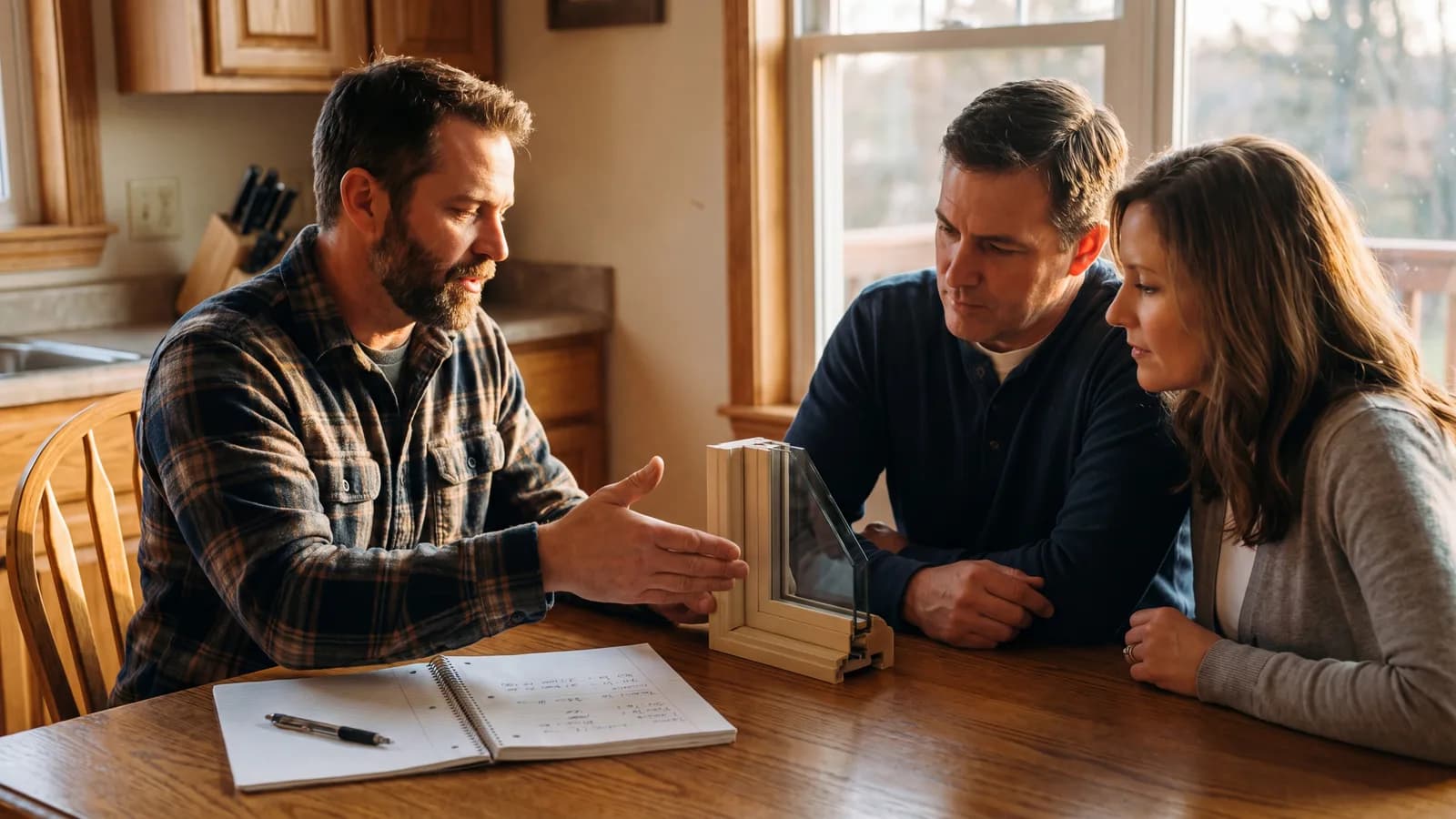
The contractors with 35-45% in-home consultation close rates run a discernible script architecture. The contractors at 15-25% are improvising, saying useful things in the right order most of the time, but with no consistent stage structure that produces predictable outcomes. The difference between those two close rates is the difference between a profitable business and one running in place. Below is the architecture that consistently produces the higher close rate for residential window & door replacement.
The 8-stage architecture
A converting in-home consultation flows through 8 distinct stages. Each has an objective, a transition signal, and common failure modes. Skipping or scrambling stages compresses close rate. Following the architecture exactly, even when it feels mechanical, produces the volume.
Stage 1: Pre-call confirmation (24h before)
Objective: reduce no-shows, set expectations, identify decision-makers in the home.
Day before: text + email confirming the appointment, who will attend (rep name), what to expect (45-60 minutes, measurements, sample case), and a single confirming question: “Will both decision-makers be home?” That last question recovers 10-15% of would-be spouse-not-present consultations. Pre-qualification covered here.
Stage 2: Greeting + frame-set (first 5 minutes)
Objective: establish trust, set the agenda, get permission to take measurements and ask questions.
The frame-set is critical and most reps skip it: “What I'll do over the next 45 minutes is take measurements of every window, ask you about how you use the space, walk you through three or four product options, and put a written scope and quote together. I'm not going to pressure you, at the end you can take the proposal, sign it, schedule a follow-up, or tell me you're shopping elsewhere. Sound good?”
That permission frame removes the “here comes the sales pitch” cognitive defense and replaces it with a cooperative posture.
Stage 3: Discovery walk (15-25 minutes)
Objective: understand pain, motivation, and constraints, and gather measurements simultaneously.
Walk the home window-by-window. Ask:
- How long have you lived here? (sets up “decision urgency”)
- What's the main reason you're thinking about new windows? (problem articulation)
- What's the room you spend the most time in? (anchors highest-value windows)
- Have you replaced windows here before? (sets context for prior experience)
- When are you hoping to have this done? (timeline check)
- Have you gotten quotes from other companies yet? (competitive context)
The discovery walk is the most-skipped stage and the most leverage. Reps who shortcut to product-pitch lose the emotional context that drives pricing acceptance.
The single highest-leverage discovery question
Stage 4: Education (10-15 minutes)
Objective: establish expertise, differentiate from low-end competitors, set the buying criteria the homeowner will use.
Walk through the spec differentiators that matter, frame material, glass package (low-E, gas fill, spacers), warranty terms, install quality. The goal isn't to lecture; it's to give the homeowner a buying framework that favors quality over price-only competitors.
Done well: 7-10 minutes, samples in hand, focused on the 3-4 decisions that actually drive long-term homeowner satisfaction.
Done badly: 25-minute lecture covering every spec detail, homeowner glazes over, you've spent your buyer's attention budget on engineering trivia.
Stage 5: Solution presentation (8-12 minutes)
Objective: match the discovered problem to the recommended scope.
“Based on what you told me about the cold rooms upstairs, the energy bill, and the timeline, here's what I'd recommend for your home: [scope]. Three-tier option structure, the foundation that solves the core problem, the recommended that adds [value], and the premium that includes [add-ons]. I'll explain each.”
The three-tier structure (good/better/best) consistently outperforms single-option presentation. Most homeowners anchor in the middle.
Stage 6: Pricing presentation (5-8 minutes)
Objective: present numbers without losing the emotional commitment built in earlier stages.
Order matters: full investment number first, then financing options, then any current promotions. Don't bury the full number, burying it signals you think it's a problem, which the homeowner then assumes too.
“The full investment for the recommended option is [number]. Financing is available, most clients use 36 or 60 months at [rate], which works out to [monthly]. We have a manufacturer rebate running through [date] that takes [number] off the total if you decide today or this week.”
The financing-monthly-payment lever
Stage 7: Trial close + objection handling (5-15 minutes)
Objective: surface objections, address them, ask for the close.
Trial close question: “Other than thinking about the investment, is there anything else holding you back from moving forward today?”
Whatever the answer, that's the real objection. Address it honestly. Common objections and patterns:
- “Need to think about it” → covered in detail here.
- “Need to talk to my spouse” → identify whether that's real or a polite stall.
- “Want to get more quotes” → respect it, ask what they're comparing on, offer to be present at the comparison.
- “Timing isn't right” → uncover what would make timing right.
Stage 8: Close + next steps (5 minutes)
Objective: sign or schedule the next defined action.
If signing: walk through the contract, payment schedule, installation timeline. Set the homeowner up for a confirmation call from operations within 24 hours.
If not signing today: define a specific next step. Not “let me know.” A specific next call: “I'll call you Thursday at 2pm to answer any questions that come up after you've had a couple days to think.” Calendar the call. Send a confirmation text. Most quoted- but-not-yet-signed jobs are won or lost in the structured follow-up. Pre-qualification + structured follow-up here.
The transition signals between stages
A working script transitions cleanly. Some signals that the rep is ready to advance:
- Discovery → Education: the homeowner has explicitly named their problem and the urgency.
- Education → Presentation: the homeowner is asking spec-related questions ungiven (signal of buying mode).
- Presentation → Pricing: the homeowner has visibly anchored on a tier (touching samples, asking specific questions).
- Pricing → Trial close: the homeowner has not raised an immediate objection to the dollar number.
- Trial close → Close: the homeowner has answered the trial close question.
The training problem
Implementing this script architecture across multiple sales reps is harder than building it. Reps revert to their prior habits under pressure. The contractors who get this right:
- Document the script architecture in a written playbook (not just verbal training).
- Run weekly role-plays in the first 60-90 days of any new rep.
- Record at least one consultation per rep per week and review against the architecture.
- Tie compensation to leading-indicator behaviors (stages completed, transitions clean) not just close rate outcomes.
35-45%
In-home close rate that becomes achievable for a residential window contractor running a structured 8-stage script. Reps without script architecture typically run 15-25%.
Ready to talk numbers on your own pipeline?
On the strategy call, we'll lay out the plan we'd run for your business and talk through how it fits your market.
Final thought
The in-home consultation is the highest-stakes 60 minutes in your business. A structured script doesn't make the rep robotic, it gives them a stable scaffold to be present, listen, and adapt within. The contractors who professionalize this single hour outperform their competitors disproportionately, because most competitors leave it to improvisation. Document the architecture. Train to it. Measure against it. Watch the close rate compound.
Tagged