
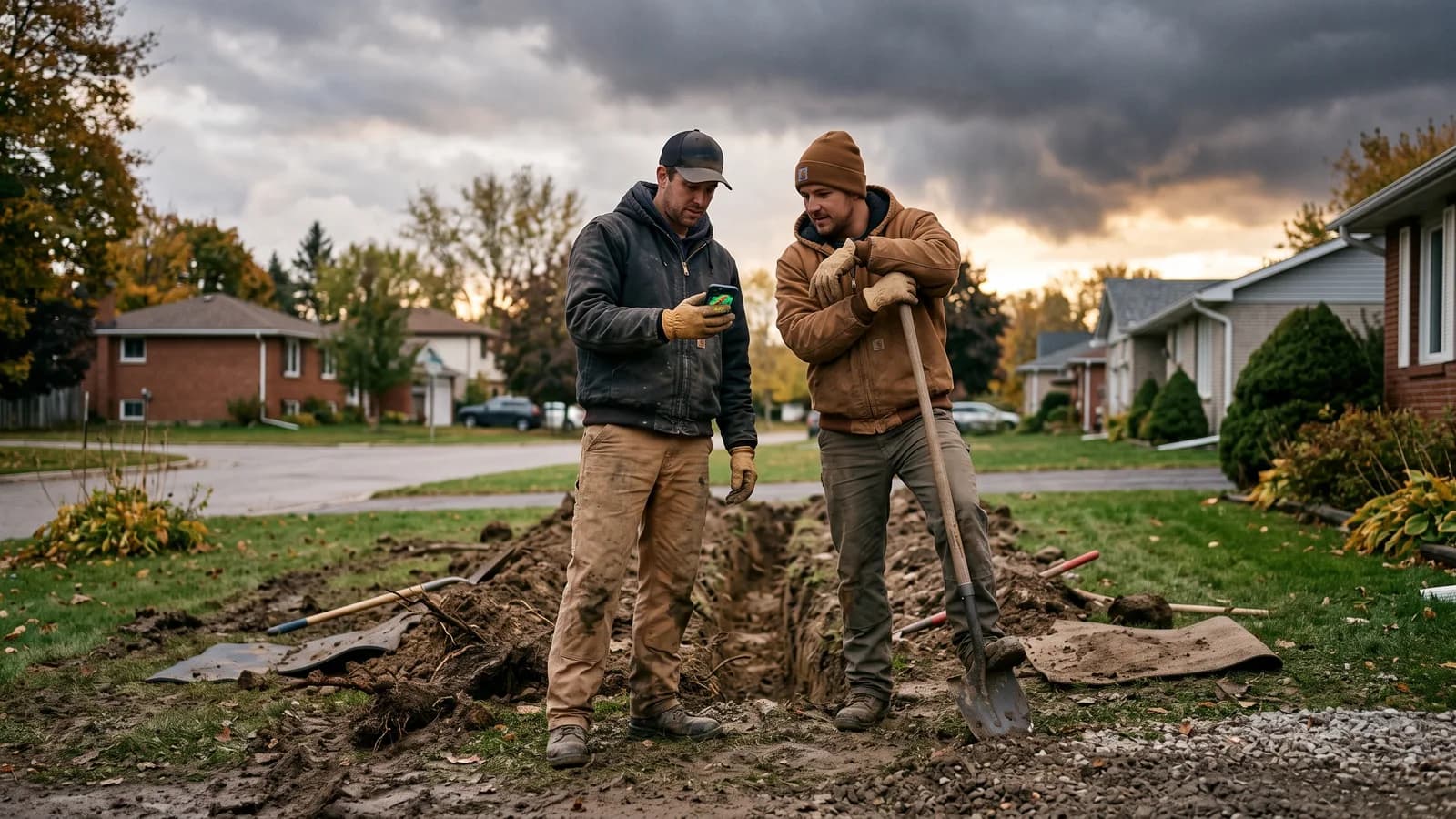
Trenching for low-voltage cable runs is straightforward work right up until the ground freezes, at which point it becomes impossible without specialized equipment most companies do not carry. Rain adds a shorter-notice constraint of its own, since a trench left open near a home's foundation during a downpour is a liability problem, not just an inconvenience. A schedule that treats weather as a planning input from the start, rather than a surprise discovered mid-project, protects both the calendar and the crew that has to work through it.
Why frozen ground is a hard stop for this trade
Fixture installation, wiring runs along an existing bed line, and transformer setup can often continue in cold weather with the crew simply bundled up for it. Trenching cannot. Once soil freezes to any meaningful depth, a standard trenching tool stops cutting cleanly, and the alternative, specialized frost equipment or hand-breaking frozen ground, is slow enough that it rarely makes economic sense for a residential lighting install. This shapes the entire calendar across the colder parts of the United States and nearly all of Canada, where a meaningful stretch of the year simply is not available for new trenched installs no matter how strong demand is.
The freeze line also does not fall on the same date every year, or even the same date across nearby towns, since local soil composition and elevation shift the point at which trenching actually stops being workable. A company relying on a single national or even regional rule of thumb risks either stopping too early in a mild year, leaving install days on the table, or pushing too late in a harsh one, stranding a crew mid-trench. Tracking actual ground conditions each fall, rather than a fixed calendar date carried over from the previous season, keeps the cutoff realistic.
Setting a freeze-line cutoff date by region
The fix is a real cutoff date, set by region and reviewed each year against local conditions, after which new trenched installs stop being booked regardless of how much demand is still coming in. This date should sit ahead of the average first hard freeze by a reasonable buffer, since a job started the week before the ground typically freezes still risks a cold snap arriving early and stranding a half-finished trench. A cutoff date that is honest and consistently enforced also protects the sales team from overpromising a job the crew physically cannot complete, which matters directly for the backlog board tracking what the crew can realistically finish before the season closes.
A cutoff date protects the crew, not just the calendar
Building rain contingency into the weekly schedule
Rain is a shorter-notice problem than frozen ground but a more frequent one. Building a standing contingency slot into each week, a half day or full day left intentionally light, absorbs a rained-out day without forcing every job that week to slide. Without that buffer, one bad-weather day cascades through the rest of the week's schedule, pushing every subsequent appointment back by the same amount and eventually creating the exact kind of unmanaged backlog that turns into missed deadlines.
The size of that contingency slot should scale with the season. Early fall, before the pre-holiday push reaches full volume, a half day a week is usually enough. Deep into the busiest stretch, with every install day already carrying a deadline-driven job behind it, a full contingency day may be worth the apparent loss of capacity, since one unbuffered rain delay during that window can ripple through several weeks of already-tight scheduling rather than just one.
Rescheduling a crew day without idling the whole team
When a weather day does get lost, the better response is not simply pushing the whole crew's week back uniformly. A crew idled by rain on a trenching day can often still handle fixture programming, transformer testing, or indoor prep work that does not depend on dry ground, which keeps the day productive even if the originally planned job slides. Having a short list of weather-flexible tasks ready to substitute in avoids turning a rained-out morning into a fully wasted crew day.
Communicating weather delays without losing the sale
A homeowner who has been waiting for an install date does not want a vague apology when weather pushes the schedule. A specific, proactive message, sent as soon as the delay is known rather than on the original install morning, protects the relationship far better than a same-day cancellation call. Framing the delay honestly, explaining that trenching in partially frozen ground or during active rain produces a worse result for their yard, turns a scheduling problem into evidence that the crew cares about the quality of the finished work rather than just clearing the calendar.
The same discipline applies on the other end of the season. Homeowners whose fall install got pushed past the freeze-line cutoff entirely are natural candidates for the spring campaign that reopens the calendar once the ground thaws, and a company that tracked and followed up with those delayed leads directly usually converts more of them than one that lets the relationship go cold over the winter.
Ready to talk numbers on your own pipeline?
On the strategy call, we'll lay out the plan we'd run for your business and talk through how it fits your market.
Final thought
Weather is not an occasional disruption for this trade, it is a predictable input that belongs in the schedule from the start rather than something discovered the morning a crew shows up to frozen or waterlogged ground. A real freeze-line cutoff date, a standing rain contingency built into the week, and honest, early communication when a delay does happen keep the calendar realistic and protect the finished quality of every install that does go ahead.
Tagged