
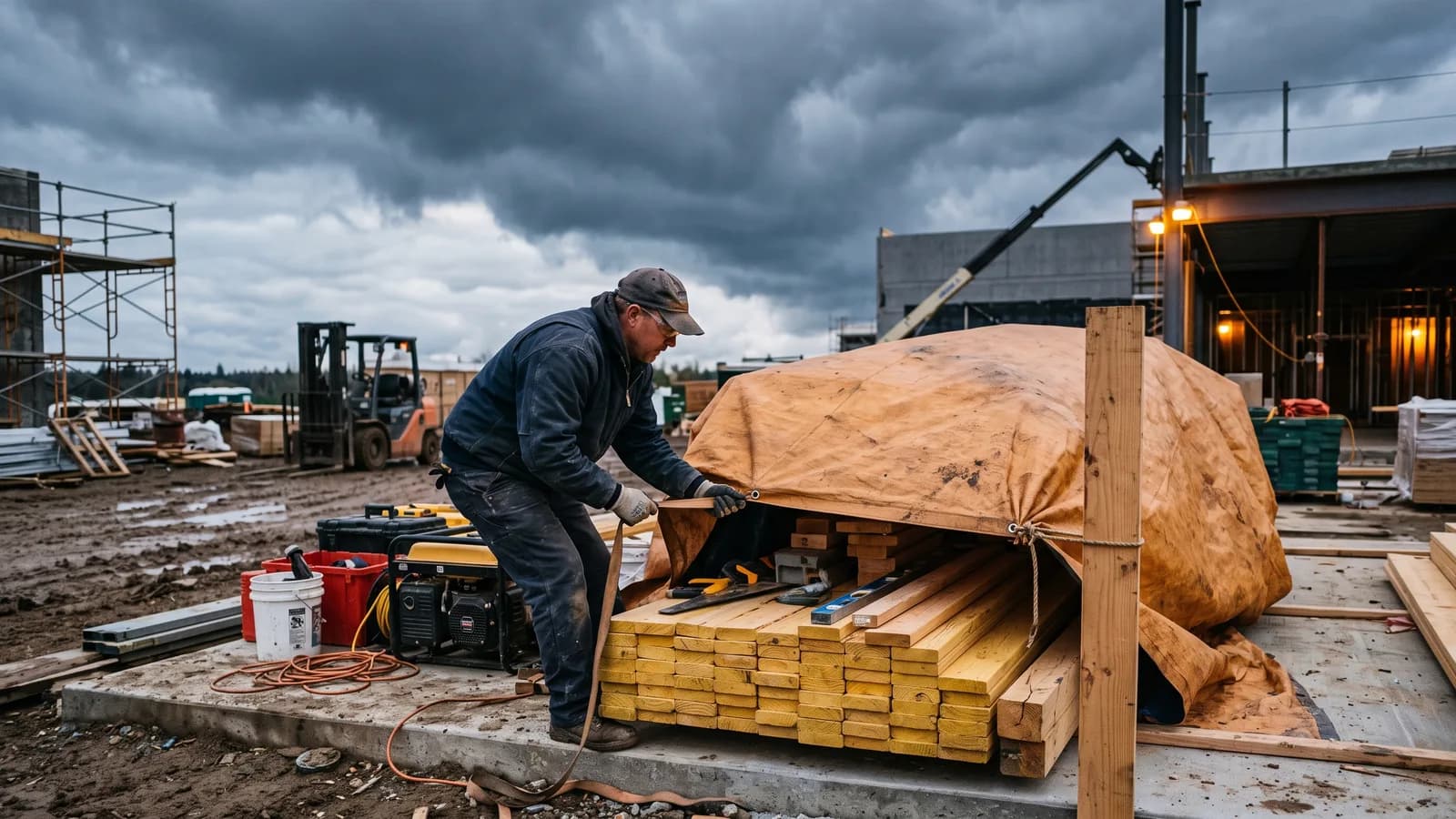
Outdoor living construction happens outside, which means rain, frost, and wind are not rare disruptions, they are a routine operating condition. A homeowner's frustration with a weather delay is usually not about the lost days themselves, it is about not being told in advance. Firms that build weather into the schedule from the start, and communicate proactively when it hits, turn an unavoidable interruption into proof of professionalism instead of a reason to distrust the timeline.
Why weather delays are structural, not exceptional, in this trade
Interior remodeling almost never stops for weather. A covered patio pour, a paver base installation, or structural framing work absolutely does. Rain saturates a base before compaction, frost halts concrete curing, and high wind makes structural work on a roof or pergola frame unsafe. None of this is a sign something went wrong on the job, it is simply what building outdoors involves, and homeowners who have not been told this up front often assume a delay means the crew fell behind rather than that the weather made the day unworkable.
The comparison homeowners make is usually unfair but understandable. Most have hired an interior contractor before, painting, flooring, a kitchen remodel, and none of those projects paused for two days of rain. Without an explanation up front, a weather delay on an outdoor project can read as a scheduling failure specific to that crew, rather than as the ordinary, universal reality of every design-build firm working outdoors in the same climate.
Building scheduling buffers into the customer-facing timeline
The fix starts before the crew ever arrives on site, in the timeline given to the homeowner during the sale. A schedule stated as a single hard date invites disappointment the first time weather pushes it. A schedule stated as a realistic range, built around historical weather patterns for the build season, sets an expectation that already accounts for the delays that are likely to happen.
- Quote a range, not a single date. “Substantial completion in five to six weeks, weather dependent” is more honest and more durable than a fixed date that has to be walked back later.
- Build in a weather contingency for outdoor-critical phases. Base excavation, concrete work, and roof framing deserve extra buffer days specifically, since these are the phases most sensitive to rain, frost, and wind.
- Say this out loud during the sale, not after the first delay.A homeowner who hears about weather buffers as a normal part of the process before signing reacts very differently to an actual delay than one hearing about it for the first time mid-project.
How the build window differs across US and Canadian markets
The size of that buffer is not the same everywhere. Much of the United States has a reliable outdoor build season that stretches eight months or longer, while many Canadian markets, particularly in the Prairie provinces and much of Ontario and Quebec, face a materially shorter window before frost makes structural and hardscape work impractical. A firm operating in both countries, or even across a wide swath of a northern state, needs different buffer assumptions for different regions rather than a single rule applied everywhere. This is also why permitting and homeowners association approval timelines matter alongside weather buffers, since a build window shortened by both a slow permit and an early frost date leaves very little margin if either runs long.
Communication scripts that keep trust intact during a delay
When a delay actually happens, the difference between a homeowner who stays calm and one who starts calling the office repeatedly usually comes down to who reached out first. A proactive message sent the moment a delay becomes likely, not after the crew fails to show up, keeps the homeowner informed rather than guessing.
Timing matters as much as content. A message sent the evening before, once a forecast is reasonably firm, gives the homeowner a chance to adjust their own day, rather than a same-morning text arriving after they have already rearranged a schedule around a crew that will not be showing up. Whoever owns scheduling should check the forecast for every active job at a consistent time each day, so this notification becomes a routine part of daily operations rather than something only remembered after a homeowner has already called in confused.
Lead with the plan, not just the apology
The same discipline applies at the business level. A firm that is actively managing several jobs through a stretch of bad weather needs the same proactive posture toward its production schedule that backlog messaging during peak season requires, since a string of weather delays across multiple active projects compounds into the same scheduling pressure a booked-out calendar creates, and it deserves the same honest communication about revised timelines.
Turning proactive weather communication into a review-worthy moment
Handled well, a weather delay can actually strengthen a homeowner's confidence in a firm rather than weaken it. A crew that covers exposed materials before a storm, sends a clear update explaining the pause, and resumes exactly when promised demonstrates the kind of professionalism many homeowners have not experienced with other contractors. That is worth asking about directly once the project wraps, since a review that specifically mentions how well a delay was handled carries real weight with future prospects browsing a firm's work during the parts of the year a seasonal marketing calendar treats as research-heavy rather than build-heavy.
Ready to talk numbers on your own pipeline?
On the strategy call, we'll lay out the plan we'd run for your business and talk through how it fits your market.
Final thought
Weather delays are not a flaw in a design-build firm's operation, they are a predictable part of building outdoors in both the United States and Canada. Firms that plan for them with honest scheduling buffers, communicate proactively the moment a delay is likely, and treat the resumption date as a promise worth keeping turn an unavoidable interruption into a demonstration of reliability. The crews that go quiet during a delay are the ones that lose trust, not the ones whose schedule shifted a few days for rain.
Tagged