
Most deck ad creative makes the same mistake, a single wide shot of a freshly finished, completely empty deck, taken straight on in flat midday light. It is technically a good photo of a deck. It is a weak piece of advertising, because it shows a structure and asks the homeowner to imagine everything that would actually make them want one.
Why an empty wide shot underperforms for deck ad creative
A homeowner does not scroll past an ad because they want a deck, they scroll past because a specific image made them picture themselves using one. An empty deck, however well built, does not do that work on its own. It reads as a product photo, accurate but static, and it leaves the emotional reasons someone actually wants a deck, entertaining friends, relaxing outdoors after work, giving kids more usable yard space, entirely to the viewer's imagination. Most viewers will not do that work in the two seconds an ad has to earn their attention. Decks are unusually well suited to visual advertising precisely because the finished result is dramatic, which makes it a real waste when the creative fails to capitalize on that with a flat, empty composition. Flat midday light compounds the problem, since it flattens the very texture and color depth that make a composite or hardwood surface look worth paying for in the first place.
Creative angles that work for this trade
A handful of creative angles consistently outperform the flat empty shot, and each one maps to a different reason a homeowner wants a deck in the first place.
Drone establishing shots for scale and design
An elevated drone shot showing the full deck against the house and yard communicates scale and layout in a way a ground-level photo cannot, and it works especially well for multi-level or larger builds where the design itself is the selling point. This angle answers a specific question a homeowner is silently asking, how much usable space would this actually add, in a single frame. It is also the angle most likely to justify a premium multi-level or rooftop build, since scale is genuinely hard to communicate from ground level once a deck wraps around a house or steps down a slope.
Close-up detail on railings, lighting, and finish
A tight shot on a cable railing, an integrated step light, or the clean line of a hidden fastener system communicates craftsmanship in a way a wide shot glosses over. These detail shots perform particularly well with homeowners who are further along in comparing contractors, since finish quality is exactly what separates a well-built deck from a mediocre one in ways a generalist viewer might not otherwise notice.
Lived-in scenes with furniture and people
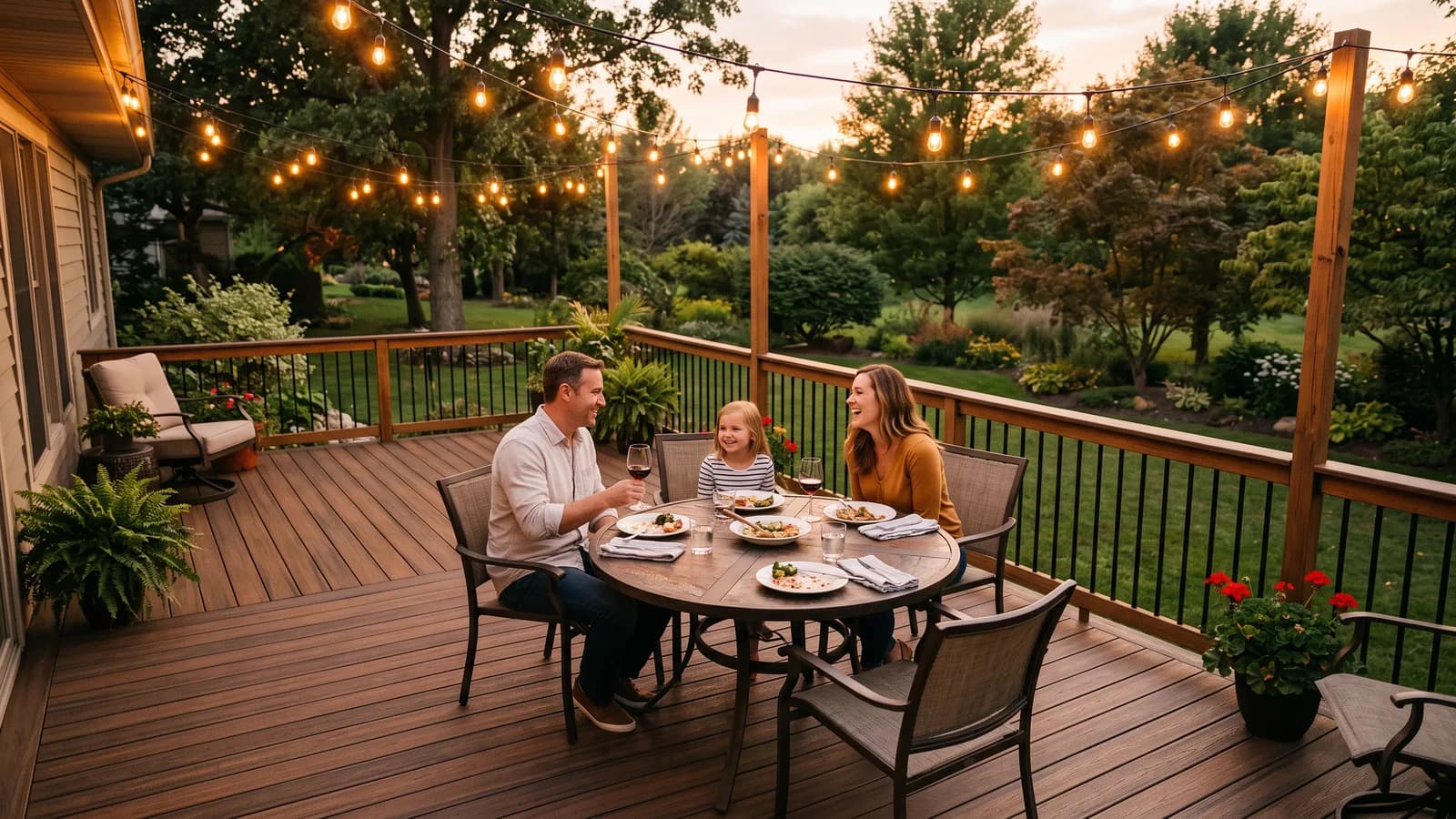
A deck with an outdoor table set for dinner, string lighting on at dusk, and people actually sitting on it converts the structure into a scene the viewer can imagine themselves in. This is usually the single strongest-performing angle for top-of-funnel creative, since it sells the outcome rather than the object, the evening on the deck, not the boards underneath it. Seasonal timing matters here too, a summer scene reads naturally through most of the warmer months, while a cooler-weather version showing a fire feature or heated seating area keeps the same emotional pitch working into the fall shoulder season.
Sell the evening, not the boards
Sourcing this creative from the project photography workflow
None of these angles require a separate production shoot if the photography workflow is already built to capture them. A crew that documents the property from the first site visit onward is already positioned to schedule a short return visit once the deck is finished and furnished, ideally with the homeowner's cooperation, to capture the lived-in shot while the light and the space still look their best. Building this handoff step into the standard project close, ask for a lived-in photo or short video session once furniture is in place, turns every finished project into a source of usable ad creative instead of relying on a handful of older photos reused across every campaign. The same photography that fuels ad creative also does real work for local search visibility, which makes the return visit worth the modest extra effort on its own.
Testing creative angles against each other
Because these three angles sell slightly different things, scale, craftsmanship, and lifestyle, the right approach is testing them against each other rather than guessing which one a given audience prefers. Running a drone establishing shot, a detail shot, and a lived-in scene as separate ad variants against the same audience segment reveals which emotional hook is actually driving clicks in a specific market, and that answer can shift by region, by season, and by the price point being advertised. Whatever wins the click should also match the page the ad sends that click to, since a lived-in lifestyle image that lands on a page built around permit paperwork and material specs will lose the momentum the ad just created. A clear description of the services on offer should back up whichever emotional angle earned the click, so the visitor can quickly confirm the contractor actually builds what the ad just showed them.
Ready to talk numbers on your own pipeline?
On the strategy call, we'll lay out the plan we'd run for your business and talk through how it fits your market.
Final thought
A finished deck is one of the more visually compelling products in home improvement advertising, which makes it a genuine waste to photograph it like a catalog listing. Drone shots for scale, detail shots for craftsmanship, and lived-in scenes for the emotional pull of the space itself each earn attention for different reasons, and testing them against each other, rather than defaulting to the flat empty wide shot, is what turns strong project photography into ad creative that actually stops a scroll.
Tagged