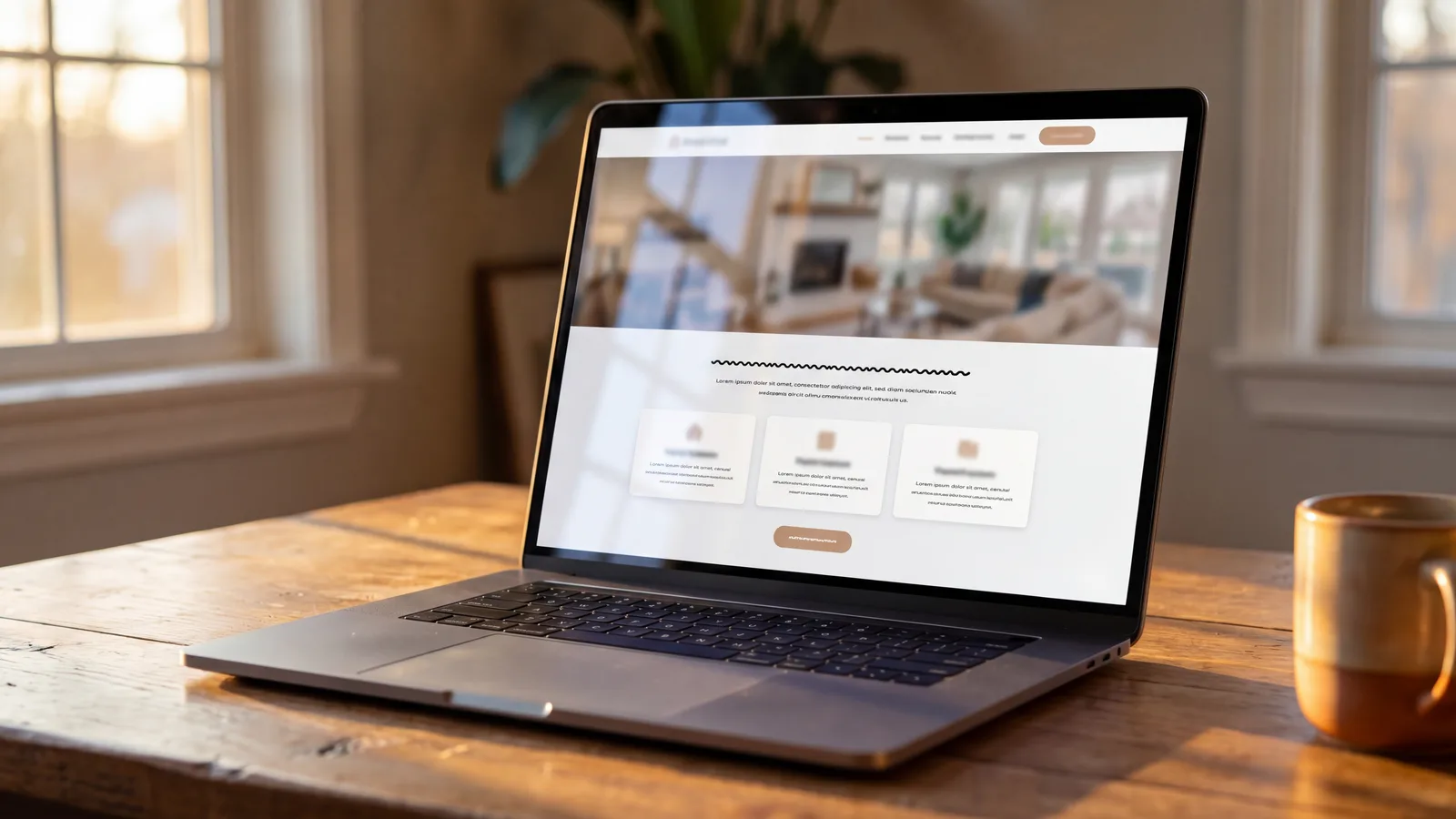
Most residential window contractor landing pages convert paid ad traffic at 3-5%, meaning 95%+ of the dollar you spent on the click leaves the page without taking action. Properly-structured landing pages convert the same traffic at 12-20%+. The difference isn't magic. It's structural, every section serving a specific conversion purpose, every trust marker placed where it does work, every CTA repeated at the moments of highest readiness. Here's the section-by-section anatomy.
The principles before the structure
Three principles shape everything below:
- Match the ad.The landing page's headline and offer must immediately confirm the buyer clicked the right thing. Mismatch produces immediate back-button presses.
- Single conversion goal.One CTA repeated, no competing destinations. “Book a consultation” OR “Get a free quote”, not both, not navigation menu options that distract.
- Trust before ask.Buyers won't form-fill until they've absorbed enough credibility signal to feel safe doing it. Trust markers come early.
The section-by-section structure
Section 1: Hero (above the fold)
Components:
- Headline:6-12 words. Specific outcome + niche specificity. “Pre-qualified appointments for residential window contractors” not “We help you grow.”
- Subheadline: 12-25 words. Concrete value statement, ideal customer profile qualifier, and a specific number where possible.
- Primary CTA button:high-contrast, action-verb language (“Get My Quote”, “Book Strategy Call”).
- Trust strip:4-6 small badges or trust markers, Google Guaranteed badge, BBB rating, “X+ installs since [year],” manufacturer partnership logos.
- Hero visual: real install photo (not stock), preferably before/after.
Section 2: Form (above or near the fold)
For paid-traffic landing pages, place the form within scroll-distance of the hero. Don't bury it three scrolls down.
- 5-7 fields max: name, email, phone, project type (radio), timeline (radio), TCPA consent checkbox. Compliance details here.
- Submit button uses outcome-language (“Get My Quote”) not generic (“Submit”).
- Brief reassurance below: “No spam. No high- pressure sales call. Just a 45-minute conversation with our team.”
The form-as-landing-page question
Section 3: Social proof (immediately after form)
For buyers who didn't convert at the form, immediate social-proof reassurance:
- Star-rating widget showing your aggregate Google rating and review count.
- 3-5 customer testimonials with names, neighborhoods, and (ideally) photos of completed installs.
Section 4: How it works (bridges the trust gap)
Most homeowners want to know what happens after they form-fill. A 3-4 step explainer:
- You submit the form.
- We call to confirm and schedule.
- We come out for a 45-minute consultation.
- You leave with a written diagnosis and quote, yes or no, no pressure.
Reduces the “what am I committing to” anxiety that produces form-abandonment.
Section 5: What makes us different
4-6 specific differentiators. Not vague claims. Concrete:
- Installer-owned crews (vs subcontracted).
- Specific manufacturer partnerships.
- Specific warranty terms.
- Specific service area precision.
- Specific install-time commitment.
Section 6: Project gallery
6-12 before/after photo pairs from real installs in the buyer's region. Visual proof of work outweighs most copy. Photography playbook here.
Section 7: FAQ (objection handling)
Address the top 6-8 objections homeowners actually have:
- How long does install take?
- Do you offer financing?
- What's the warranty?
- Do you handle disposal of old windows?
- What brands do you carry?
- Do you have insurance?
- How long is the lead time?
- Do you do the install yourselves or sub it out?
Section 8: Closing trust strip
Final reinforcement before the second form repeat: manufacturer logos, certifications, BBB / Google Guaranteed badges at full size.
Section 9: Form repeat
Repeat the form for the long-scroller who absorbed all the content and is now ready. Same fields, same CTA. Don't force the buyer to scroll back up.
Section 10: Footer (minimal)
Privacy policy link, ToS link, address (CASL/CAN-SPAM compliance), phone number. Don't add navigation, landing pages have one job.
The structural mistakes that kill conversion
1. Site navigation
Landing pages with full site navigation give the visitor ways to leave the conversion path. Strip the nav. The visitor came from an ad, they don't need to explore your site.
2. Multiple competing CTAs
“Book a call OR get a quote OR call us OR chat” produces decision paralysis. Pick one, repeat it.
3. Long pages with no early form
Some marketers preach Hormozi-style 30-section value-stack pages. For warm-traffic, complex offers, that can work. For most window-contractor paid traffic, it produces scroll-fatigue and lower conversion than a focused 8-10 section page with the form near the top.
4. Stock photography
Buyers spot stock photos in seconds and discount the contractor accordingly. Use real install photos, real crew photos, real testimonials with real photos.
5. Generic value props
“Quality work, fair prices, satisfied customers” says nothing. Specific, measurable, differentiated claims convert.
The mobile-first reality
The technical performance requirements
Page speed directly affects conversion. Targets:
- Largest Contentful Paint (LCP) under 2.5 seconds on 4G mobile.
- Cumulative Layout Shift (CLS) under 0.1.
- Interactive in under 3 seconds.
- Image weight under 1.5MB total above the fold.
Slow landing pages lose 7-10% conversion per second of delay. The fastest path to better conversion is often a page-speed audit, not a copy rewrite.
The conversion-tracking infrastructure
Every landing page must capture:
- Meta pixel + CAPI events on form submit.
- Google Ads conversion + Enhanced Conversions on form submit.
- UTM persistence across multi-page sessions.
- Server-side consent record on form submit.
- Source-attribution mapped through to signed-job revenue.
Without this, optimization is impossible because you can't connect the spend to the outcome. CAC tracking depends on this.
3-5x
Typical lift in landing-page conversion rate when generic 'send to homepage' is replaced with a properly-structured landing page matching the ad creative. Same ad spend, dramatically more signed jobs.
Ready to talk numbers on your own pipeline?
On the strategy call, we'll lay out the plan we'd run for your business and talk through how it fits your market.
Final thought
Landing-page architecture is one of the highest-leverage marketing investments a residential window contractor makes, and one of the most commonly skipped. Most contractors send paid traffic to the homepage and accept 3-5% conversion as “normal.” Building a single dedicated landing page per major ad creative, following the structural anatomy above, produces 3-5x the signed jobs from the same ad budget. That math is hard to ignore once you've seen it work.
Tagged