
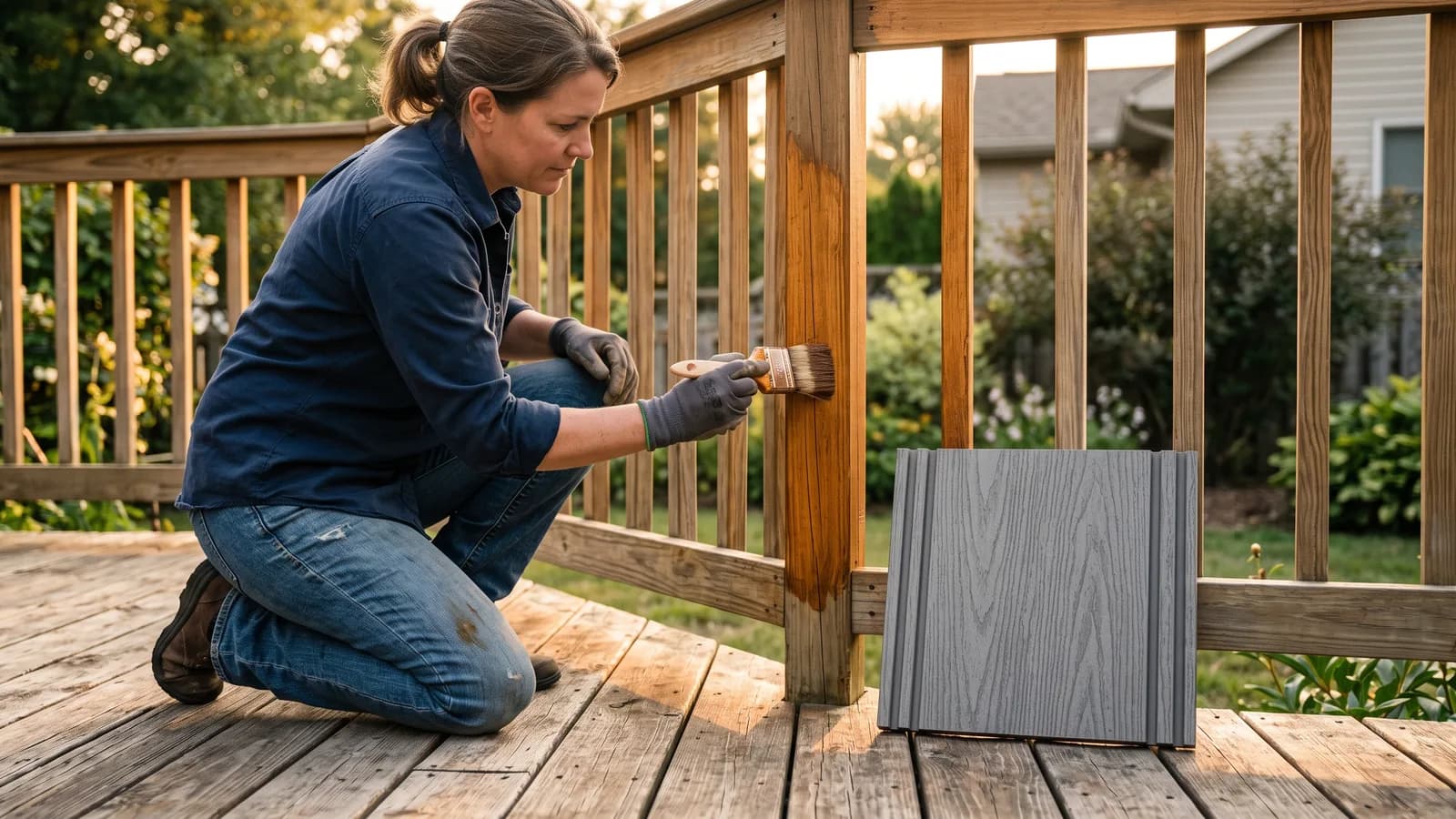
“Why would I pay more for composite when wood does the same job for less?” is close to a universal objection in deck sales, and it is usually asked in good faith by a homeowner comparing two upfront numbers without yet weighing what happens to each material over the years that follow. Answering it well means presenting a real trade-off, not a sales pitch dressed up as one.
Why the composite-versus-wood objection comes up in nearly every deck sale
Composite decking almost always carries a higher price per square foot than pressure-treated wood, and that gap is visible on the estimate before any other factor enters the conversation. A homeowner comparing two numbers side by side, with no other context, reasonably gravitates toward the lower one. The objection is not irrational, it is incomplete, because the estimate captures the purchase price but not what each material costs to own over the years the deck will actually be used. Homeowners who have owned a wood deck before, or who grew up around one, often arrive already primed to ask this question, since they have personally lived through a summer spent restaining a railing rather than using it.
What total cost of ownership actually includes for each material
Total cost of ownership means adding the recurring cost of upkeep to the upfront price, rather than comparing the two materials only on day one. For wood, that includes periodic staining or sealing and occasional board replacement as boards crack, warp, or splinter with age. For composite, the ongoing cost is far lower, generally limited to occasional cleaning, though composite is not entirely maintenance-free either and can show fading or surface wear over a long enough timeline depending on the specific product. Climate plays a role on both sides of this comparison, a deck exposed to heavy freeze-thaw cycles through a Canadian winter or intense direct sun through a southern United States summer will put more stress on either material than a milder climate would, which is worth mentioning as a factor rather than assuming every region ages a deck the same way.
Recurring maintenance wood requires that homeowners often underestimate
Wood decking generally needs restaining or resealing every couple of years to maintain its appearance and protect against moisture, and that maintenance is easy for a first-time deck owner to underestimate, both in frequency and in the physical effort of actually doing it. A homeowner budgeting only the purchase price of a wood deck is implicitly budgeting zero dollars for years of recurring maintenance that will, in practice, show up as either their own weekend labor or a paid service call. That recurring maintenance work is also a legitimate ongoing revenue relationship for the contractor, worth mentioning as a service the business offers rather than leaving the homeowner to figure out on their own.
Where composite's higher upfront cost gets recovered over time
Say a homeowner is comparing a wood deck against a composite one at a meaningfully higher upfront price. Over a decade or more of ownership, the wood deck's accumulated staining costs, board replacements, and the value of the homeowner's own time spent maintaining it start closing that gap, sometimes substantially. The exact numbers vary by region, product, and how diligently a homeowner actually keeps up with wood maintenance, but the direction of the trend, composite recovering some of its premium over time through lower upkeep, holds broadly true.
2 to 3x
Illustrative rule of thumb for how much more frequently a wood deck typically needs staining or sealing compared to how often a composite deck needs its equivalent surface maintenance, useful for framing the upkeep conversation rather than as a precise figure for any specific product.
When wood is genuinely the right answer despite the upkeep
Total cost of ownership is not the only factor that matters, and presenting it honestly means acknowledging when wood is still the right choice. Some homeowners genuinely prefer the look and feel of natural wood and are willing to maintain it. Others plan to sell the home within a few years and are less concerned with long-term upkeep than with upfront cost. A homeowner with a smaller budget who wants to build now rather than wait or reduce scope may also be better served by wood, especially when paired with financing options that address the cash-flow side of the decision directly instead of steering the material choice around it. A homeowner planning to sell within a few years is worth a separate note too, since a freshly stained wood deck can photograph and show just as well as composite for that short a window, which narrows the practical difference for someone who will not personally live through a decade of upkeep.
The comparison should include the whole family
Presenting the comparison without steering the homeowner
The goal of this conversation is an informed homeowner, not one steered toward whichever material carries a better margin. Presenting real, honest ranges for maintenance frequency and cost for each material, then letting the homeowner weigh that against their own budget, timeline, and preference for natural wood, respects the decision as theirs to make. A clear side-by-side of composite, wood, and hardwood options during the estimate itself gives the homeowner the full picture up front, rather than requiring this conversation to happen later as damage control after an objection has already formed.
Ready to talk numbers on your own pipeline?
On the strategy call, we'll lay out the plan we'd run for your business and talk through how it fits your market.
Final thought
The composite-versus-wood objection is really a request for more complete information, not a rejection of the higher-priced option. Presenting total cost of ownership honestly, including the cases where wood is genuinely the better fit, builds more trust than either dismissing the objection or oversimplifying composite as maintenance-free. Homeowners can tell the difference between a real trade-off and a sales script, and the honest version wins more often.
Tagged